

B2B marketers have spent the last two years congratulating themselves for solving connected TV. The targeting got precise, the DSPs got clever, and identity graphs started matching households to job titles, so everyone assumed that was the hard part done and dusted. It wasn’t. Precision without respect for the viewer’s frame of mind doesn’t fix the CTV problem for B2B. It just moves the damage from “we wasted the budget” to “we actively annoyed the account we were trying to win.”
New here? If the account graph concept below is new to you, or you’d rather see it proven out elsewhere before trusting it with a CTV budget, two pieces from the archive go deeper: The Account Graph Is Not an Identity Graph on what actually separates the two, and Native Advertising Didn’t Die. Now It’s Signal-Aware And Back On Plan on the same infrastructure applied to a different channel.
Subscribe free and the next issue lands in your inbox, not your feed.
What you’ll learn in this issue:
Why TV and B2B never got on, and why precision alone doesn’t fix that
What I’m calling the living room tax, and why it costs more than a wasted impression
Where CTV context genuinely lines up with a B2B buying journey, and where it doesn’t
How sponsorship adjacency lets you borrow credibility without the live-event price tag
Why layering the account graph onto CTV, not just onto display, is the actual unlock
When it’s worth breaking your own rules for the accounts closest to signing
The one CTV window that’s more forgiving than any other, and it’s not prime time
Why TV and B2B never really got on
Go back a decade and the mismatch was obvious.
TV is a mass-reach medium built for demographics and dayparts, its adverts invented to fund soap operas in the daytime, which is as far removed from B2B as you’ll get. B2B is a narrow-audience discipline built for named accounts and buying committees.
Unless you were Dell, HP, or one of the handful of B2B brands with genuine consumer crossover, you weren’t on the soap opera ad break, and there wasn’t much reason to be.
Connected TV changed the instrument, not the mismatch.
Streaming penetration is now near universal across households, and identity graph matching means a DSP can, in principle, map a named contact to a device rather than guess at an age bracket.
The tool went from a sledgehammer to something closer to a scalpel. That’s why B2B has piled in over the past eighteen months, and it’s also why the industry is about to repeat the mistake it made with programmatic display a decade ago: assume the targeting precision does the whole job and the creative can stay generic.
The living room tax
Here’s the part most of the CTV sales decks skip. TV is a lean-back medium. People watch it to switch off, not to stay switched on. That matters more for B2B than for almost any other category, because the thing you’re selling into is the exact mental state the viewer is trying to escape.
Advertising has always been about the right person, right time and the wright place, and CTV challenges a marketer to be able to tick all 3.
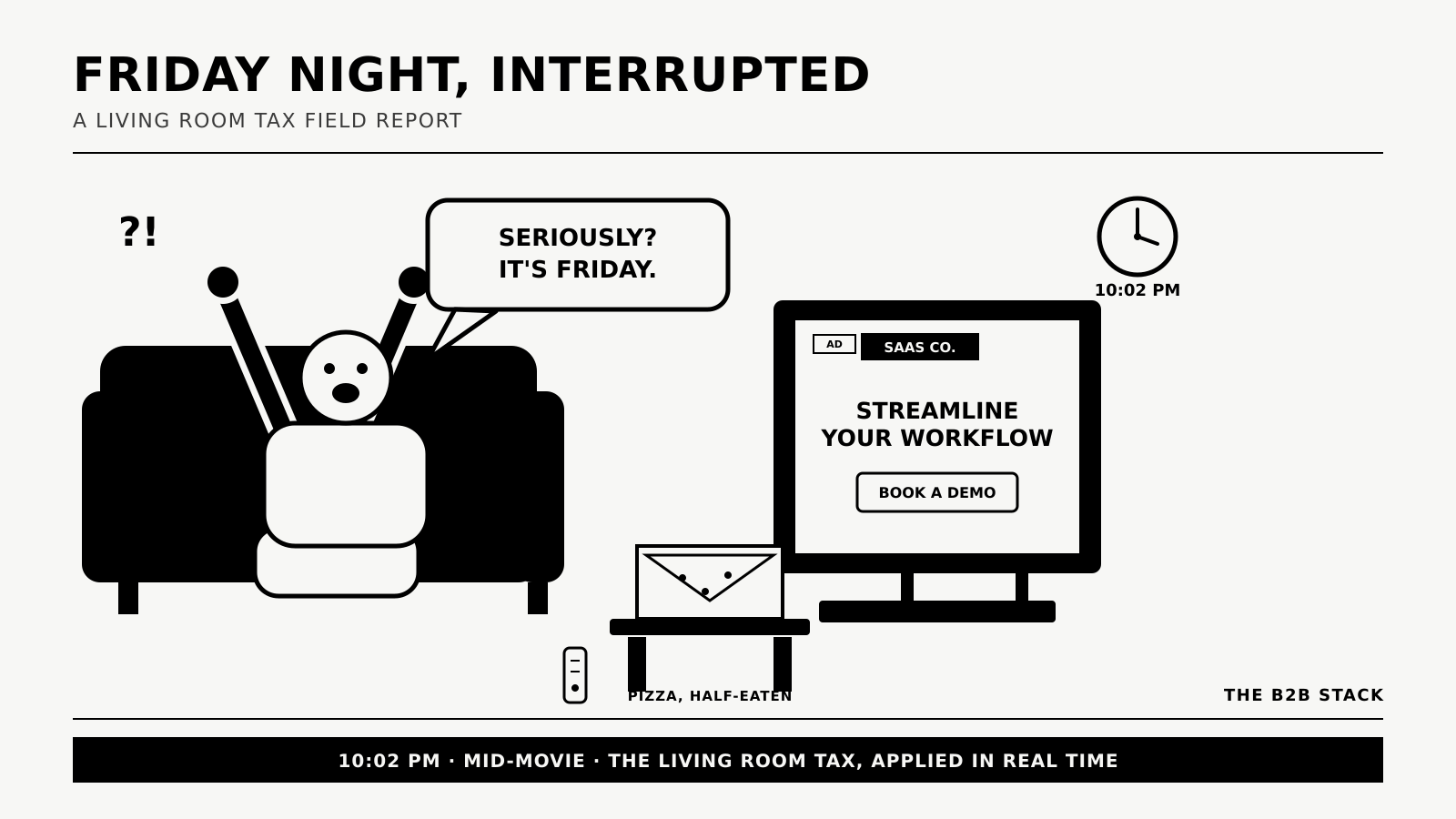
I’ve watched this play out at home. Rebecca and I will sit down on a Friday evening with Netflix or Prime, and if a HubSpot or QuickBooks ad drops in at ten o’clock, the reaction isn’t neutral. It’s actively negative. Work found her on the one evening she’d set aside not to think about it, and the resentment doesn’t land on the platform, it lands on the brand.
I’ve heard the same reaction from colleagues often enough that I don’t think it’s a household quirk. It’s a structural cost, and most media plans don’t price it in.
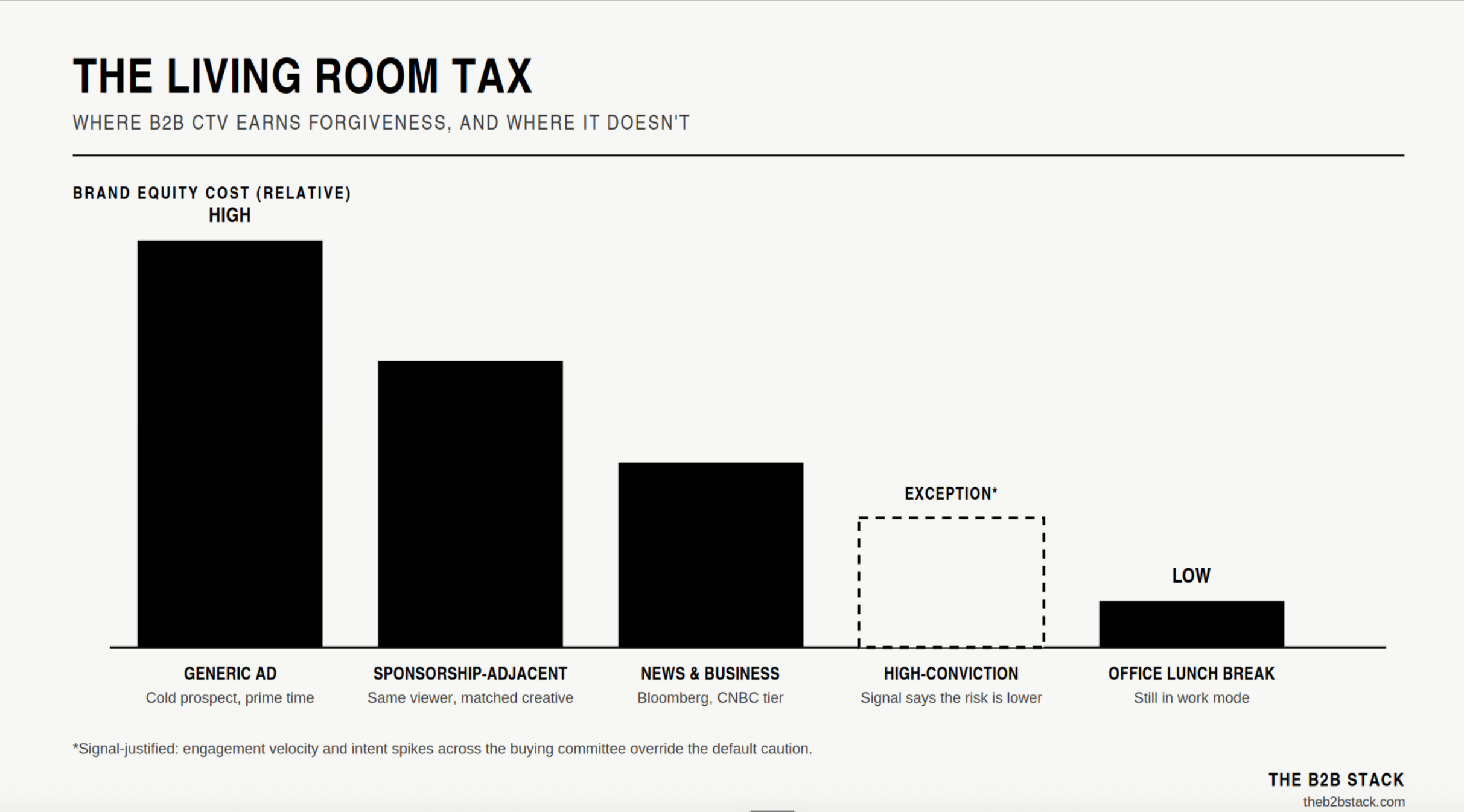
Call it the living room tax: the negative brand equity you incur when a B2B ad interrupts a moment the viewer has deliberately carved out to stop thinking about work.
It’s the inverse of everything CTV is supposed to buy you. Used well, this channel builds brand memory, reinforces positioning, and keeps you present when a procurement process eventually kicks off. Used carelessly, in the wrong context at the wrong hour, it does the opposite of all three, and it does it in the one channel most B2B buyers have the least experience reading.
Where CTV context actually works for B2B, and where it doesn’t
Audio has a context advantage TV doesn’t. A commuter can be listening to a B2B-specific podcast on the drive in, learning as part of the working day. Television doesn’t offer the equivalent. Nobody’s settling in on a Tuesday night to watch a show about programmatic advertising, and pretending otherwise is how you end up serving the wrong ad into the wrong headspace!
There are exceptions, and they matter. Bloomberg, CNBC and the business news tier give you real contextual alignment, because the viewer’s mindset in that environment is already adjacent to work - but lets not kid ourselves about the scale - especially if we’re applying TAL and persona targeting on top. Its diddly squat or close to none existent, a tiny play which will struggle to spend a handful of bucks.
If you want the learning-and-context fit that podcasts offer for B2B in something close to TV format, YouTube does it better than pure-play CTV, because the buying journey and the platform’s content overlap there in a way broadcast-style streaming rarely manages.
Outside that narrow band, the fix isn’t to avoid CTV. It’s to stop treating every slot the same way.
Borrowing credibility through sponsorship adjacency
Most major B2B vendors already sponsor something: Formula 1, golf, occasionally live cycling. The obvious move is to run the same creative you built for the live event and stop there. The better move is to look at what sits adjacent to it. If you’ve built a sport-specific ad for your F1 sponsorship rather than a generic B2B spot with a chequered flag bolted on, that asset has value well beyond the live broadcast. Streaming shows and documentaries in the same orbit, motorsport documentaries, adjacent sports coverage, give you a much larger canvas to run it against, at a fraction of the live-rights cost. This is smart contextual diversification and is all very doable.
It’s also worth building a wish list of sponsorship-adjacent territory you haven’t committed real budget to. Maybe you like the idea of aligning with the Tour de France or the Giro d’Italia but it’s never made the media plan. CTV is where you test that cheaply, with data-driven buying rather than a full sponsorship commitment, before deciding whether it earns a bigger slice next year.
The principle underneath all of this: creative built for the specific moment the viewer is in earns forgiveness that generic creative never will. That’s true of the best golf and motorsport ads in any category, B2B included.
Where the account graph actually earns its keep
This is the part that turns sponsorship adjacency from a nice idea into something systematic. Most people treat the account graph as a display and email targeting tool. It’s better used as an interest map for the exact accounts you’re trying to move.
If you know which named individuals sit inside your priority buying groups, you’re not limited to serving them the same B2B creative regardless of context. You can look at the wider interest segments those groups actually hold, the sports they follow, the adjacent content they watch, and align your CTV buy against that instead of against a demographic proxy. Done properly, that’s the difference between a blunt, cheap-feeling made-for-streaming ad and one that reads as built for the moment. It’s also the one piece of this a generic media agency running CTV as a line item won’t be set up to do, because it needs the account graph and the media buy sitting on the same side of the table.
When it’s worth breaking your own rules
Everything above is a case for restraint: read the room, match the context, don’t ambush the viewer. There’s one situation where the calculation flips, and it’s worth naming rather than leaving as an unstated exception.
If an account is showing the signals that actually matter, engagement velocity climbing across several members of the buying committee, an intent spike on your priority topics, direct site visits from multiple named contacts in the same fortnight, the living room tax stops being the deciding factor. You’re not interrupting a cold prospect’s evening for a brand impression they’ll resent. You’re staying present for someone already deep in an active evaluation, where a vendor showing up looks less like an ambush and more like confirmation you’re taken seriously. It is not without its risks and we do not want that negative association, but this could be the time to roll the dice and use a pure signals play to run a more generic TV commercial
This only works as a short, dynamically updated list, built from the account graph’s live signal, not the broader ABM tier. Keep it tight. Cap frequency very hard even here, because proximity to a decision doesn’t buy you the right to be repetitive, and let the creative do something a cold-prospect ad can’t: reference the stage they’re actually at, a case study in their vertical, a direct answer to the question their evaluation is likely stuck on, rather than top-funnel brand awareness they’ve already moved past.
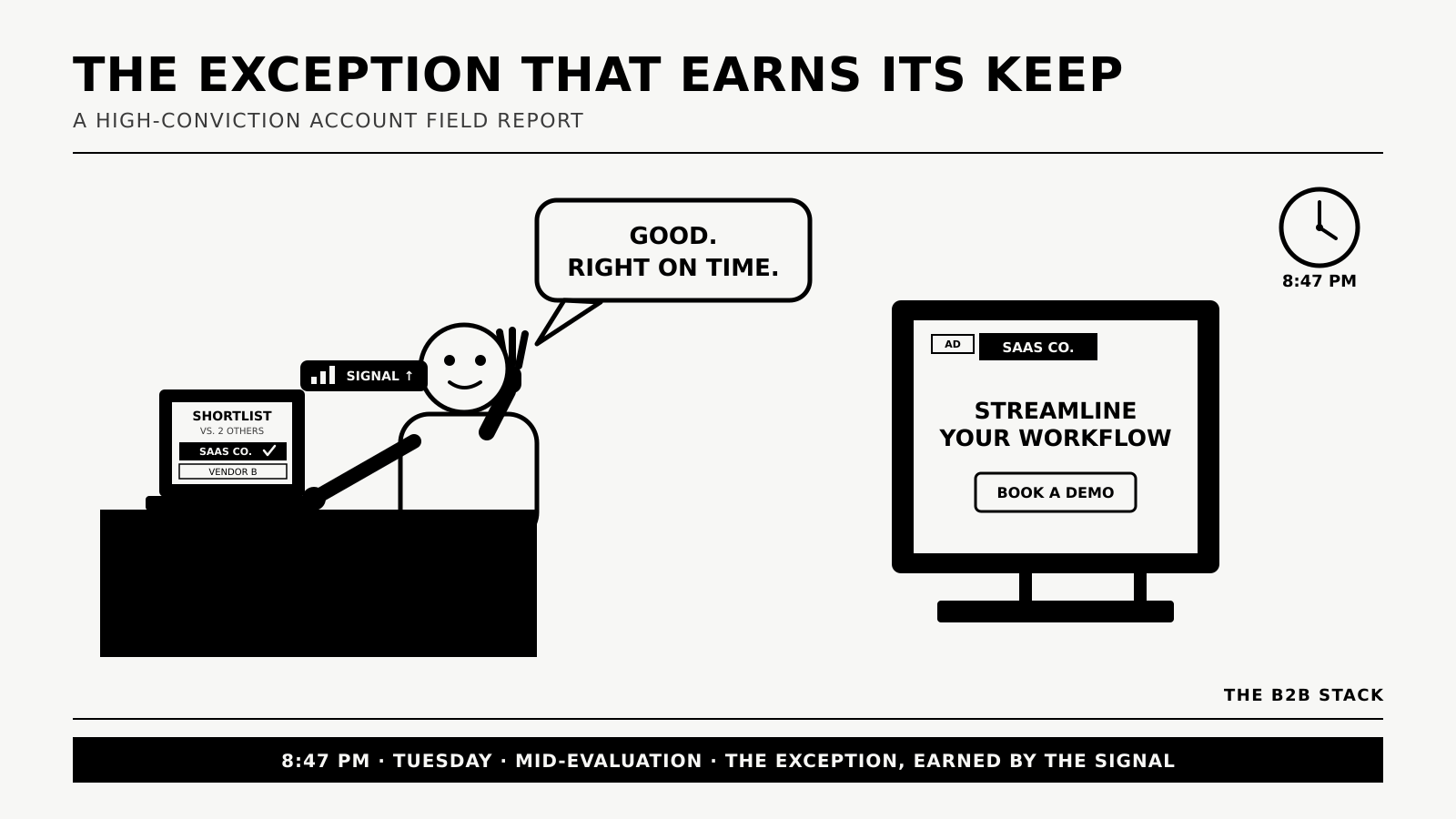
Its worth flagging that there’s probably a psychological gap between later on a weekend (including Friday) versus earlier evening weekday spots, and the likelihood of people being fully switched off, or potentially answering some emails and dual screening on a midweek Wednesday. In the above scene, the user is working on the sofa, and the live signal of them being on the vendors website has been picked up and rapidly pipelined to enable TV retargeting. The proximity of signal to advert makes it excusable and more likely to be valuable
The accounts on this list have earned a slightly higher-risk ad because the signal says the timing risk is lower than it looks.
The window nobody’s using: office lunch breaks
There’s one CTV moment that avoids the living room tax almost entirely: the forty-five minutes someone takes over lunch, at their desk or in a break room, watching something on a laptop or a tablet they brought in to the office or whilst working from home. I see it in my own office constantly. That viewer hasn’t left work mode behind the way the Friday-night Netflix viewer has. A B2B ad landing there is a much smaller ask, and it’s a more precise buy too, because you’re not extending to the whole household the way a living-room CTV impression often does.
It won’t carry the emotional weight of the sponsorship-adjacent inventory above. It doesn’t need to. It’s a low-friction, low-cost slot most B2B media plans haven’t even considered, largely because CTV planning still defaults to evening viewing by habit rather than by evidence.
The manifesto, shortened
CTV gives B2B a real shot at brand memory, at getting past the dark funnel, and at being in the room before procurement starts.
It also punishes carelessness harder than almost any other channel, because the viewer’s guard is down for reasons that have nothing to do with you. Respect the moment: contextual environments where they exist, sponsorship-adjacent inventory built on creative that actually fits, an account graph doing the targeting rather than a demographic guess, a short exception list for the accounts already deep in evaluation, and the office lunch window nobody else is bidding on.
Get that right and CTV does what no other B2B channel can. Get it wrong and you’ve bought negative brand equity at a premium CPM.
If you’re weighing whether now’s the moment to add CTV against an account you’re already close on, or you want the exception list built properly rather than guessed at, reply to this email and tell me where the account sits. I read every reply myself.
And if you’re trying to stand this up across multiple regions rather than one market, that’s its own problem, worth reading alongside this piece: Running Account-Based Advertising Globally: The Regional Fault Lines Nobody’s Mapped Yet.
Running B2B CTV at scale, globally, is exactly what we do at FunnelFuel. Account graph, sponsorship adjacency, exception lists, regional identity coverage, the lot. If you want someone who has actually built this rather than sold it, get in touch or see how we run it at funnelfuel.io.
Where do you draw the line between a CTV moment worth interrupting and one that’s going to cost you more brand equity than it buys, and does a hot enough signal move that line for you the way it moves it for me? Drop your answer in the comments.
Subscribe free to The B2B Stack for the next issue straight to your inbox.