

Most explanations of containerisation in adtech start with speed.
Latency.
Milliseconds.
Infrastructure efficiency.
That’s technically correct but really, it is strategically irrelevant. We’re not trading the worlds leading financial instruments, we’re trading ad space for B2B influence and with the aim of progressing accounts towards pipeline - this is not about milliseconds, it is about finding the right ad opportunities when they arise, and fishing in the largest oceans of inventory to improve our odds of winning.
Therefore, what’s happening is not an optimisation of the existing model. It’s a relocation of where power sits in the value chain.
And that’s what makes it dangerous and transformative.
From Airports to Private Runways
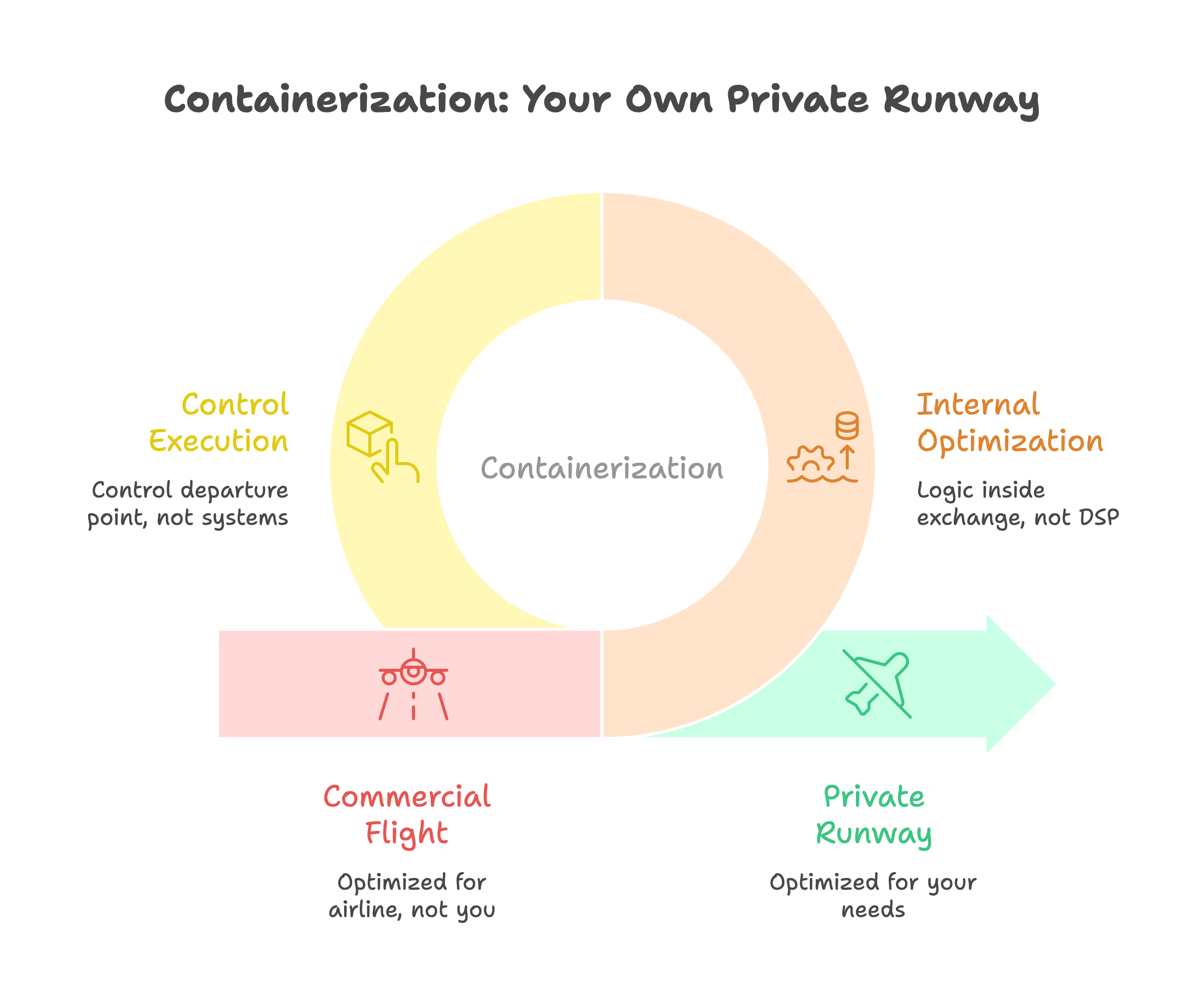
Lets try and bring this to life with an analogy. Imagine flying commercial.
You book through an airline.
You pass through their systems.
Their security.
Their boarding process.
Their routing logic.
Their timing.
Everything about the journey is optimised for their operating model, not yours.
Now imagine you own a private runway.
You decide:
when you take off
who flies
what cargo moves
how routing works
which aircraft you use
how security operates
The infrastructure still exists. Airspace still exists. But you control execution at the point of departure. That’s containerisation.
Instead of sending your decisioning through a DSP’s operating system, your optimisation logic sits inside the exchange itself, where the trade actually happens.
You’re no longer “booking flights.”
You’re running your own runway.
And that changes everything when you work in B2B, where the audiences are small and hard to locate
The Real Shift: Decisioning Moves to the Point of Trade
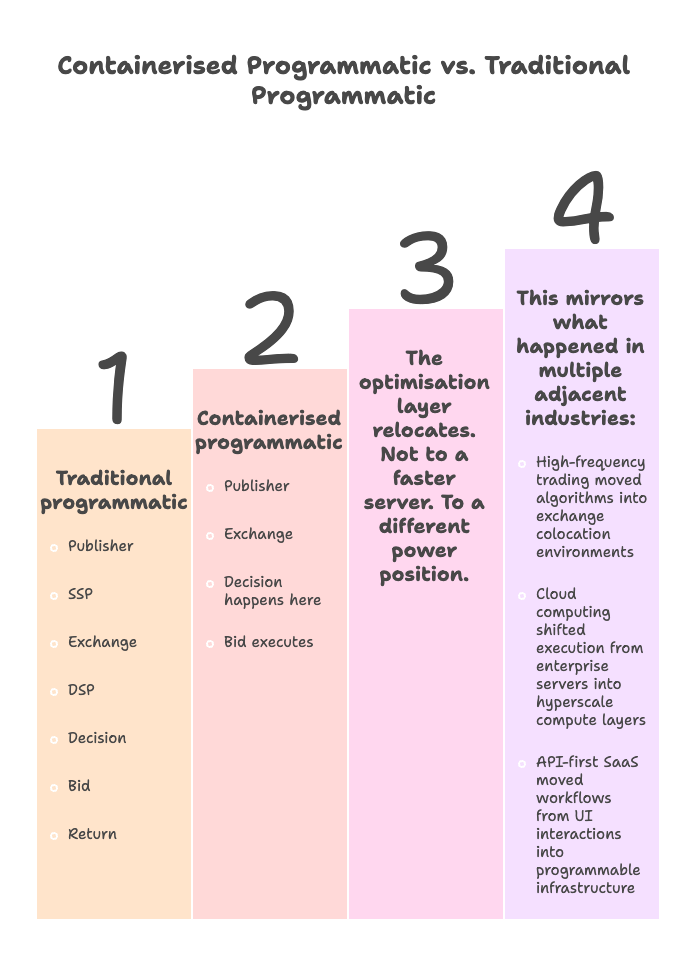
Traditional programmatic:
Publisher → SSP → Exchange → DSP → Decision → Bid → Return
Containerised programmatic:
Publisher → Exchange → Decision happens here → Bid executes
The optimisation layer relocates. Not to a faster server. To a different power position.
This mirrors what happened in multiple adjacent industries:
High-frequency trading moved algorithms into exchange colocation environments
Cloud computing shifted execution from enterprise servers into hyperscale compute layers
API-first SaaS moved workflows from UI interactions into programmable infrastructure
Each time, value moved toward whoever controlled execution closest to the transaction layer.
Adtech is now repeating the same pattern.
Why B2B Feels This First And Hardest
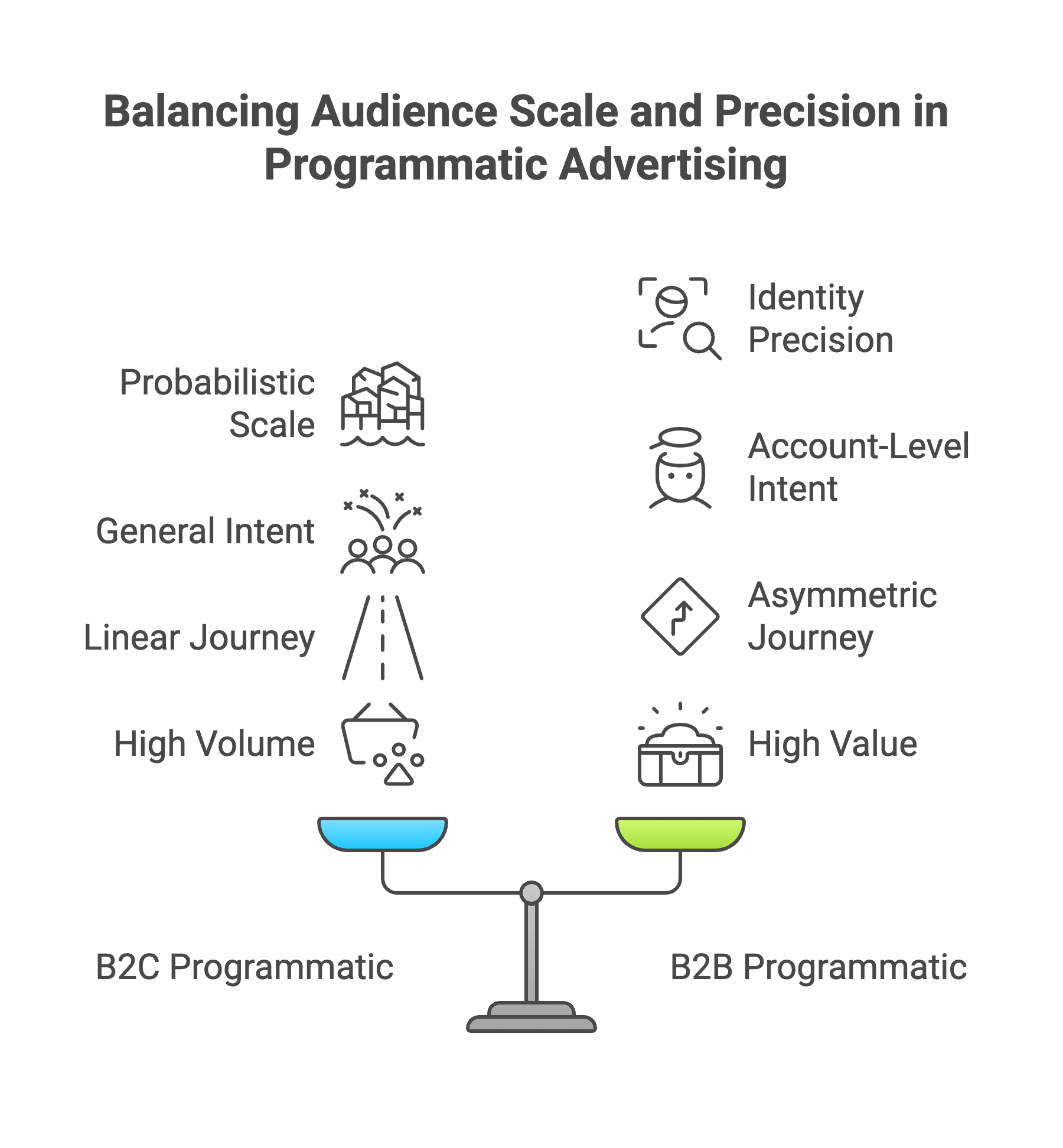
B2C programmatic thrives on probabilistic scale.
B2B thrives on:
identity precision
account-level intent
asymmetric buying journeys
small, high-value audiences
Which means the current stack introduces structural inefficiencies that are invisible in B2C but devastating in B2B:
signal degradation across platform hops, especially with signals like corporate IPs
identity translation losses between vendors
latency missing narrow intent windows
DSP optimisation built for FMCG, not enterprise buying cycles
reliance on proxies like CTR and reach
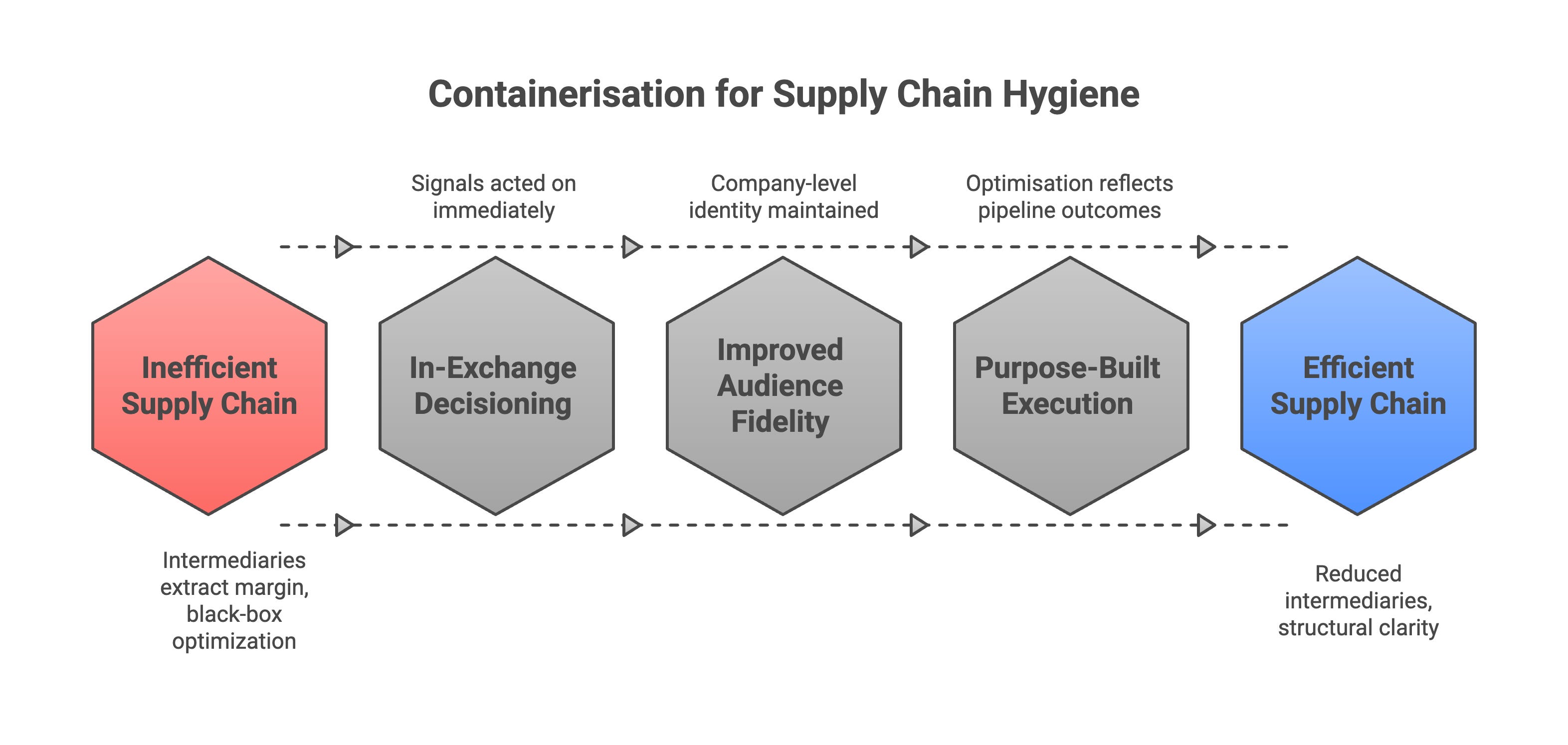
Containerisation attacks these at the root. When decisioning happens inside the exchange:
Accuracy increases
Signals are acted on the moment they surface, not after being handed across platforms.
Audience fidelity improves
Company-level identity isn’t repeatedly re-modelled and diluted.
Execution becomes purpose-built
Optimisation logic reflects pipeline outcomes, not generic DSP objectives, most of which are chalk and cheese to B2B needs
Cost compresses and the supply chain of the future emerges
Fewer intermediaries extract margin. Less black-box optimisation tax.
This isn’t incremental performance uplift.
It’s structural clarity and supply chain hygiene at mega scale
The Shipping Container Moment for Adtech
Before global shipping containers, every port repacked goods manually.
Every transfer introduced:
delay
damage
cost
inefficiency
Containers standardised movement. But the biggest winners weren’t shipping companies. They were the operators who controlled supply chains:
Walmart
IKEA
Target
They moved faster, cheaper, and with more control than competitors.
Containerisation in adtech mirrors this.
The biggest winners won’t be SSPs or exchanges, but make no mistake, these players ARE winning with a structural shift that brings pendulum of power firmly back in their direction.
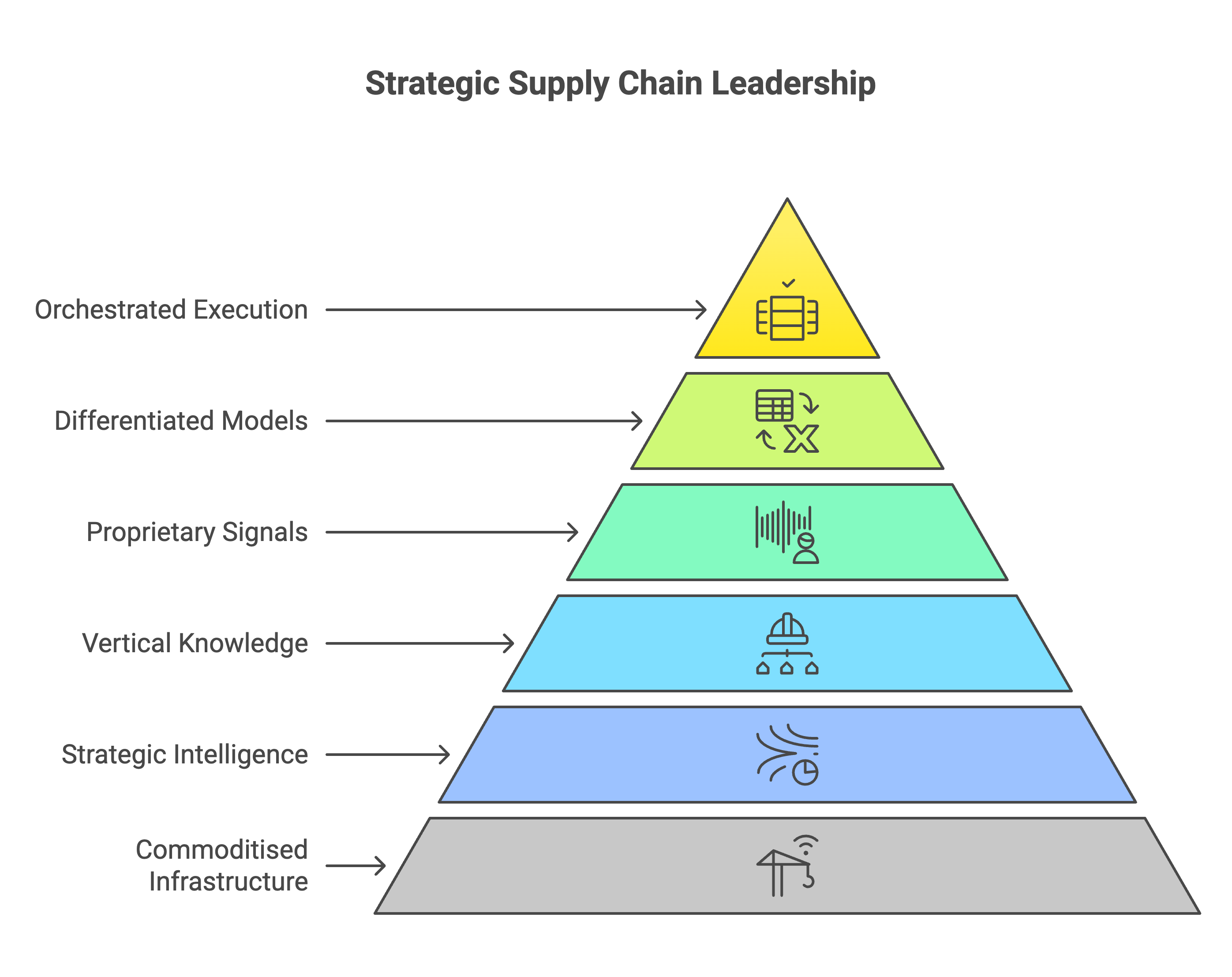
That said, the real winners will be the organisations that:
control decision logic with highly specific vertical knowledge, like FunnelFuel brings for B2B
bring proprietary signals which otherwise have never lived in the supply chain
deploy differentiated models, such as optimising for B2B outcomes
orchestrate execution across vendors
The infrastructure layer becomes commoditised. The intelligence layer becomes strategic.
The Industry Is Already Quietly Moving Here
This isn’t theoretical. Signals are emerging across the ecosystem:
Exchange-side compute initiatives, and early movement from AI optimisation orgs like Chalice
Prebid and server-side header bidding evolution
Supply-path optimisation pushing logic upstream
Retail media networks embedding decisioning closer to supply
Identity frameworks moving from DSP-managed to publisher/exchange-controlled
Each of these reduces the distance between signal, decision, and trade.
Containerisation is simply the next logical step.
Once we start layering in Agentic AI, we start to see a vision of a post programmatic world.
What We Cover Next (And Why It Matters)
Everything above explains why containerisation is happening.
What follows explains how it actually reshapes B2B execution and how operators start preparing now.
Inside the paid section, we go deeper into:
how agentic AI actually plugs into exchange-side environments, unlocking a post programmatic, or at least post DSP, vision
what a sovereign B2B stack looks like in real terms (identity, signals, trading logic)
how decisioning shifts from DSP workflows into programmable execution layers
what changes in org structure, tooling, and measurement
where early adopters gain structural advantage and where laggards get trapped
practical mental models for implementing this thinking inside existing stacks
This is not theory.
It’s where infrastructure, identity, AI, and revenue optimisation collide.
If you work in B2B media, product, growth, or RevOps — this is the layer that determines who builds durable advantage over the next 3–5 years.
Read The Full Piece Free (7-Day Trial)
The rest of this article is part of the paid research stream, where we go beyond trend commentary and into execution, implementation, and operator playbooks.
You can:
start a 7-day free trial
unlock the full article immediately
access the rest of the deep-dive archive
If you’re serious about how B2B programmatic, identity, and agentic execution evolve from here… Read the rest today.
