

Most B2B marketers think native advertising is a 2016 relic: sponsored listicles, “you won’t believe” thumbnails, the stuff that gave content marketing a bad name. That’s the wrong belief to carry through H2 2026. Native never went away. It went quiet, there was a major shakeout of adtech vendors, it matured to live alongside display rather than being pre-occupied with killing it, and it’s now resurfacing in B2B media plans with a signal layer underneath it that didn’t exist the first time around.
I’ve got a personal stake in saying this. I built PowerLinks around native, B2B and contextual adtech, back when the whole industry was trying to solve banner fatigue.
The OG premise was strong. The internet has morphed fast from desktop devices to mobiles, and banner ads didn’t really fit on mobile sized screens. Web pages, across both desktop and mobile were increasingly getting splashed in prodigious volumes all over the pages, causing breaking, ads covering content and the proliferation of video formats, many of which interrupted the content - was all driving users away. Pages were loading slow, and the web was starting to look like a dumpster truck of competing ‘impact formats’.
Native promised something different. Where display ads won attention by standing out, native ads won attention by blending in. Where display ads were typically only aligned to users by audience signals (think retargeting), native had a greater requirement to align more contextually to the topic of the page because the ad looked like any other story in the publishers news feed. Native also stood to align the approach taken on social platforms like Facebook and Linkedin - ads that looked like any other posts, using titles, images or videos and other assets that populated to look like they belonged. They were, and are, hard to visually skip.
A lot of these points remain as true today as they were around 2015. V1 didn’t scale but V2 just might.
I personally stepped out of native specifically around 2020, when I went all in on B2B and broader programmatic through FunnelFuel. Watching it come back, this time with account-level signal underneath it, is the closest thing adtech gets to a sequel that’s actually better than the original. This is personally interesting, and maybe this format can be weaponised properly this time around with some next gen thinking - which I will dive into below
What you’ll learn in this piece:
What native advertising actually is, and the real difference between advertorial-style native and programmatic in-feed native
Why native faded from view after its first wave, and what’s changed structurally since
Why B2B specifically is the environment where signal-aware native has the best shot at working
How an account graph turns a generic native placement into an account-targeted one, and what that requires technically
How to measure it properly, and where it fits alongside rich media display rather than instead of it
WTF is “native advertising”?
Native advertising is any ad format built to match the look, feel, and function of the environment it sits in, rather than interrupting it. That’s the whole definition. Everything else is a variation on how far that blending goes and believe me, people in native will spend plenty of time arguing over that.
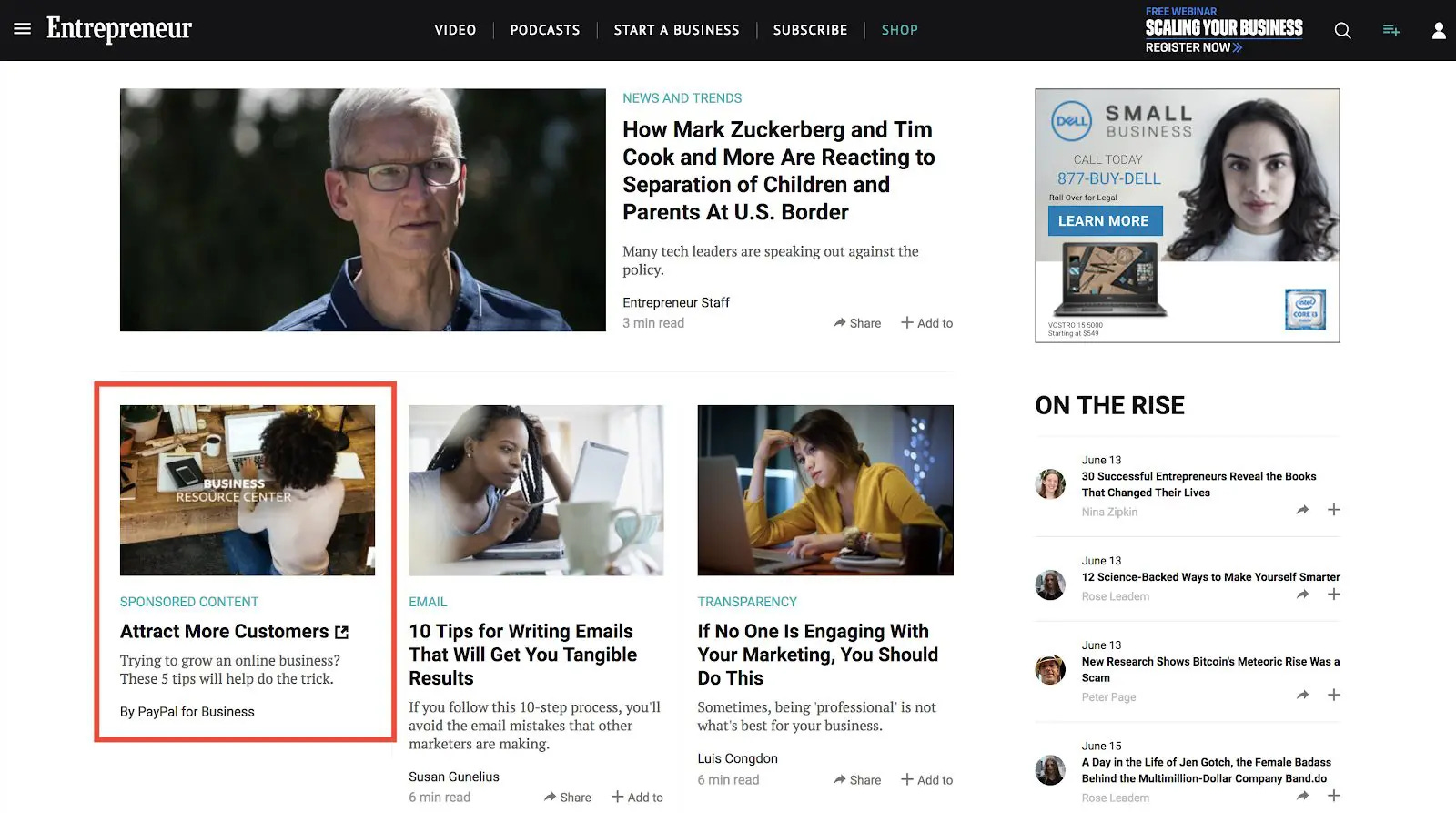
below is an example of a native in-feed format, ringed in red. Notice how the shape and size of the image, the colours and fonts, and general website styling is broadly adhered to. In order to really highlight the value, did you even notice the 300x250 MPU in the top right hand corner and call out it is a Dell ad? if not, that is kinda the point here.
There are two broad versions worth separating, because B2B marketers tend to conflate them.
Advertorial-style native is editorial-shaped sponsored content: a branded article, a “presented by” feature, something written to read like the publication’s own journalism. It’s bought directly with a publisher, it’s slow to produce, and it doesn’t scale past a handful of placements at a time. It has genuine value for brand storytelling with a specific title or publication, but it’s not a media buying strategy. IMO, it is best used to seed premium memory building content and to ensure you have amplification rights - because this stuff gets really powerful when you can promote the story. Think about that above example on Entrepreneur. The advertiser is PayPal for business. PayPal could promote that story around how to attract more customers using Entrepreneur magazine as the advertiser, driving reads within their premium website. The win is hijacking trust in a way that a banner click to a vendor site can’t replicate
Programmatic in-feed native is the format I care about, because it’s the one with scale and signal. These are ad units auctioned through exchanges like TripleLift and StackAdapt, served through a DSP, and designed to sit inside a content feed, a recommendation widget, or an article layout as a component: image, headline, short description, and a call to action, styled to match the host page rather than sitting on top of it as a foreign object.
The distinction matters because only the second version can be targeted, measured, and scaled the way a B2B media plan needs it to be.
Why native faded, and why that’s the wrong lesson to take from it
Native’s first wave was a response to banner blindness. Standard display had raced CPMs toward the bottom, and readers had learned to stop seeing bright, boxed-in ad units entirely. Native’s pitch was the opposite of standard display’s logic: instead of standing out through size and motion, stand out by blending in. A well-built native unit, with the right image and title working together, earns a moment of attention that a banner in the sidebar never gets a chance at. Good creative can then rapidly anchor brand memory to context - which is psychologically compelling.
Native didn’t replace display, and it was never going to. What actually happened is more interesting: display was built around audience targeting, following a person across sites based on who they were assumed to be, while native’s contextual roots meant it was better suited to matching content, not chasing identity. When the entire industry’s targeting foundation started shifting away from identity (think the death of the cookie and the growing net being cast by privacy regs globally), native’s original strength turned out to be the one built for what came next.
That shift is not theoretical anymore. More than three-quarters of global internet traffic now runs through environments where third-party cookies are limited or unavailable, and behavioural targeting depends on signals that are disappearing faster than most budgets have adjusted to. Google’s own reversal on Chrome cookie deprecation hasn’t changed the practical picture much: Safari and Firefox already block third-party cookies by default, and Apple’s App Tracking Transparency framework has already collapsed most mobile-side signal availability. Contextual targeting isn’t the fallback option anymore. For a growing share of the open web, it’s the only option that still works cleanly.
Why B2B is the environment where this actually lands
B2B buying happens inside trusted, researched environments. And yes this still remains the case despite the role of AI, which is very real and is taking audiences away, but it misses the point that great volumes of audiences remain in these environments today.
Buying committee members read trade press, analyst content, and industry newsletters as part of doing their job, not as leisure browsing. That’s a fundamentally different attention state than a consumer scrolling a feed, and it’s exactly the state native advertising was built to work inside: matching an ad’s tone and placement to content the reader already trusts and is actively engaged with.
Pair that with where B2B buying decisions actually get made. Most of the real research and internal debate happens in what’s often called the dark funnel: research reports, peer conversations, internal Slack threads, none of it visible to a vendor’s tracking.
A component of the dark funnel, which is both real and often not referenced, is the web browsing that happens in cookie-killed web environments and within trusted trade press. If you rely on signal alone, you miss it, if you lean on native with contextual targeting dialled up, you can win those placements. If your ad gets clicked and drives through to a trackable page, that your website, then signal exhaust is now generated - and native ads drive at least double the CTR of banners. So native becomes a compelling way to capture signal out of hard to capture environments, like cookie-less display and to resolve the account on your website.
An account showing up in a trusted editorial environment, reading content adjacent to a category you sell into, is one of the few observable moments where dark funnel activity briefly surfaces - and that has to be the best moment to expose that buying committee member to your brand and to work to win a click to your website. Serve a native ad into that moment well, and it reinforces intent that’s already forming rather than trying to manufacture it from nothing. Serve a loud banner into it instead, and you interrupt exactly the research behaviour you should be trying to support and the risk is the ad goes unseen. Serve both - well targeted display ads using placementID to find the good actors and to avoid buying disruptive garbage ads AND at the same time serve native ads, all against the same signal, and you get the ultimate in in my opinion. This is next level programmatic thinking - using signals like placementID to find the great ad slots, using different formats with different objectives to dial up the brand memory and impact we can make on the researcher, aiming to drive dark signals from context into ones we can infer through website traffic acquisition. This is the only time I argue in-favour of aiming to drive CTR. Everything has a time and a place.
The part native was missing: knowing which account you’re actually in front of
Here’s the honest gap in native’s original pitch. Contextual alignment tells you the page is relevant. It doesn’t tell you whether the specific business reading that page is one you actually want to reach. A contextually perfect placement served to the wrong company is still wasted spend.
This is where an account graph earns its place in the stack, and it’s the piece most B2B advertisers haven’t connected to native specifically. To illustrate in a real example; FunnelFuel’s (B2B programmatic specialists) graph maps 75 million companies across 370 million business locations globally, resolved against up to 300 attributes per account and stitched together from all the major signals across cookie and cookieless techniques; hashed email signals, network-level IP resolution, and hyperlocal contextual data. Layer that onto a native placement and the targeting question changes from “is this page relevant” to “is this specific account, at this specific moment, in a content environment adjacent to what we sell.”
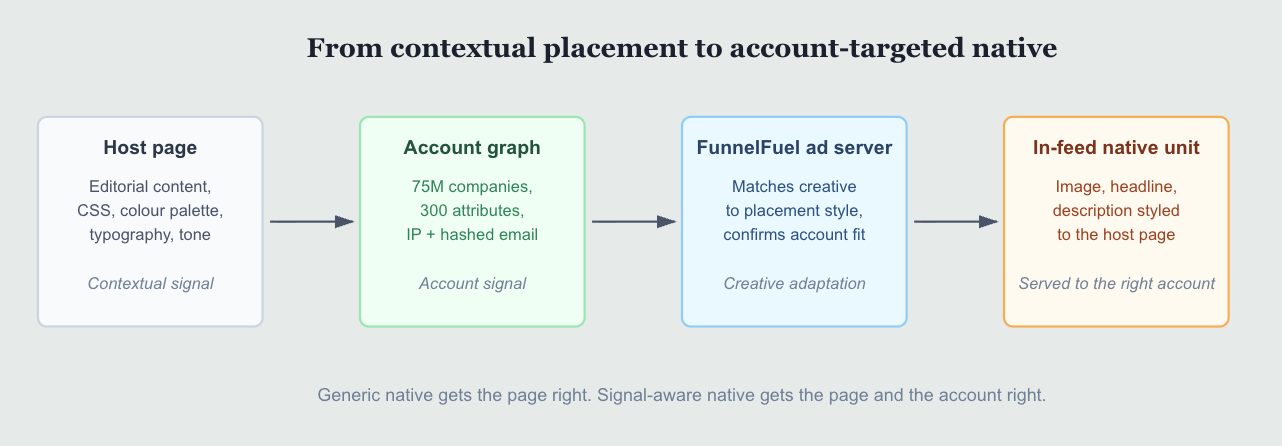
The technical piece that makes this work in practice is the ad server itself. When I designed one of these, I aimed to index a placement’s characteristics on the page it’s served against: the surrounding CSS, the colour palette, the typography, the tone of the surrounding copy. Standard display creative then gets adapted to take on native’s ‘visual grammar’ for that specific placement, rather than every advertiser needing a bespoke native unit hand-built for every publisher. That’s what lets native scale as a programmatic buy instead of staying a boutique, publisher-by-publisher exercise.
Measuring it properly, and where it fits next to rich media
The upside is real, but it needs the right measurement frame or it gets dismissed as a vanity format. Click-through rate on native in-feed units consistently outperforms standard banner display in B2B environments, largely because the format earns a moment of genuine attention rather than being scrolled past on reflex. Attention time, not just clicks, is the metric worth tracking here: a native unit that holds a reader’s eye for two extra seconds inside a trusted editorial context is doing something a banner impression can’t claim credit for. Attention metrics were not even a thing when native launched, so joining the dots to link account level attention to native ad exposure, alongside clicks, is logical and exciting in equal measure.
As I reflect on native ads today, with much less of a vested interest then I did a decade ago, my framing to you would be that you should think about native as a signal layer, not a standalone channel. Combine it with account-level intent data and high-value-action tracking, and native becomes part of how you influence an account already in motion, not the thing generating that motion on its own. Judged against last-click conversion alone, it will always look weaker than it actually is.
Rich media display still has a place, and I’d argue the strongest B2B media plans in 2026 run both together rather than picking one. Rich media earns impact through scale and format, big expandable units in ad real estate that was never built for native conversion in the first place. Native earns relevance through contextual and account fit, served inside feed placements where a large expandable unit would feel like an intrusion. Run them in parallel and you get memory-building impact from one format and trusted, in-context relevance from the other, rather than treating it as a choice between them.
If I was a B2B advertiser in 2026, how would I run it?
If you’re briefing a DSP, agency or managed service partner like FunnelFuel to run native this year, the question worth asking directly is whether they can accept component-based creative, meaning image, headline, and description supplied as separate elements rather than one fixed banner asset, so the placement can render it in the native style specific to that page. If the answer is no, you’re leaving in-feed inventory on the table that your competitors’ media plans are already picking up. I’d also want to know what signals they can leverage for native, and if they have any workflows like bespoke ad serving to bring native principals into my display ads.
That last point is huge, and should be re-surfaced. I’d be mandating a native-first display ad approach in 2026, because they are proven to win more attention. They don’t cost more yet they drive more attention and action - so why wouldn’t you want that? I’d be asking for the ability to deliver genuine native experiences into the right placementIDs for a native approach, and then synergising with big rich media formats to combine the best of both worlds. I’d be asking how this can uncover dark funnel research and cast a light on some of it, whilst impacting more through well placed exposure
Native advertising isn’t back because it’s nostalgic. It’s back because it was built around content relevance rather than identity tracking, at exactly the moment identity tracking stopped being reliable, and because B2B buyers already spend their research time in the trusted editorial environments this format was designed to sit inside. The question isn’t whether native belongs in a 2026 B2B media plan. It’s whether your current stack can serve it against the right account, or whether it’s still just guessing at the page.
Are you running native as an account-targeted signal layer, or still treating it as content-farm leftovers from 2016?
If any part of this doesn’t square with how your stack currently handles in-feed inventory, reply to this email. I read every one. If you want to talk through what account-graph-targeted native could look like for a specific campaign, reach me directly at mike@funnelfuel.io.