Programmatic 2.0 quietly shipped on June 1st + FunnelFuel 33rd on Times 100 Fastest Growing Companies + Omnicom tells brands to go direct to Publisher + Your Buyer found a new front door
The B2B Stack. 8th June 2026.
A quick personal note before the week’s news, because it would be odd to skip it.
This weekend, My business FunnelFuel.io landed at number 33 on the Sunday Times 100, Britain’s fastest-growing (and profitable) private companies. Fifth year of the list, topped this year by Goalhanger, the podcast outfit behind The Rest Is History, on the back of 321 per cent average annual growth. Scan the rest of the table and it is mostly what you would expect: celebrity-backed drinks, challenger beauty, food brands you have seen on a tube poster. Consumer names now make up close to half the list
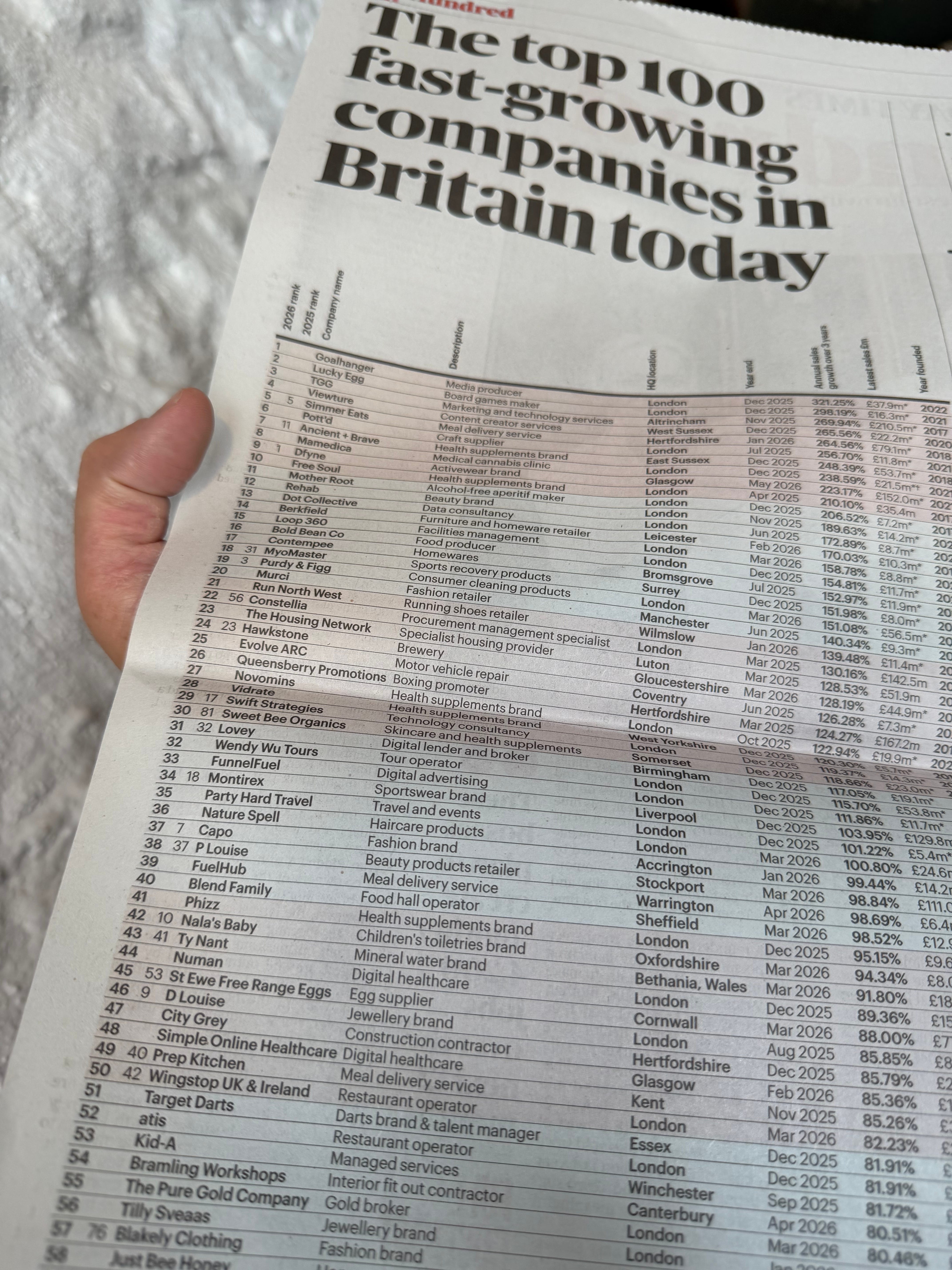
So a B2B programmatic managed service turning up at 33 is, frankly, a bit of an oddity - an one we are very proud of.
Part of the reason is that the Sunday Times runs pure-technology companies on a separate table, the Sunday Times 100 Tech, which means the main list rewards trading businesses growing real, audited revenue rather than software multiples and a funding round. We got there on sustained sales growth, built with very little outside capital, and at a time where tech businesses are burning credits and cash 24/7, we got there profitably. That last part is the bit I am quietly proud of. Plenty of adtech grows fast by setting fire to someone else’s money. Anyway. That is enough of that.
Onto the last week, which was a good one for anyone who actually cares where their media decisions get made.
What you’ll learn in this article
Why PubMatic launching a containerisation layer on 1 June is bigger than it looks, and what “decisioning in the supply path” actually means for your campaigns
What Omnicom telling its buyers to go direct to publishers tells you about supply-path optimisation in 2026
Why the discovery surface for B2B buyers is shifting under your feet, and what Google’s Universal Cart and OpenAI’s new ad hires signal
The one question to take into your next media review off the back of all three
Decisioning is moving into the pipes
The story of the week is dull-sounding and yet very important. On 1 June, PubMatic launched a containerisation layer it calls Decision Fabric, built on the AgenticOS standard, with partners including MiQ, Chalice, inPowered and SWYM able to run their own decisioning logic inside it (Digiday).
If “containerisation” hasn’t reached your team yet, here is the plain version. For most of programmatic’s life, the clever part of a campaign, who to bid on, at what price, against which signal, happened inside the demand-side platform. The DSP was the brain. Containerisation flips that. It lets a buyer, a curator or a data company drop its own decisioning logic into a container that runs further down the pipe, on the supply side, closer to the inventory. The brain moves out of the DSP and into the plumbing. The unlocks that follow include cost savings and efficiency upgrades which have been estimated by Index Exchange - the pioneers of this - at 75-100x, thrashing their own initial estimates of one order of magnitude and gaining nearer ten orders. Efficincy, carbon, cloud costs, niche audience unlocks, genuine supply path optimisation and cleaner/stronger signals all play their roles. This is the future of programmatic 2.0
PubMatic is not first here. AgenticOS has been gathering partners for months, and this is the supply side formalising a shift that the buy side has been circling since the back end of last year. What changed this week is that it stopped being a concept deck and became a product you can point partners at.
Why this matters if you run B2B paid media: the value in B2B has never been the bidding - which is vanilla programmatic 101 - it has instead been the targeting logic. Knowing that this set of accounts, showing this pattern of intent, sitting at this stage of a buying committee’s journey, is worth paying up for. If that logic can now live in the supply path rather than being flattened into a generic DSP audience, the people who own genuinely differentiated decisioning get to apply it much closer to the impression. The flip side is the risk: if you don’t own your decisioning, you are renting someone else’s, and you are now renting it in more places. The question to ask any partner pitching you “AI-optimised” anything in 2026 is a boring one. Whose logic is in the container, and can you see it?
Omnicom would like fewer hands in the pipe
In the same beat, two supply-side sources told Digiday that buyers inside Omnicom are being pushed hard to route more spend straight to publishers rather than through the usual stack of intermediaries (Digiday). The pendulum beings to swing again, from supply platform dominance over demand side power pays, to agencies who were in danger 18 months ago of becoming relics.
This is supply-path optimisation, SPO, with the gloves off. The holding companies have spent two years trimming the number of hops between a buyer’s budget and a publisher’s page, partly for cost, partly because every hop is a place fraud and made-for-advertising inventory hides. And realistically because every third party hop can become a first party - for the agency - revenue grab, to make up for their eroding media margins. Jounce Media still has roughly 15 per cent of open-exchange impressions landing on MFA sites. A shorter path is a cleaner path, and should work harder for B2B vendors.
The B2B angle is uncomfortable and worth sitting with. B2B campaigns run on smaller, more precise audiences than consumer, which means we are more exposed to the tax of a long supply path, not less. A consumer brand buying broad reach can absorb a few wasted hops. A B2B advertiser paying a premium to reach 4,000 named accounts cannot, because every dollar lost to an intermediary or an MFA arbitrage is a dollar that was meant to reach a finance director at a target account and didn’t. If you have never asked your agency or your managed service to show you the path your money takes from your card to the publisher, this is the week to put it on the agenda. The honest ones will have the answer ready.
The buyer found a new front door, and it isn’t your website
Now the lighter one, though it stops being light if you think about it for more than a minute.
Three things happened in the last fortnight that point the same way. Google unveiled Universal Cart, a shopping cart that follows a person across Search, Gemini, YouTube and Gmail and lets Gemini hunt down deals before checkout. Less useful for B2B, but this is generally super interesting from Google.
OpenAI posted for a head of enterprise marketing for its ads business, which is not the job listing of a company dabbling. And supplement brand Olly started rewriting its product pages, not for Google’s crawler, but so that AI chatbots describe it accurately when a shopper asks for a recommendation (Digiday, Digiday).
Consumer stories, on the face of it. But the behaviour underneath is exactly the behaviour we have been documenting on the B2B side for two years. Buyers research independently and arrive late. The repeated finding is that B2B buyers are something like 70 per cent of the way through a purchase before they speak to a vendor, and spend a sliver of their total buying time actually with suppliers. The new wrinkle is that a growing share of that independent research now happens inside an LLM rather than on a search results page or your carefully optimised website. This is a behaviour change that spans personal and professional lives, so shouldn’t be ringfenced into B2B or B2C, its changing behaviours behind vast cohorts of people.
That should change where some of your effort goes. If a procurement lead asks ChatGPT or Gemini to shortlist vendors in your category, the deciding factor is whether the model has been fed an accurate, well-structured picture of what you do, not whether your homepage hero animation is on brand. Olly worked this out for collagen gummies. The B2B version is making sure your category, your differentiators and your proof points are legible to a machine that has never seen your pitch deck. Call it GEO, call it AIO, call it housekeeping. It is becoming table stakes.
The thread tying all three together
Notice what these have in common. Decisioning sliding out of the DSP and into the supply path. Spend being pushed past the intermediaries to the source. Discovery moving from the open web into AI assistants. In every case, value is migrating closer to the edges and away from the middle layers that used to capture it by default.
For a B2B advertiser the practical takeaway is the same in all three. Own the part that is actually yours. Your account intelligence, your decisioning logic, your understanding of the buying committee. Be ruthless about the parts that are just toll booths. That is the line we have organised FunnelFuel around for years, which is presumably some of why this week went the way it did, but the principle holds whoever you work with.
One question to take into your next media review: of every dollar you spend on B2B paid media, how much is working media reaching a real target account, and how much is paying for the privilege of getting there? If nobody in the room can answer, that is the answer. Those dollars work hardest when they unlock the strongest vectorised targeting AND the strongest insight and reporting payloads back - when you get both, your marketing investment pays for insights that justify its place in the CFO’s budgets, when either slips, the investment case weakens and budgets follow
That is the week. If you want the longer version of any of this, or you are wrestling with the supply-path question on a live budget, just hit reply. It comes straight to me and I read them all.
Until Friday.
Mike


Excellent breakdown, Mike. The shift of decisioning closer to the supply path and the growing role of AI-driven discovery are trends every B2B marketer should be paying attention to. Congratulations as well on FunnelFuel’s Sunday Times 100 achievement an impressive milestone built on profitable growth.