

Welcome back to The B2B Stack. Fresh off a break and straight back into the argument I keep having in client meetings: programmatic wasn’t built for B2B, and most of the programmatic ecosystem still isn’t. Build the missing layer underneath it, though, and it becomes one of the best opportunities sitting in a B2B media plan today, for anyone willing to do the building.
New here? I'm Mike Harty, founder of FunnelFuel, a B2B-native programmatic business, and before that I built PowerLinks, a native advertising adtech platform. If this is your first issue, two pieces sit closest to today's topic: The Account Graph Is Not an Identity Graph and Segment vs Signal.
Subscribe for one argument a week on where B2B, ABM, programmatic and data actually meet, straight to your inbox.
What you’ll learn in this article:
Why the buying committee, not the account, is the real unit programmatic needs to be built around, and how large that committee has actually grown since the pandemic changed the game
What the open web gives you at the individual URL level that LinkedIn structurally cannot
Why the data coming back out of a programmatic buy, not just the placement itself, is the more valuable half of the trade - and the value most buyers miss
Where programmatic beats walled gardens on cost and on reaching the stakeholders LinkedIn under-indexes
Why this capability gap has persisted for a decade, and what actually closes it
The wrong belief
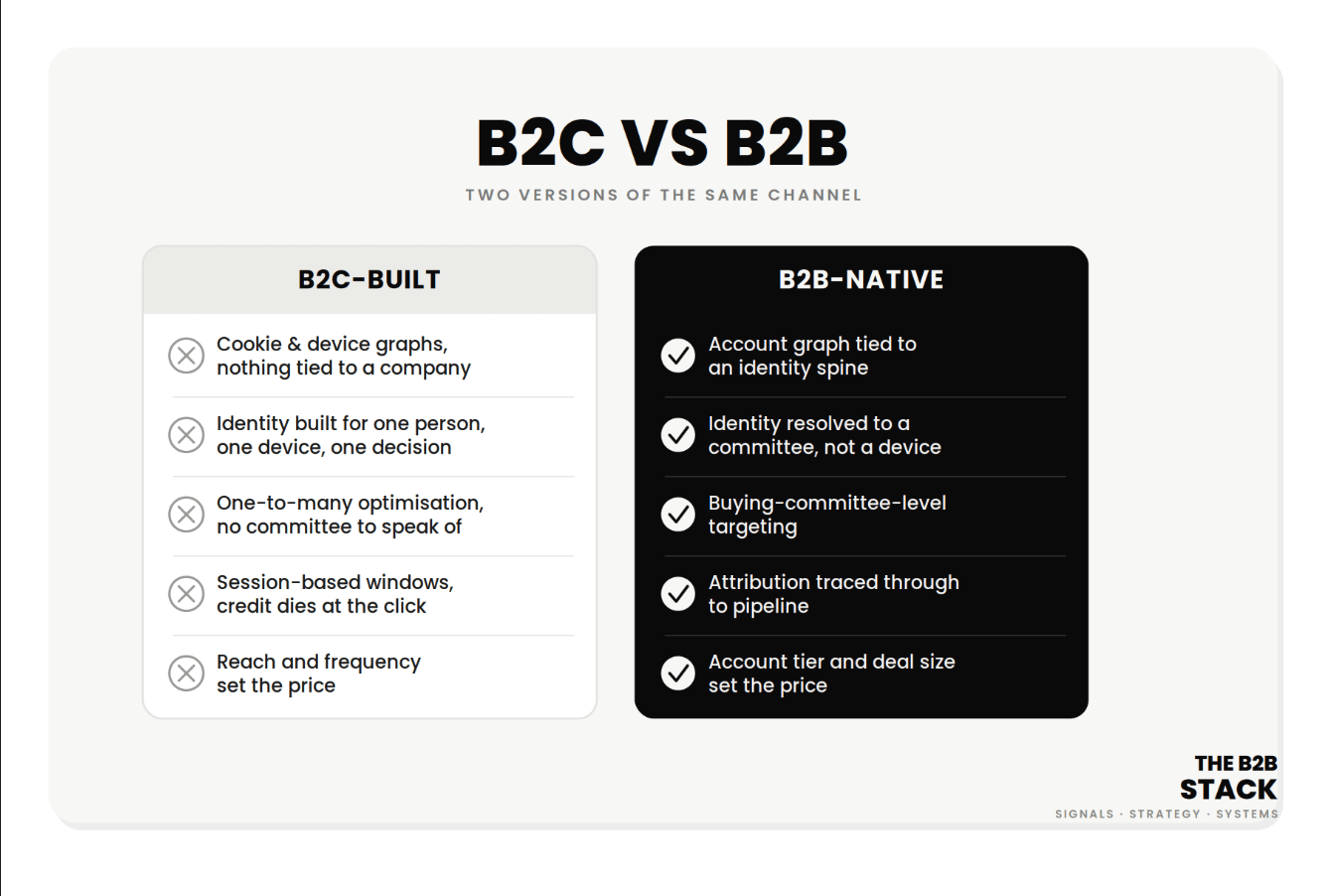
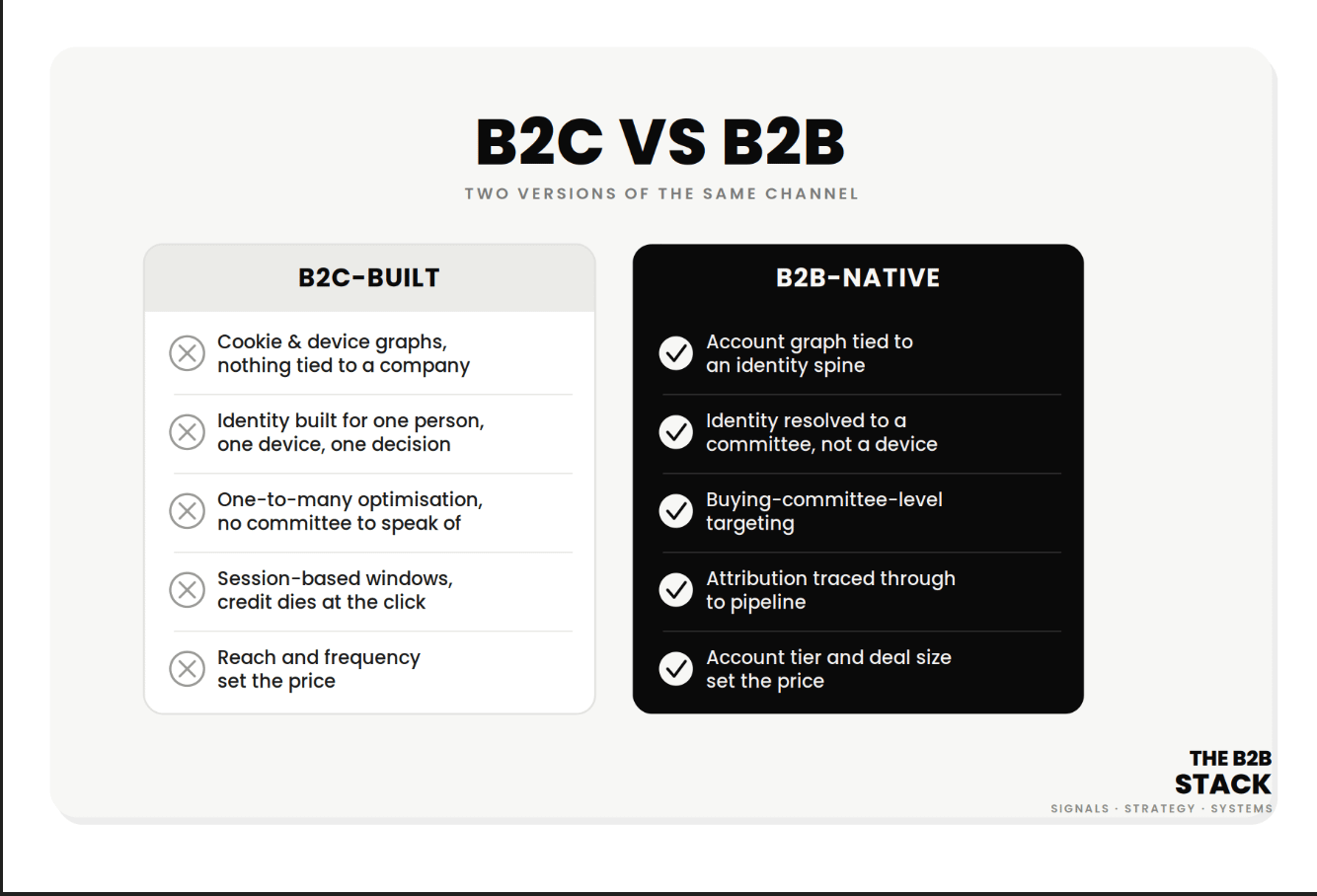
Most B2B marketers have quietly written programmatic off, and the reasoning isn’t unreasonable: the entire discipline, cookie and device graphs, individual consumer segments, one-to-many optimisation, session-based conversion windows, was engineered for selling trainers and holidays to one person at a time.
Judged against a B2B sale involving six, ten, twenty stakeholders, that plumbing looks like the wrong tool, so programmatic gets treated as the channel you fall back to once the LinkedIn budget runs out. The cheap remnant inventory that nobody wants to prioritise.
Here’s the flip. Programmatic wasn’t built for B2B, and that part of the belief is correct.
Where it breaks down is the next step, the assumption that this makes the channel permanently unfit for the job. It doesn’t. It means the auction infrastructure, the real-time bidding, the exchange connectivity, the contextual crawling, is powerful technology aimed at the wrong unit by default. Point that same infrastructure at an account graph and an identity spine built to resolve real companies and real committee roles, and the channel that was supposedly wrong for B2B becomes the only one built to reach a full buying committee across the open internet at scale.
I often see the gap as data hierarchy. Programmatic thrived because it focussed on targeting end individual users (really end devices measured by cookie footprint but I’m trying to avoid being pedantic for a moment). That was always awesome for selling fast moving consumer goods, but missed the hierarchy levels of account and buying groups. The moment you can transpose those into the programmatic auction, including the other bits mentioned above - as well as optimisation, pacing, reporting, and targeting - then you have changed the game. You have weaponised some of the best optimisation AI in the game to work for the buying group within an account currency, which is a game changing upgrade
The buying committee is bigger than most media plans assume
Gartner’s own buyer research puts the typical enterprise buying committee somewhere between six and ten stakeholders today, up from 5.4 a decade ago, with larger deals routinely running past ten and some surveys putting the ceiling above twenty. Forrester’s figures land in a similar place: somewhere between two-thirds and three-quarters of the buying journey now happens before a prospect ever speaks to a salesperson.
That’s not a subtle shift. It means the individuals a vendor needs to reach, and the window in which they can be reached, have both expanded and moved earlier, largely out of view of the channels built around a form fill or a sales call (think dark funnel). It also means “the account” was never the right unit to plan media against. The committee is, and a committee of six to twenty people spread across procurement, security, legal, technical evaluation and the executive sponsor is not a group any single channel reaches on its own, least of all a channel built to sell one person a pair of trainers.
These 6-20 person clusters, who need targeting in unison not isolation, is the precise gap I have spent millions of dollars engineering to resolve.
This is where an account graph, tying together tens of millions of businesses, their firmographics, their technology stack, their inferred size and revenue, against an identity spine that makes the individual committee member targetable, stops being a nice-to-have and becomes the actual precondition for doing this properly. Without it, “reach the buying committee” is an empty slogan. With it, it’s a targeting spec, and it’s the specific piece of infrastructure the B2C version of programmatic was never built to include.
What the open web gives you that LinkedIn structurally can’t
Traditional programmatic formats, display, video, native, delivered against premium content sites and apps, come with one advantage that gets MASSIVELY underrated: the full URL of the page carrying the ad, both as a targetable signal going in and a reportable one coming out. That lets a business crawl and analyse the page itself, its text, its imagery, its video and audio, and understand semantically what it’s actually about, not just which segment the visitor supposedly belongs to.
Its resultantly easy to fall into a fallacy of believing the entirety of the value is in targeting what I like to call apex-fit pages.
Apex-fit pages, where a buying committee member is doing visible, deep research, are rarer than the pitch decks imply. Most people are not observably doing deep research online, and that segment is shrinking further: SparkToro’s tracking of Google search behaviour puts the zero-click rate at somewhere around two-thirds of searches by early 2026, up from roughly half in 2019, as AI Overviews and on-SERP answers absorb queries that used to end in a page visit.
But “rarer” is not “rare.” and “rare” does not mean “not at all”. The open web still carries an enormous footprint of contextually relevant page views, and while every published estimate of daily programmatic bid volume disagrees with the next by an order of magnitude depending on whose infrastructure is being counted, even the conservative end of those estimates dwarfs total impression volume across every walled garden combined.
That’s the opening.
While budget keeps piling into Facebook, Instagram, Reddit and LinkedIn, the open programmatic ecosystem remains the only channel that can, at scale and with real ad tech behind it, go and find the pages where your buying committee’s research journey is actually happening, upstream of the point where they know they’re running a formal process at all. That’s an opportunity to build brand memory early, to form your own view of intent rather than renting someone else’s, and to align a brand contextually with what a prospect is actually reading, whether that’s a technical deep-dive or a sponsorship context like a company backing Formula One and then buying against the content a fan of the sport is reading.
The real prize is the data coming back out
The placement is only half the trade, and the only half that most buyers seem to value.
The depth of data returned from a programmatic buy, the raw event logs and bid-level detail sitting behind platforms like The Trade Desk, isn’t matched by anything a walled garden reports back. That observable signal, tied to the right account graph, is what turns a media buy into a data asset: knowledge of which named accounts, and ideally which individuals within them, engaged with which contextually-aligned placements.
That’s an underused opportunity in itself, because it lets a B2B marketer build a proprietary read on intent rather than depending entirely on third-party intent providers whose methodology is, to varying degrees, a black box. Feed that signal into your own model, and you can push it back out into every other channel you run: sync it against YouTube buys, sync it against social, use it to prioritise content syndication, and let your own observed behaviour, not a vendor’s inferred score, set the plan. This is a huge and massively under-appreciated component of programmatic advertising
The same principle extends to owned-property signal: an individual mobile ID, IP address or cookie behind a visit to your own site or a partner’s, tied back to a named account and ideally a named buying committee member, recognisable well before that person raises a hand. Put together, that’s the 360-degree loop the B2C version of this channel was never designed to close, and that most B2B media plans still don’t.
Where programmatic beats the walled gardens, and where it doesn’t
LinkedIn earns its premium. It reaches named accounts and named individuals with genuine precision, and its reporting is good. But it’s expensive, and its 2026 benchmarks show it: CPMs for tech and IT audiences commonly run $30 to $75, sometimes higher for senior or C-suite targeting, up meaningfully on 2023 levels.
Open-web programmatic display trades at a fraction of that, and the data which transforms a B2C generalist impression into a B2B one is what changes the cost, not Linkedin’s arbitrary pricing structure.
The cost is one thing, but much more meaningfully (in a negative sense) is the fact that LinkedIn structurally under-indexes on exactly the roles that don’t spend their working day in the feed: technical evaluators, legal, procurement, security. These are people who are absolutely central to whether a deal closes, and who are considerably easier to find in a technically-aligned podcast or a premium trade publication than in a LinkedIn auction built around front-of-house job titles.
That’s the blunt and honest version of the coverage argument. LinkedIn is strong where it’s strong. Programmatic, built out properly, rounds out the committee LinkedIn was never built to reach, at a materially lower cost per impression, with a deeper and more individually attributable signal coming back. Put those two facts together and the case stops being a nice-to-have argument and becomes close to a cost-of-capital one: less waste, cheaper reach, deeper penetration into a wider committee, all at once.
Why this hasn’t happened already
If the case is this strong, the obvious question is why B2B programmatic spend has stayed this underweight for a decade. Surely not every major vendor has missed the memo on this?
The honest answer is infrastructure, not appetite. Purpose-built B2B programmatic capability, anchored to account-level data pipelines that can target and then report and attribute all the way through to a website visit, simply hasn’t existed as a category until recently. Most of the ecosystem is still running the B2C version underneath a B2B media plan and calling it done. This is the specific gap we built FunnelFuel to close, and it’s taken real investment, not a repackaged consumer DSP with a B2B label stuck on it, to make the targeting-to-attribution loop actually close.
That gap, more than any lack of belief in the channel, is why programmatic has spent the better part of a decade as B2B marketing’s most underinvested line item. It also means the opportunity is still there for anyone willing to bring in the expertise, whether that’s built in-house over time or borrowed while the programme stands up.
It would be a mistake to assume big vendors, especially big B2B tech vendors, are not materially running B2B programmatic - there’s tens of millions getting spent annually by individual big vendors that I know and we work with. The structural miss is probably outside of this land of the giants but which represents a huge chunk of the B2B industry
The position
Programmatic was built for B2C. On its own, unmodified, it’s exactly the channel most marketers still think it is: cheap filler, a segment-of-one tool bolted onto a committee-level sale, easy to deprioritise next budget cycle. Rebuilt on an account graph and an identity spine that can resolve a real buying committee, the same auction infrastructure gives you committee-level targeting an account list alone doesn’t, contextual reach LinkedIn structurally can’t replicate, a deeper and more attributable data return than any walled garden hands back, and a materially better cost basis for reaching the parts of the committee that never open LinkedIn.
That gap between the two versions of the same channel is, in my view, one of the more expensive things sitting inside a lot of 2026 media plans heading into 2027. So here’s the question I’d put to anyone still running programmatic as an afterthought: if two-thirds of your buying committee’s research is happening before your sales team ever hears about it, and the channel was never built to reach that committee out of the box, what’s actually in your plan to close that gap, and what’s it costing you that it isn’t?
Is running B2C-era programmatic infrastructure against a B2B buying committee a live problem for you right now? Whatever the specific version of it is, I’d like to hear about it.
FunnelFuel works across a few different models: from a full managed service, to something built around what you already run in-house.
Connect with me on LinkedIn, message me directly here on Substack, hit reply if this landed in your inbox (it comes straight to me), or email mike@funnelfuel.io. No pitch attached, happy to talk through what I’m seeing across the market and see if there’s a fit. Just as happy if the answer is there isn’t one.