

LinkedIn switched on CTV Ads in the UK on 12 November, and its PR team sent me the release and the Cisco case study the same morning. The headline numbers are good and further validate CTV and B2B:
52% more midmarket accounts reached than in-feed video alone
141% higher lead form completion among people who had seen the TV ad first
And a claim that LinkedIn’s CTV ads build B2B awareness 2.6 times more effectively than other CTV options.
This is not a review of LinkedIn’s product, and it is not a takedown of a press release.
The numbers deserve to be taken seriously because they describe something B2B marketers have been slow to accept: television reaches buyers the feed cannot, and it makes everything that follows work better. However, the release also shows the limits of targeting by job title, and it says nothing about proving a brand outcome inside the accounts you actually sell to. So today we will explore how to do B2B CTV even better
So the plan is to read the LinkedIn data for what it shows, borrow the language of brand outcomes to describe what television is for in B2B, and set out the account-based version: a multi-source account graph instead of a profile list, television orchestrated with the other surfaces an account touches, and brand outcomes measured at account level rather than assumed.
New here? I’ve been building B2B programmatic platforms since 2011. I’m a co-founder of FunnelFuel, where we run advanced account-based programmatic for B2B brands. If this is your first visit, the two pieces that set this one up are The Living Room Tax: CTV for B2B and The Account Graph vs the Identity Graph.
Subscribe and join 1600+ B2B marketers from leading agencies like Dentsu and WPP, as well as the biggest enterprise vendors like Hubspot, and ABM players like 6Sense and DemandBase
What you’ll learn in this article
What LinkedIn launched in the UK, and how a job title ends up on a television
What the Cisco and Kantar numbers show about television as a B2B medium, and what they leave out
Why brand is the right job for television in B2B
How brand outcomes are measured properly, and why exposed versus unexposed is not enough
What the account-based version looks like: account graph, orchestration and outcomes measured inside the accounts you sell to
What did LinkedIn launch, and how does a job title end up on a television?
The product is simpler than the release makes it sound, which is not a bad thing, and does not detract from its power. You build an audience in Campaign Manager by role, industry and seniority. LinkedIn matches it to people watching ad-supported streaming on partner inventory, which in the UK means LG Channels on LG smart TVs, Titan OS - the system behind Philips, Sharp and JVC sets - and Paramount+. Your video runs as pre-roll or mid-roll inside long-form programming, and reporting sits in Campaign Manager next to your feed campaigns. The UK is the third market after the US and Canada. During 2026 the same audiences also became buyable through Amazon DSP, The Trade Desk, Microsoft Advertising and Google DV360, although every one of those routes is still US only, according to PPC Land’s write-up.
The constraints matter before you brief it. The same report notes that the only objective LinkedIn allows for CTV is brand awareness, the only bidding option is maximum delivery, and the supply is LinkedIn’s own audience network rather than the open CTV market. This is a reach product with professional targeting bolted on, and LinkedIn has been clear-eyed about that. Therefore when we analyse the impressive results, they come on the back of the product being new and I sense a lot of room for it to expand and improve - so this all acts as a big validation of TV for B2B.
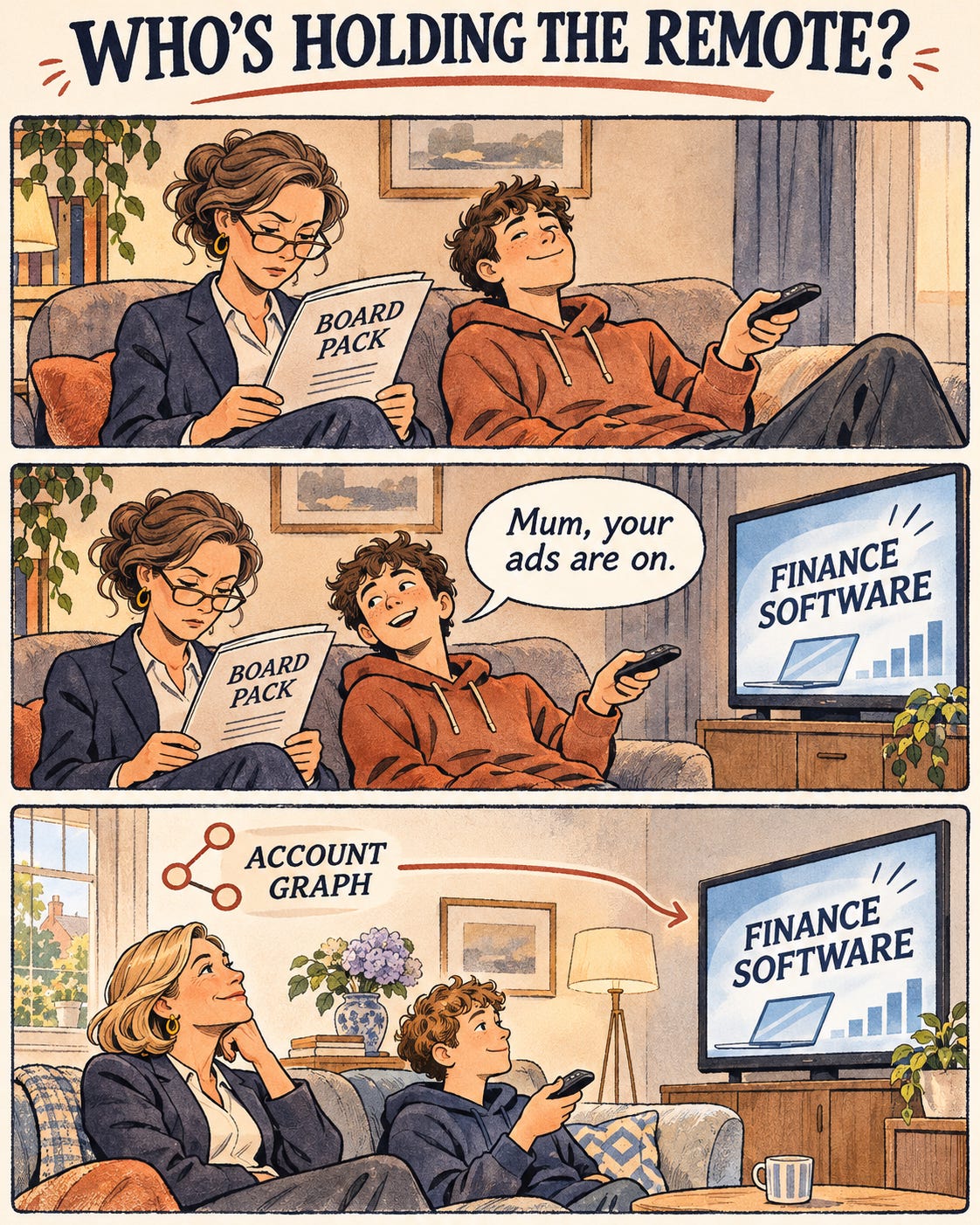
The matching step deserves the most thought. A job title belongs to one person. A television belongs to a household. LinkedIn does not say how a member is linked to a screen, what share of UK members can be matched, or what happens when the finance director’s teenager has the remote. That is less a criticism of LinkedIn than a description of television: every B2B CTV product, including the account-based kind we run, resolves a professional identity to a home or a device and accepts that the screen is shared. There will always be noise, but for B2B this represents a quantum leap forward in the targeting behind TV, and marries the surface that builds the most brand memory with the majority of the addressability that the industry brought to 300x250 MPUs. So, the questions that really matter are whether the targeting key you start from is the right one, and whether you can measure what the exposure did afterwards.
Television is where buyers first notice you. The AI assistant is where they check you out afterwards. If the second half of that sentence is the one keeping you up at night, The Advanced B2B AI Discovery Playbook is the method I use to find out whether ChatGPT, Perplexity and Gemini cite a brand when a buying committee asks, and what to change when they don’t. It runs in Claude with very little manual work, and it is what I hand clients who ask whether they can run ChatGPT ads.
What do the numbers show, and what do they leave out?
The release makes four claims, and they are four different kinds of evidence, so they are better taken one at a time.
The first is reach - and this is genuinely very interesting. Cisco reached 52% more midmarket accounts in the UK than its in-feed video reached on its own. The footnote confirms the comparison is against in-feed video alone, so this is incremental reach, not audience size. It is the most useful number in the pack, because it describes something practitioners know from the inside: the feed has a ceiling. Not everyone in a buying group scrolls LinkedIn, frequency caps bite, and the people you most want often open the app least. Television found the rest of the room. LinkedIn’s product page cites Atlassian reaching an audience 57% incremental to the feed, which points the same way. I have argued this for years, LinkedIn data is awesome but big chunks of the modern buying group spend very little time on it.
The second is priming. People who had seen Cisco’s TV ad completed lead forms at a 141% higher rate, and clicked at a 35% higher rate, when Cisco followed up in the feed. This is multi-touch, multi-surface advertising working in reality and it shows the concert affect of formats and channels, and the marketing mix working in reality. The comparison is exposed versus unexposed, and nothing in the footnote says the groups were assigned at random. That matters, because people who get matched to a television and exposed are not the same as people who don’t: they stream more, they live in matchable households, and they are probably easier to reach in the feed too. So the 141% mixes what the ad did with who the ad found. However, the direction is not in doubt. Prior exposure makes the next response cheaper in every brand effectiveness dataset I know of, and the 30% lower cost per lead for audiences first reached on TV, drawn from 2025 US and Canadian campaigns rather than the UK, is the same effect measured a different way.
The third is awareness. The 2.6 times figure comes from a Kantar analysis of 97 LinkedIn CTV campaigns commissioned by LinkedIn, against other CTV offerings the release does not define. The more interesting finding in that research, which LinkedIn cites on the same product page, is that the awareness effect roughly doubles when CTV runs alongside other LinkedIn formats. That is a finding about orchestration rather than television, and it is the one I would build a plan around. I strongly suspect this impact would be improved considerably further by including account surround tactics across audio (stuff like relevant podcasts), Digital out of home banners around offices and events, and broader online advertising in contextual environment which are already proven to reach more of the buying group then LinkedIn alone.
So the honest reading is this. One advertiser, two markets, one commissioned study and no randomised controls. Taken literally, none of it belongs in a board deck. Taken indicatively, all four claims point the same way, and that way matches independent evidence: MAGNA’s research with LinkedIn found 98% of members watch connected TV in a typical week. Television reaches the people the feed cannot, it makes the next touch work harder, and it works best as one part of a sequence. The release proves the format. What it cannot prove is a brand outcome inside the accounts you are trying to win.
Why is brand the right job for television in B2B?
Most B2B media plans treat television as a luxury you buy once the pipeline is safe. The evidence runs the other way. In 2021, Professor John Dawes of the Ehrenberg-Bass Institute put a number on something every enterprise seller already felt: only around 5% of a category’s buyers are in market at any moment, and the other 95% will not buy for months or years. Advertising aimed at the 5% is ignored by the 95%, which is why demand capture on its own has such a hard ceiling. Binet and Field’s work for LinkedIn’s B2B Institute had already found that B2B businesses grow best with around 46% of budget on brand and 54% on activation, with mental availability doing the long-term work.
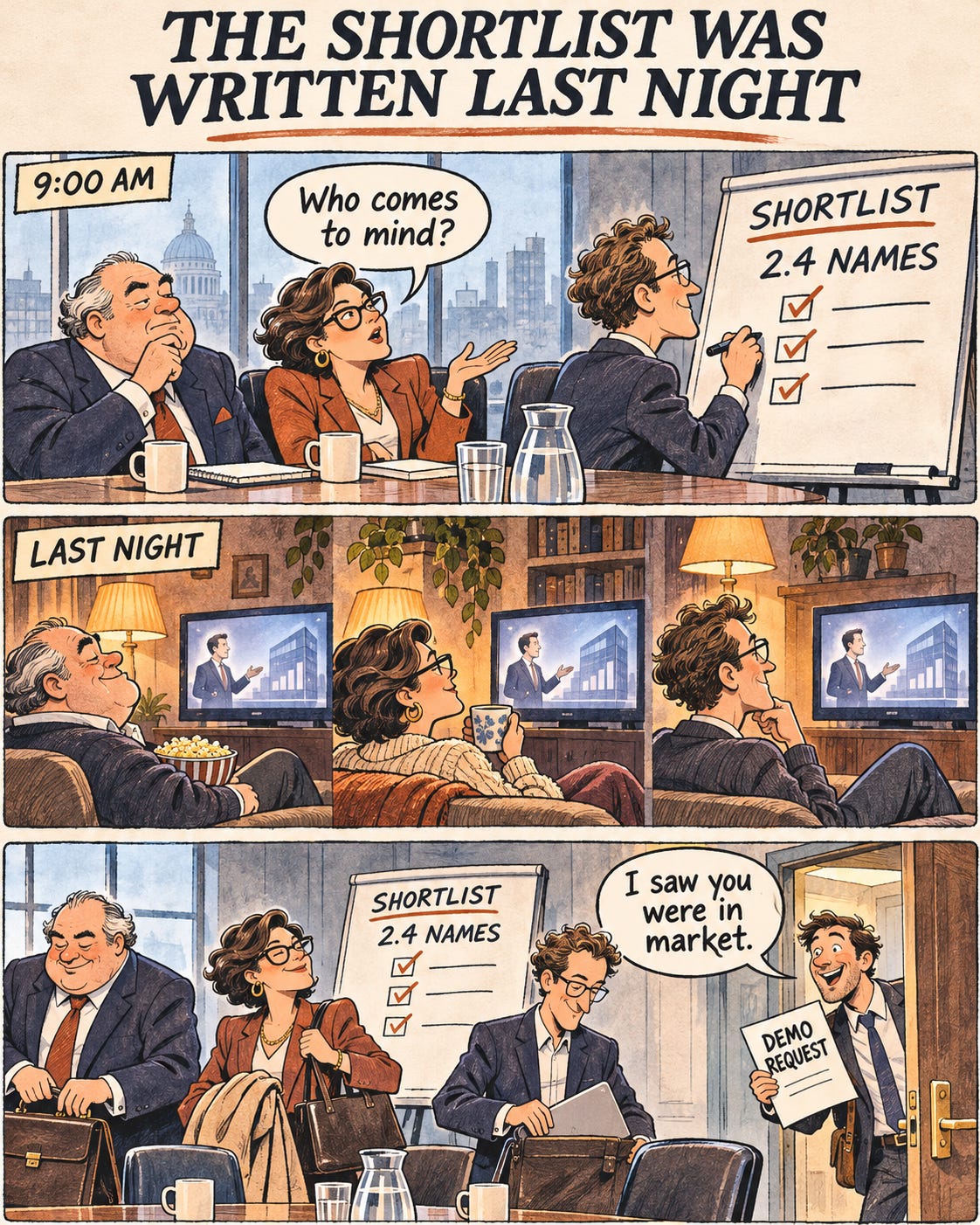
The practical reason is the shortlist. Buying groups arrive with names already in mind, and LinkedIn’s later research with Ehrenberg-Bass puts the average consideration set at around 2.4 brands. If you are not one of them before the evaluation begins, no amount of intent-triggered display will put you there. The job of brand media in B2B is to be remembered by the right accounts before anyone fills in a form, and television is built for that job: full screen, sound on, a lean-back audience and an environment that lends the brand some of the programme’s authority.
Buying behaviour has made this more urgent. The research a committee once did on vendor websites has moved into AI assistants, so the educational journey that gave a brand a dozen chances to be noticed now happens where you cannot see it or retarget it. When the first visit you observe is a demo or pricing page, the shortlist has already been written.
The reality is that AI is shaping the way businesses buy. What comes out of an AI prompt is based entirely on what goes INTO the prompt. Bigger brands - the sorts who have more branded search volume in general - get added to the short list more because they have pre-built the awareness and the trust needed to drive consideration. This is why brand in 2026/7/8 and beyond is absolutely critical in my opinion. Its about shaping consideration sets and being one of the 2.4.
How should brand outcomes on television be measured?
If television’s job is memory, the measurement has to be of memory, and most B2B teams have never been given a usable way to do that. The vocabulary I find most useful is to think in “brand outcomes” rather than “brand lift”, and the distinction is deliberate: lift is a number, an outcome is a change in how a buyer relates to you.
To my mind this method is the opposite of a vendor dashboard. Exposure is tracked first, including frequency and time in view. Exposed people are identified when they return to the same environment and asked one question about the advertised brand, with no panel, no lab and nobody claiming to remember an ad. Answers are read against a ladder: not familiar, familiar but not interested, would consider, one of my preferred, intend to act.
Results should then be benchmarked against a statistically relevant volume of responses (tens of millions), which gives us a B2B ready model which works on campaigns far too small for a traditional brand study - which is most of B2B marketing. That matters more in B2B than anywhere, because a serious enterprise campaign is a rounding error by television standards. Media owners such as DPG Media have already taken the approach onto connected TV.
Put that next to the release, which offers an exposed versus unexposed comparison with no randomisation. The weakness is not the direction of the result but the absence of a control: a share of the audience that could have been exposed and was held back, so the only difference between the groups is the ad. Without it you are measuring the audience as much as the campaign.
For B2B there is one more adjustment, and it turns a media metric into a commercial one. The unit of measurement should be the account, not the person. The questions that matter are whether awareness, consideration and preference moved inside the target account list, whether they moved in exposed accounts rather than held-out accounts, and whether the movement reached more than one person in the buying group.
That is a brand outcome in the language a CFO uses, and it is where our own thinking is going: outcomes models built on brand outcomes measured inside the target account list, alongside engaged-account reporting, rather than brand and performance running as separate campaigns with separate scorecards.
What does the account-based version of B2B television look like? How would I improve how B2B brands ‘do’ CTV even further?
LinkedIn’s targeting key is occupation. It is a good key, even a great key and for a long time it was the only one that reached the big screen. However, B2B does not sell to occupations. It sells to accounts, and inside each account to a group of people who rarely share a job title. The account-based version starts from that difference and changes three things.
The first is the audience. Instead of a profile list you start from an account graph: a named target account list enriched with firmographics and corporate hierarchy, intent from more than one source, CRM status and first-party behaviour on your own site, resolved through identity partners to the offices, home networks and devices where those accounts’ people actually watch. No single source is good enough on its own, so corroboration across sources is the condition for putting an account in the audience at all. The result is packaged into deal IDs before the auction, so the television buy runs across any premium CTV supply rather than one network’s audience extension. That is what I call containerisation, and it is the opposite of a single-objective, maximum-delivery product. You decide the accounts, the frequency and the environments.
The second is orchestration. Television primes; the other surfaces harvest. The sequence Cisco ran, TV first and then the feed, is the sequence that works with account-based display, native, audio, digital out-of-home and YouTube, except that frequency is managed per account and per buying group rather than per channel. When an account has seen the TV spot, the airport screen and the trade-press placement, the follow-up on the open web is the fourth touch, not the first. Kantar’s finding that awareness roughly doubles when CTV is combined with other formats is the orchestration effect measured inside one walled garden. Across an account graph there is no wall.
The third is the scorecard. Reach is reported as accounts reached and people reached per account, not impressions. Engagement is reported at account level. Brand outcomes are read inside the target account list, exposed accounts against held-out accounts, on the ladder above. Pipeline lift against the holdout is the bonus slice, not the headline, because it is the slowest number to move and the easiest to argue about.
Television proves it can reach B2B buyers. The account graph decides which buyers, orchestration decides what they see next, and brand outcomes measured inside the account list decide whether any of it worked.
Where does this leave a B2B media plan for 2027?
LinkedIn has done B2B marketing a huge favour. By putting professional targeting on UK televisions and publishing numbers, however partial, it has settled whether television belongs in a B2B plan. It does. It reaches people the feed cannot, it makes the next touch cheaper, and it builds the memory that gets a brand onto a 2.4-name shortlist before the evaluation starts. Read indicatively rather than literally, the release is the clearest public evidence yet that the big screen works for B2B.
What it cannot tell you is whether your accounts moved. For that you start from an account graph rather than a job title, run television as the first move in an orchestrated sequence rather than a standalone reach buy, and measure brand outcomes inside the target account list with a real control. That is the direction we are building in, and the one I would push any agency or brand about to spend its first serious money on the big screen.
So here is the question for anyone planning 2027 budgets. If television can now reach the people you sell to, and brand outcomes can be measured at account level, what is the argument for keeping brand and account-based media on separate plans with separate scorecards? If you have one, I would like to hear it in the comments.
If your buyers meet you on a television and verify you in an AI assistant, you need both halves working. This piece covered the first half. The Advanced B2B AI Discovery Playbook is my method for the second: the audit, the scorecard and the fixes that decide whether ChatGPT, Perplexity and Gemini put your brand in front of a buying committee when it asks. I use it on my own newsletter and on client work, it runs in Claude with very little manual effort, and it is the only asset I know of aimed at measurable, B2B-specific citations rather than generic AI SEO advice.
Sources opened for this piece
PPC Land: LinkedIn takes job-role TV ad targeting to the UK (mechanics, constraints, footnotes, MAGNA 98% figure)
LinkedIn Connected TV Ads product page (Kantar 2026 source line, Atlassian 57% incrementality, pairing claim)
LinkedIn B2B Institute: How B2B marketing really drives growth (46:54)
Brand Metrics home and media owners page (method, ladder, 60,000 campaigns, 35 countries, 13 million responses, DPG Media CTV)
LinkedIn press release and Cisco case study, as sent by Propeller on 12 November 2026
One measurement challenge worth considering is how to separate the contribution of each channel when an account is exposed across several surfaces. If TV, LinkedIn, audio and display all contribute to the same brand outcome, an account-level lift may show that the combined approach worked, but not which part made the difference. That distinction matters when teams decide where to increase or reallocate budget.
The awareness-only objective is the part I'd build the creative around. Nobody clicks a TV, so the brand name has to land in the first few seconds and again at the end. The lift shows up later in search and direct, which is why your account-level measurement point matters.