Roundtable prep, published. Change my mind.
My honest positions before tomorrow’s room tries to change my mind
Tomorrow I’m hosting a roundtable with a room full of B2B marketing operators. The event is sold out — but if you’re in London and there’s a spare seat, reply to this email and I’ll see what I can do. The event is called B2B unplugged and has quickly gathered a lot of traction in the London scene
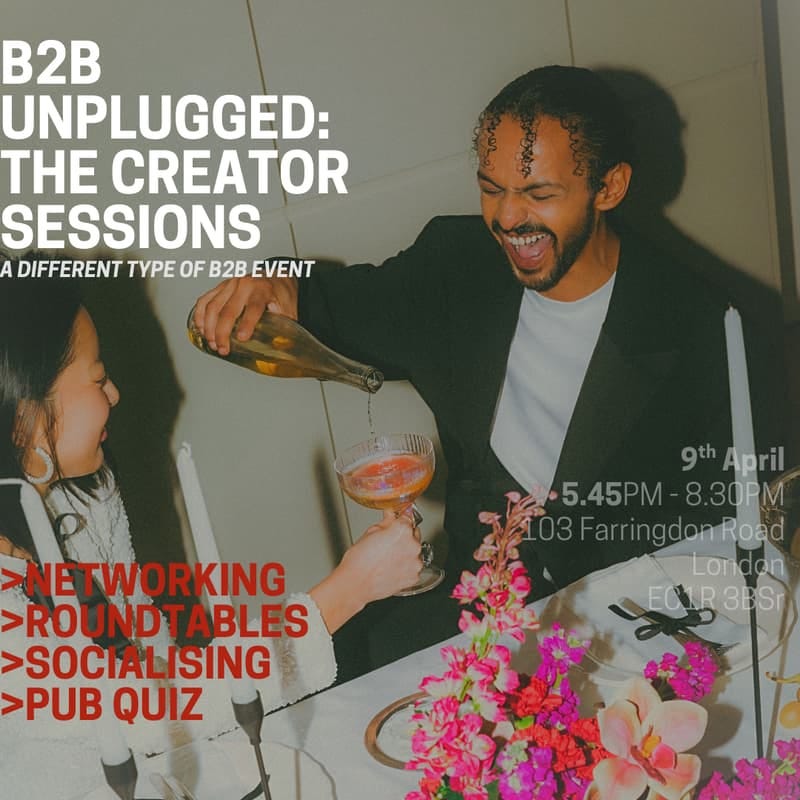
Before I walk in, I’m doing what I always do: writing down exactly what I think. Not what sounds smart. Not what’s safe to say in a room full of peers. What I actually believe right now, in April 2026, based on what I’m seeing in the market every day.
Consider this my pre-match notes. I might walk out tomorrow with all of it intact. I might walk out having had my mind changed on half of it. That’s the point.
Here’s where I stand going in.
Roundtable 1: What’s actually changing in 2026 and what’s just noise?
My position going in: the B2B playbook isn’t being rewritten. It’s being stress-tested like never before
The fundamentals of demand creation haven’t shifted. What’s shifted is buyer tolerance for irrelevance. They’re forming opinions about your brand before you’ve had a single touchpoint, and they’re doing it on terms you don’t control. That’s not a content problem. That’s a signal quality problem.
It’s the living embodiment of the dark tunnel
Multi-channel orchestration is real now too. CTV is not just noise. Search dollars are moving to the ad games best storytelling surface, showing the need to raise awareness higher up the funnel. Brand advertising is back.
On AI-generated content: the backlash isn’t coming, it’s already here, it’s just polite.
Buyers aren’t complaining about it. They’re just quietly not converting on it. There’s a difference between content that fills a pipeline and content that moves a buyer. Most AI-generated B2B content does neither.
All content ever written by mankind has now been processed by LLMs. To save a doom spiral, they NEED fresh perspective and thoughts. For better or worse that’s partly why LinkedIn is now a major source for LLM’s. The chance is there to shape narrative but it needs fresh and real thoughts of your own - and your brands - to work. In LLM world this is the chase for net new knowledge, otherwise the systems learn on their own output, in a spiral of no new knowledge. There’s a chance to win here. It’s partly why I write this substack
The trend I’m actively ignoring right now? Anything that tells me to produce more, faster. Volume is not a strategy. It’s a symptom of not knowing what actually works.
What does the 2026 buyer expect that they didn’t twelve months ago? They expect you to have done your homework. Generic outreach, generic retargeting, generic nurture — all of it now reads as proof that you don’t know them. The relevance bar has moved. Most programmes haven’t. Thin AI personalisation can still be seen through a mile away
I’m open to being wrong on the AI content piece. I know there are people making it work. I want to hear how.
A clever play which I like is one my old friend Dax Hamman shared with me via a loom. His business fomo.ai now has an AI interview tool, called Hello Gordon. It uses AI voice to track the interview and behaves more like a journalist - reacting to answers and asking smart follow-ups, with the aim of extracting knowledge. I’ve immediately shared that around my business, FunnelFuel, because we’re trying to encourage our specialist team to share knowledge outwardly. It seems like a great combination of the best of LLMs ability to “write well” but with proper knowledge based input. I’m going to be testing it too to help me interview sector experts for this newsletter.
I’m keen to find more such solutions that bridge human + LLM vs “write me an article on buying committees”
Roundtable 2: What are CEOs actually scared of and what did Q1 teach us?
My position going in: most senior leaders are scared of being wrong about AI. Not AI in the abstract but the specific version of AI transformation they’ve committed to internally, while quietly suspecting their competitors have found a better one.
The gap between talking about AI and doing something with it is still enormous in most organisations I encounter. The companies that moved fast in 2024 are iterating on real outputs. The ones that waited for the right strategy are still waiting for permission. That’s not a market problem. That’s a leadership culture problem.
AI is fast becoming business infrastructure. Whilst others chase between LLMs based on the latest update, the winners are building AI into the heart of their business operations and mobilising it at scale
On Q1:
I think it’s widely accepted that many companies in our space had a soft Q1. The macro is full of bad news, from the economy, government anti-business decisions here in the U.K. and the war in Iran. None of this is the bedrock to encourage significant marketing investment around. There are signs that is picking up in to Q2, with a slightly more bullish outlook than I was expecting
More specifically on B2B marketing…
I suspect the honest reviews in most rooms looked something like this — ABM programmes that looked sharp in the planning deck and underdelivered because the underlying data wasn’t clean enough. Paid that hit impressions and missed pipeline. Content that ranked and didn’t convert a single account worth having. The macro combines with this, all of which could feel discouraging.
Metrics, metrics, and more metrics - this pain is not subsiding fast
The question I want the room to sit with: are we measuring the right things, or the things we know how to measure? Most Q1 reporting I’ve seen is built around comfort metrics. Vanity-to-signal ratio is still far too high across the industry. I’m hearing for example that agencies are testing ChatGPT ads and looking at CTR (around 0.9%) and judging it for being lower than search. Its $60 CPM is being backed into a CPC, or is it?
This is a live view of metrics in the battlefield. Search has high CTRs because of a combination of intent - the user is searching for answers AND a user experience where the search engine presents solutions, which you need to click to see. ChatGPT and LLMs are a different game - a conversational, generative flow. They are in many ways designed to REPLACE clicks with answers delivered straight to you. We need to get better at understanding what a click in a particular surface means - and how high quality is it relative to intent. Agencies OR brands if they are in-housing and doing it all themselves need to create a valuation model for clicks which takes into account context, surface, intent and not just raw numbers.
I want to hear from people who had a genuinely good Q1. What did you do differently?
Roundtable 3: AEO, discovery, and the question nobody has cleanly answered yet
My position going in: AEO is mostly SEO with a rebrand, except for the small minority of companies that have genuinely rethought how buyers discover them in an AI-first world. Most haven’t.
The point that I keep coming back to: if Google isn’t the front door anymore, and increasingly it isn’t, most B2B brands have no idea what their new front door looks like. And that is not a good look
They haven’t checked how they appear in AI-generated answers. They don’t know whether the summary a prospect gets from ChatGPT or Perplexity about their category is helping or hurting them. And really, these tools are hard to properly check because they are so personalised, shaped by the chats you have had previously, and what it knows about you. This is not checking Google 1.0 for a term like “CRM software” and seeing if you show up. This is positioning based on far more inputs form the user, collected over far longer, and reflecting in an ever evolving chat. What you can check is, if in general, you get cited.
All of this threatens to be a strategic blind spot for B2B brands. This will need to change, and the upcoming ChatGPT ads, which look likely to be programmatic ads powered by the TradeDesk, will put more emphasis on LLMs, and darned quickly
The question that I think cuts through everything else in this session: is your website still your best asset, or is it quietly becoming a fallback? For a lot of brands, the real answer is the latter. The website exists for the already-converted. Discovery is happening elsewhere, on terms you don’t control.
Visibility in 2026 is about being cited, referenced, and trusted by the systems your buyers use to form their initial view of a category. Its partially why I am bullish on influencer advertising done right. That’s as much a thought leadership problem as a technical one. How can you take thought leadership and seed it in ways that drive discoverability, and at scale? Most SEO teams aren’t set up to solve it. Most content teams don’t know it’s their job either.
This is the session I expect to have my mind changed the most. I don’t think anyone has fully cracked this yet — most definitely including me.
Why I’m publishing this before the event
Partly as prep - I like to write down my thoughts and think through them in this sort of form, so why not share? Partly because I think the most valuable thing I can offer this room tomorrow is a genuine point of view, not a facilitated fence-sit.
If you’re a subscriber and you’re going to be there, come find me! If you’re not going to be there but you’ve got a strong take on any of the above — hit reply. I read everything.
And if you’re in London, free tomorrow, and want a seat — reply to this email now. There may be drop-outs. First come, first served.
More from me after the sessions.
The B2B Stack is a practitioner-led newsletter for senior B2B marketers. If someone forwarded this to you, subscribe below. We cover the latest news, changes and evolution of paid B2B media and the underlying B2B tech stack


