

For the last decade, Target Account Lists (TALs) have been treated as sacred objects.
They’re curated in spreadsheets. Argued over in quarterly meetings. Frozen, uploaded, activated.
They are measured as if the market politely stood still.
That model isn’t just creaking. It’s quietly breaking.
Not because ABM was wrong but because discovery itself has changed. And boy did discovery change in 2025.
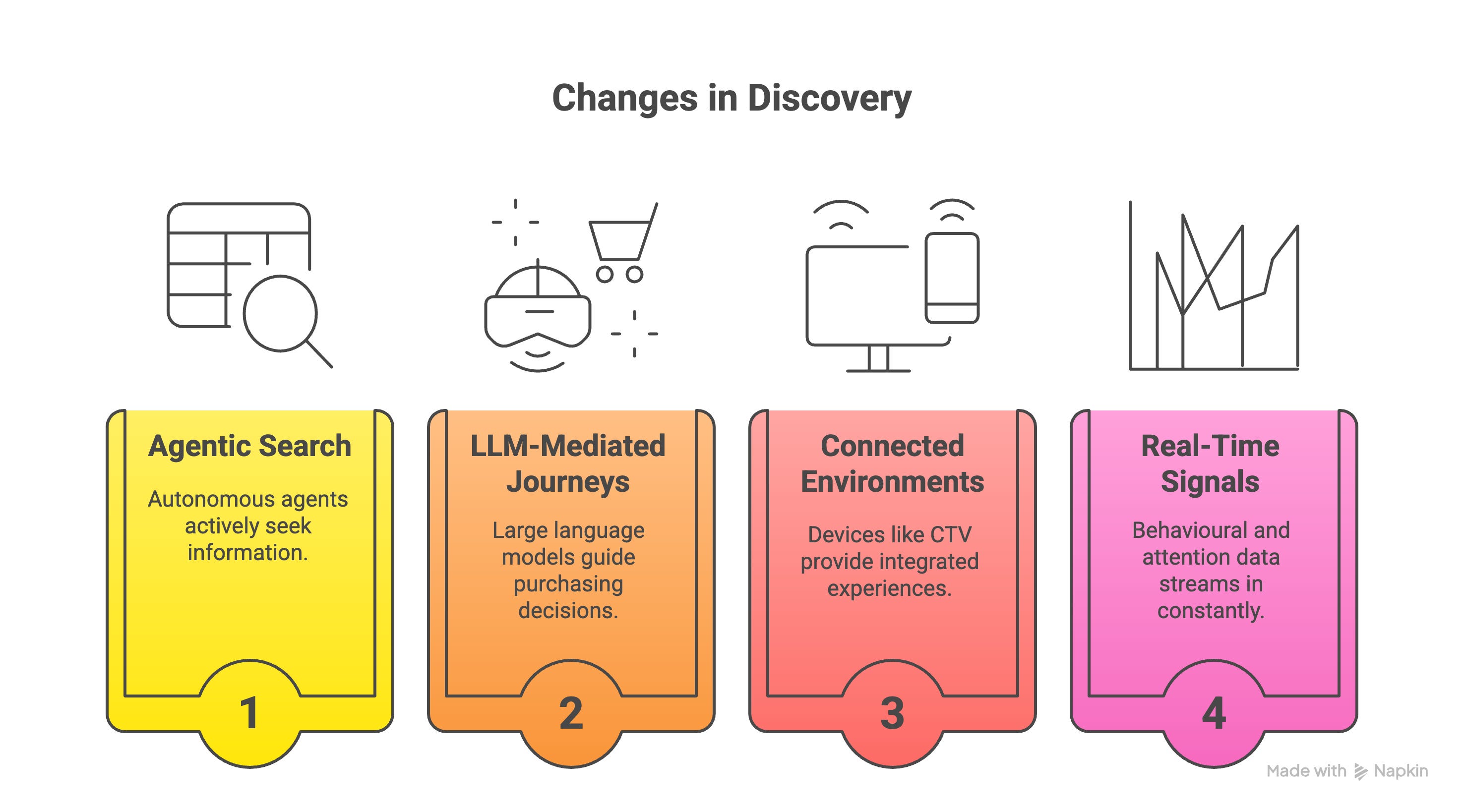
Agentic search.
LLM-mediated buying journeys.
Connected environments like CTV.
A flood of real-time behavioural and attention signals.
Together, they’ve rewritten how demand forms.
And static TALs, no matter how well researched, simply can’t keep up. They fundamentally lack the agility to really work in this new world order
Here’s the uncomfortable truth:
In the next phase of B2B, TALs don’t disappear — but they stop being the input.
They become the output of a much more dynamic system.
The original sin of TALs: mistaking intent for readiness
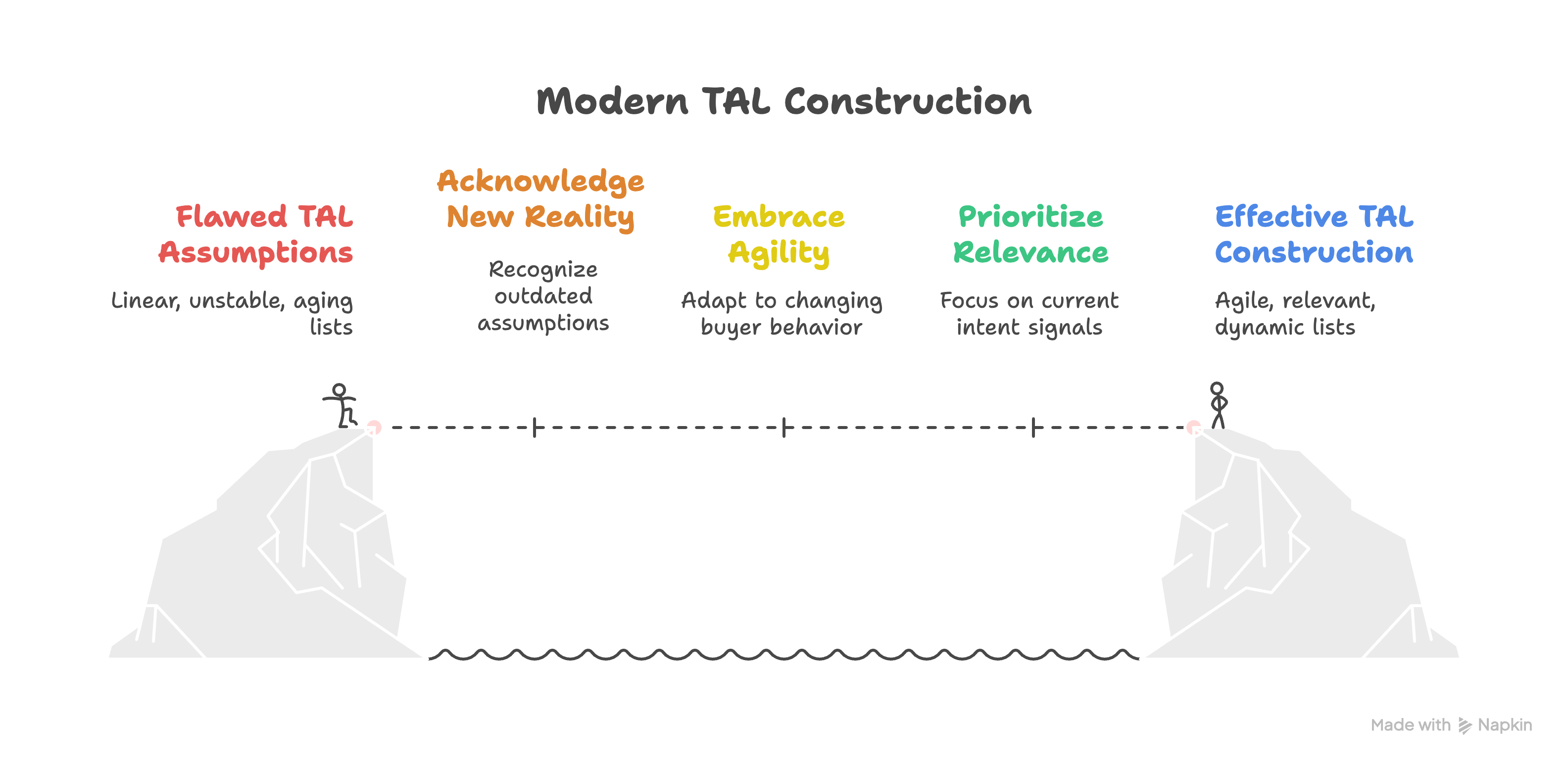
Classic TAL construction rests on three assumptions:
1. Discovery is linear
Buyer → research → shortlist → engage → buy
2. Intent is stable
If an account shows intent this quarter, it remains relevant next quarter
3. Lists age gracefully
Once defined, they decay slowly enough to be “good enough”
None of these hold anymore.
Agentic search collapses exploration, synthesis, and comparison into short, asynchronous bursts. Buyers no longer “move down funnels” in the traditional sense, they dip in and out of evaluation states, often across devices, environments, and moments that never touch your website. For all the belief that LLM and AI will collapse sales cycles, this has been the one output of the new system which we have not yet seen. These evaluations are still long, still convoluted and still take multiple offices, many, many months to reach a consensus.
So all of this means that Intent is episodic, not directional. This really is why intent needs a more dynamic team mate, one which attempts to identify the osciliations and reacts to the episodes
Static TALs most definitely do not do that, and they increasingly age fast.
The result?
Teams optimise against accounts that used to matter — not the ones that matter right now.
They then spend millions and millions of dollars smashing into these dated relics of lists when there are much better ways of doing it already available, as we explore here today
Agentic search breaks discovery and raises the bar for relevance
Agentic search doesn’t just change how buyers find information.
It changes what it means to be discoverable.
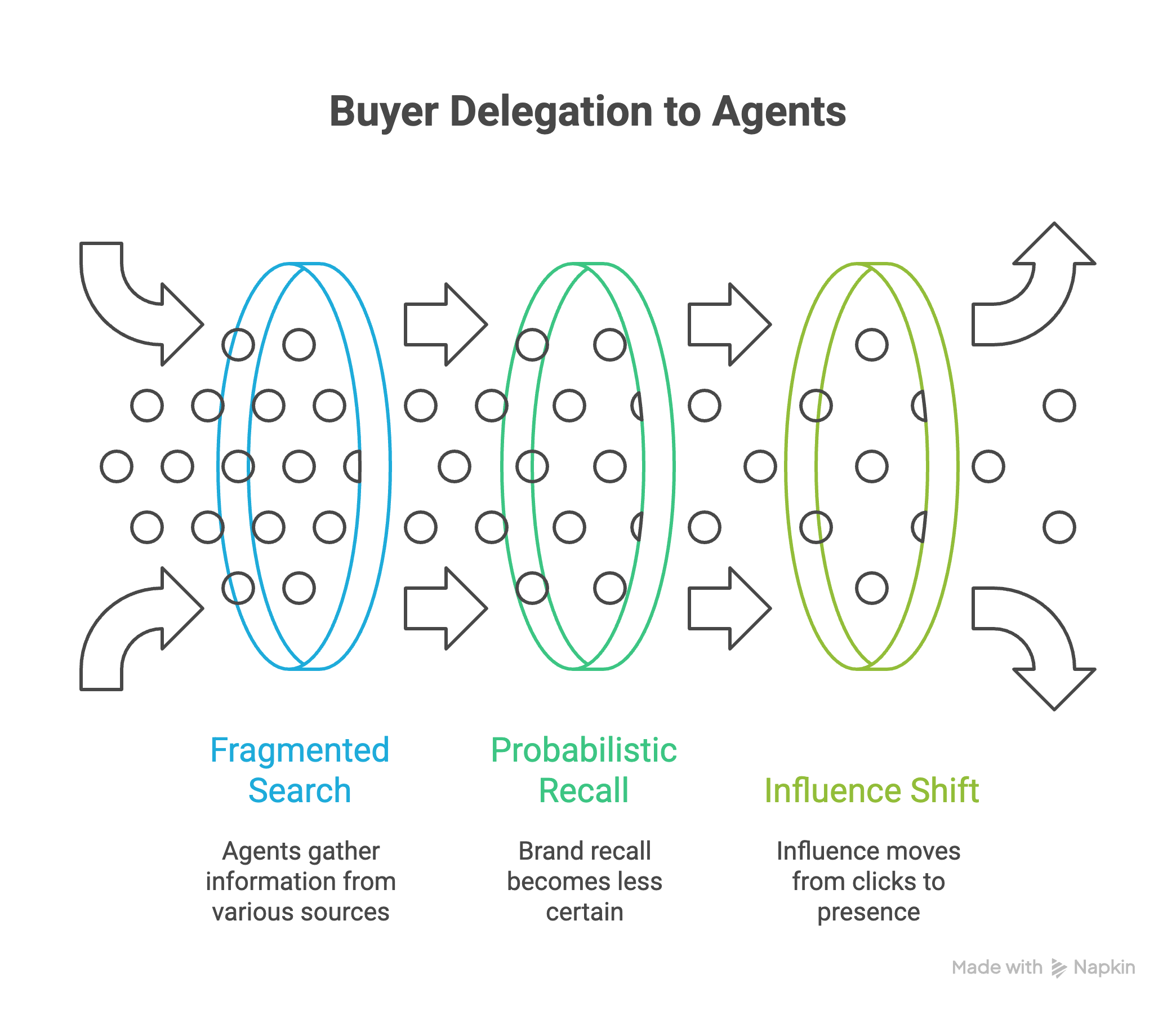
When buyers delegate exploration to agents, which make no mistake, they absolutely are already doing:
Search fragments across sources
Brand recall becomes probabilistic
Influence shifts from clicks to presence during synthesis
This creates a paradox for B2B marketers:
The more autonomous discovery becomes, the less useful static targeting becomes.
You can’t predefine relevance when relevance is being recalculated continuously by machines reacting to live signals. What we are really seeing here is a massive fragmentation of discovery paths, which in turn makes buying harder to predict, not least because of signal loss - and to compound the pain, the machines are sniffing and reacting to signal and accelerating the buying journey in such ways that, to vendors, it increasingly looks ‘random’.
Which is a very long winded way of getting to the point - it all means TALs can’t be lists anymore.
They have to become living boundary conditions.
They have to be treated more akin to a product roadmap then a CSV; a live, living entity which is being constantly kicked, tweaked and re-evaluated - and really in 2026, these ‘lists’ need to be fully dynamic
TAL hygiene is no longer list management — it’s signal governance
The next evolution of TALs isn’t about finding better data vendors or layering on more enrichment.
It’s about governance.
In a signal-rich world, the hard problem isn’t access, it’s deciding:
which signals matter
how they’re weighted
when they override static assumptions
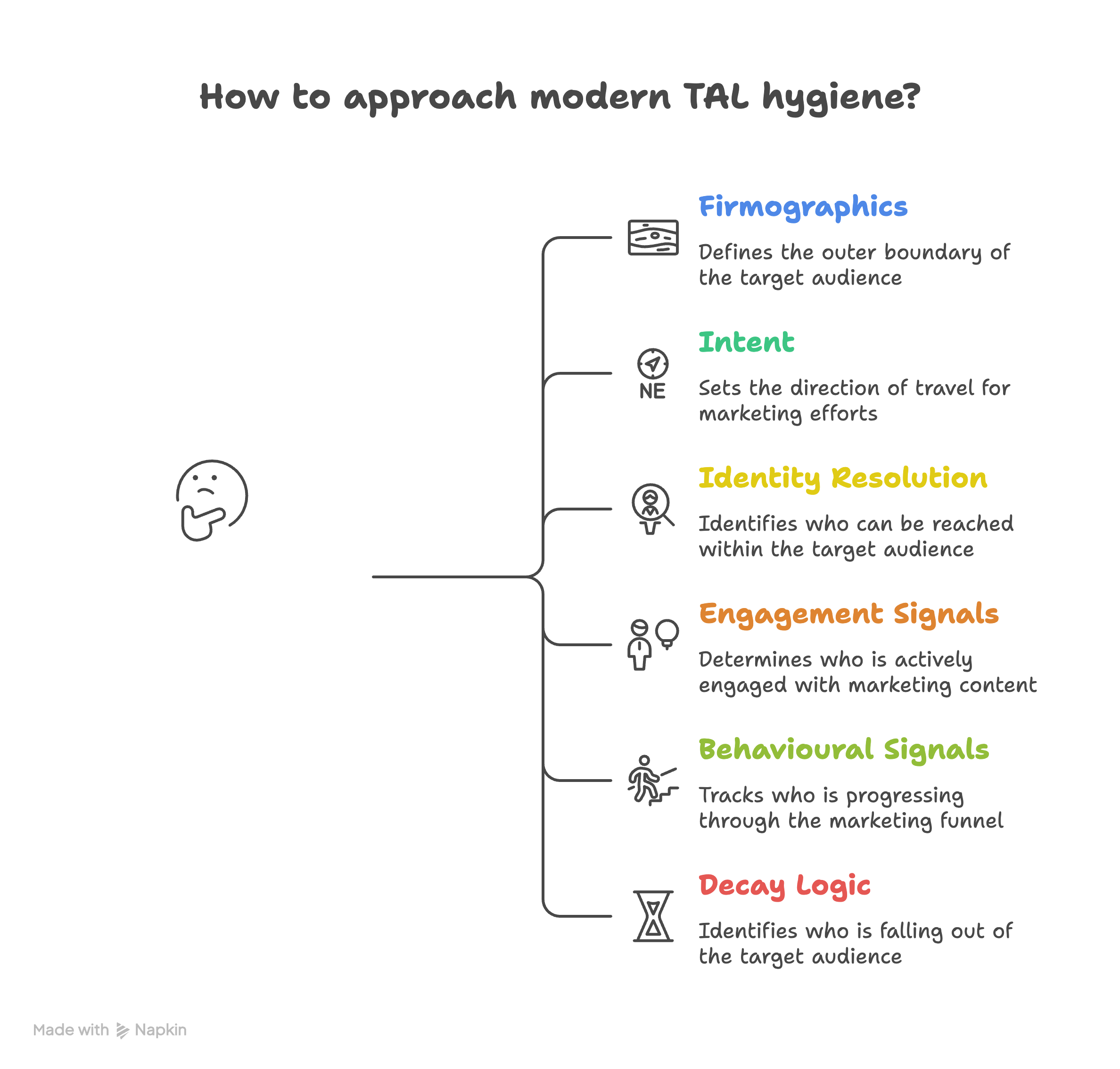
Modern TAL hygiene looks more like this:
Firmographics define the outer boundary
Intent sets the direction of travel
Identity resolution defines who can be reached
Engagement & attention signals define who is active
Behavioural signals define who is progressing
Decay logic defines who falls out
In other words:
TALs become continuously re-scored populations and not fixed audiences.
This is the shift from account lists to account states.
Why CTV matters more than most people realise
Most teams still treat CTV as upper-funnel branding.
That’s a mistake.
In connected environments:
Identity resolution improves
Signal fidelity increases
Attention becomes measurable in ways display never allowed
CTV isn’t just reach.
It’s signal amplification.
In a world where agentic discovery abstracts buyers away from clicks, environments that generate observable, attributable engagement become disproportionately valuable. Engagement and attention absolutely supersede clicks, and in a connected multi channel (omnichannel) world, we need to level the measurement and attribution playing field.
This is why CTV increasingly sits upstream of TAL evolution:
It surfaces latent interest
It validates account-level attention
It feeds behavioural signals back into the identity spine
The mistake is activating CTV against a static TAL.
The opportunity is letting CTV inform which accounts belong in the TAL at all.
Identity spines replace funnels
Funnels assume progression, but as we already explored, that progression is much harder to quantify now.
Identity spines assume observation, which is more qunatifyable and can be reacted to.
When identity becomes the organising principle, not sessions, cookies, or channels — a different operating model emerges:
Accounts enter and exit relevance dynamically, mechanically, and bloody quickly
Signals accumulate across environments
Agents act on state changes, not milestones
This is where most DIY stacks break.
Not because the tools are bad but because the middleware logic is brittle.
Without a unifying identity layer, signals fragment.
Without scoring discipline, noise overwhelms signal.
Without decay rules, TALs bloat and rot.
The future isn’t “more intent data.” however many times I read that on LinkedIn at the moment
It’s fewer, better-governed signals tied to identity. The logical answer, when I stop and think about this, is that there just are not going to be a LOT of B2B signals, at least not high governance and really high quality ones, we simply are not in a volume game
TALs don’t go away but they invert
Here’s the inversion that actually matters:
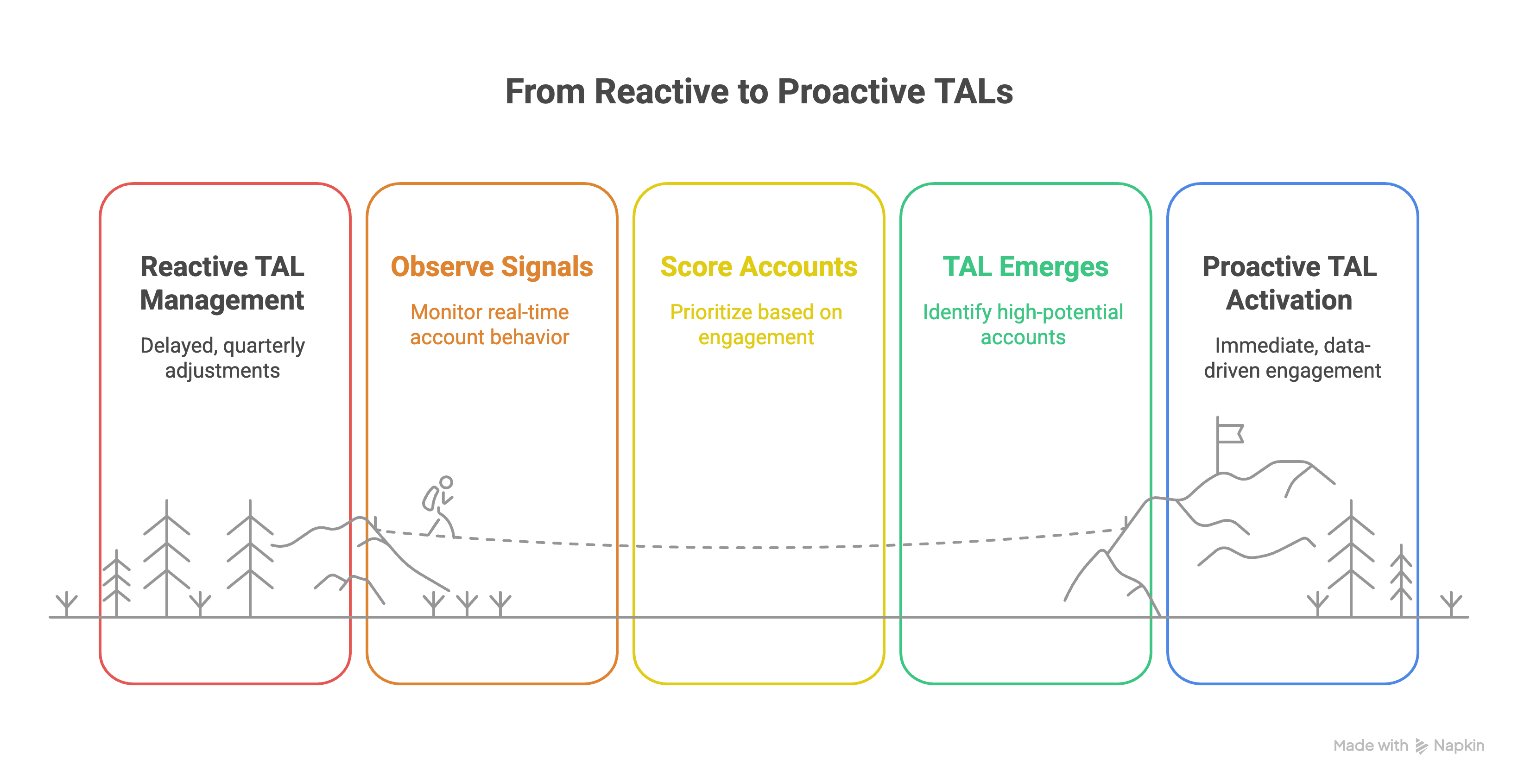
Old world
Define TAL → activate → measure → adjust next quarter
New world
Observe signals → score accounts → TAL emerges → activate immediately
In this model, TALs are no longer the starting gun.
They’re the current snapshot of a constantly shifting system.
And agentic workflows across media, sales, and ops operate against that snapshot in real time.
What this means for B2B teams right now
A few uncomfortable implications:
Quarterly TAL refreshes are already obsolete
“Intent-only” scoring will underperform
Channel-first optimisation will miss signal compounding
Static ABM dashboards will lie to you
The winners won’t be the teams with the biggest lists.
They’ll be the teams who can answer one question — continuously:
Which accounts matter right now, and why?
That’s not a tooling problem.
It’s a systems-thinking problem.
🔒 Paid: Designing a Signal-First TAL Operating Model
Up to this point, we’ve talked about why static TALs fail.
The paid question is simpler — and harder:
What does a TAL operating model look like when lists are outputs, not inputs?
Most teams instinctively reach for more tools here.
That’s the wrong move.
This shift isn’t about tooling.
It’s about control planes, scoring discipline, and governance loops.
Let’s break it down.
