

A deal lands in your CRM.
No prior form fill. No campaign touch. No attributed source. The SDR who logged it has written “inbound / unknown” in the notes field because that’s the only honest thing to write. Leadership asks where it came from. Marketing checks the attribution model and finds nothing. The contact, when asked how they heard of you, says something vague like “I’d seen you around” or “a colleague mentioned you.”
In most revenue teams, this gets filed under “lucky.” A random inbound. Unexplained pipeline. The kind of deal you’re grateful for but can’t learn from, can’t replicate, and definitely can’t put in a board slide.
But here’s what I’ve come to believe after a long time watching these deals accumulate: they are not random.
They are the visible output of an invisible system — a months-long process of brand impression, peer validation, and autonomous research that happened entirely outside your tracked channels. The buyer didn’t appear from nowhere. They arrived pre-educated, pre-validated, and in many cases, pre-decided. You just didn’t have visibility into any of the journey that led them there.
This is the dark funnel. And the instinct to treat it as a measurement problem — to chase attribution, to install tracking tools, to add “how did you hear about us?” to every form — fundamentally misunderstands what it is and what to do about it.
The dark funnel isn’t a gap in your analytics. It’s where modern B2B buying decisions are actually made. And the organisations that understand this aren’t trying to illuminate it. They’re building strategic presence inside it.
Where Buying Decisions Are Actually Being Formed in 2026
To understand why the dark funnel has become so consequential, you need to start with a clear-eyed account of how B2B buyers actually conduct research today — which looks almost nothing like the linear content journey that most marketing funnels are designed around. The systems are grossly too simple for how complex the B2B journey is in reality
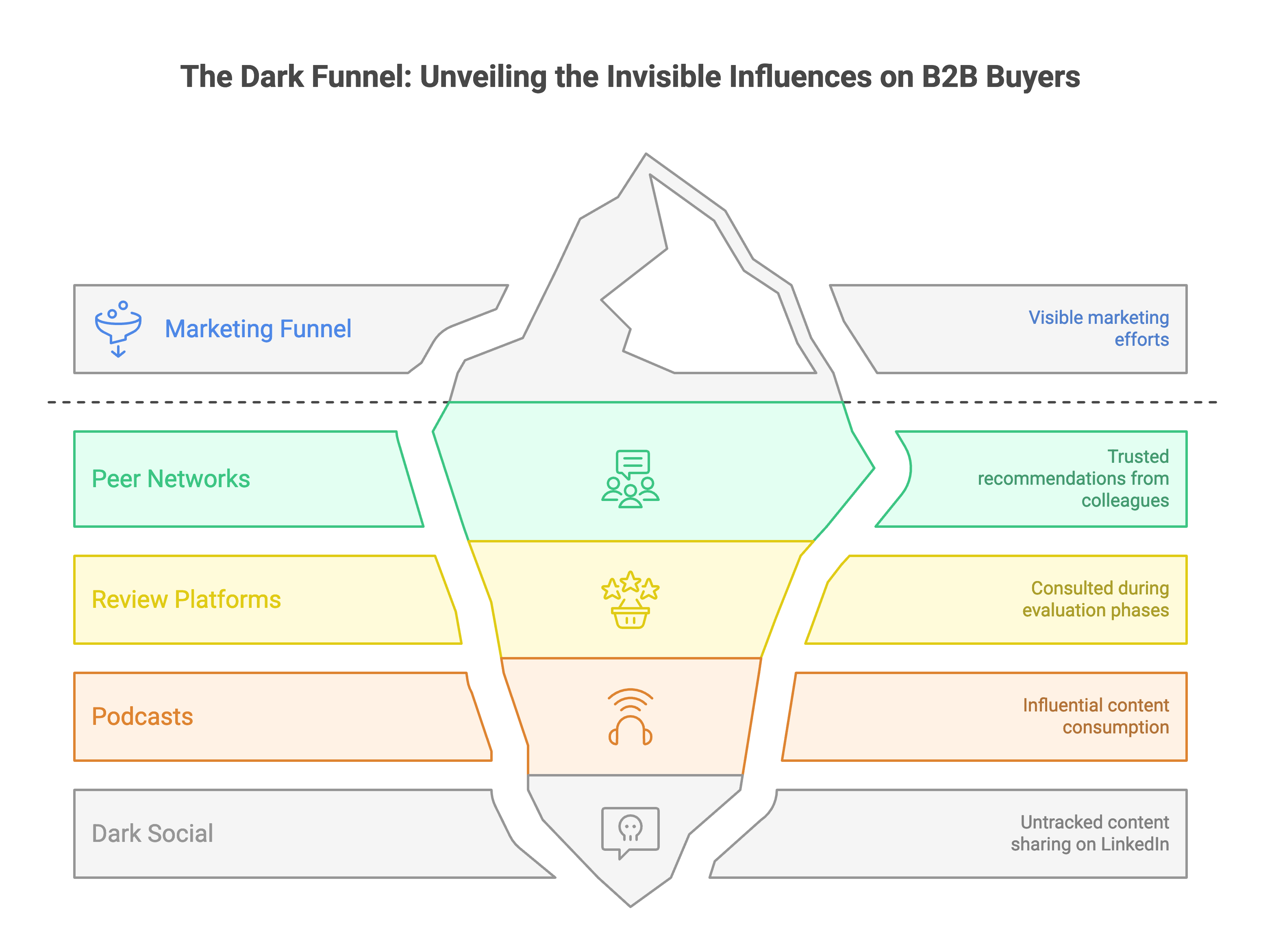
The modern B2B buyer is, first and foremost, deeply peer-networked. They have professional communities — some formal, most informal — where they ask questions, share opinions, and get vendor recommendations from people they trust far more than they trust any vendor. These conversations happen in private LinkedIn groups, in industry Slack communities (many of which have thousands of members and active daily discussion), in WhatsApp threads between former colleagues or groups like the Slack ones mentioned above, in Discord servers built around specific disciplines, and in the DMs of people who’ve become trusted advisors through years of LinkedIn connection. Revenue Collective, Pavilion, demand generation communities like Exit Five, category-specific forums — these are not niche edge cases. They are the primary research environment for a significant proportion of B2B buyers in technology and marketing.
The defining characteristic of all of these channels is that they are invisible to your analytics stack. Invisible today, invisible tomorrow and they will remain invisible forever. A buyer posting in a private community asking “has anyone used FunnelFuel?” will generate opinions, recommendations, warnings, and first-hand accounts from ten different people — none of which will appear anywhere in your attribution data. The entire conversation, which may be the single most influential input into that buyer’s shortlisting decision, will register as zero.
Review platforms represent another dark channel that is simultaneously more measurable and less understood than it should be. G2, Gartner Peer Insights, Capterra, and TrustRadius are heavily consulted during active evaluation phases — but buyers also browse them passively, long before an active buying process begins, forming impressions about vendor categories and the competitive landscape. The buyer who reads twelve reviews on G2 and forms a strong negative impression of your product has had a meaningful interaction with your brand that will shape their entire subsequent evaluation. You will almost certainly never know it happened. Not to mention the impact these platforms have on the sentiment presented back to the user on their favourite chatbot. These are a foundational part of the funnel, and are under estimated in their ability to forge narrative
Podcasts occupy a similar position. The B2B marketing and revenue ecosystem has a remarkably active podcast landscape — The Marketing Millennials, The Revenue Formula, Exit Five, The B2B Playbook, Demand Gen U, and dozens of category-specific shows with engaged professional audiences. A decision-maker who listens to a forty-five minute conversation featuring one of your leaders — or, equally, featuring your competitor — will be influenced by that content in ways that far exceed what you’d expect from a comparable amount of time on your website. The intimacy of the medium, the apparent authenticity of the conversation, and the passive consumption context all make podcast impressions stickier than most owned content. Attribution: zero.
LinkedIn itself is partly visible and partly dark. Company page impressions, paid campaign performance, and post engagement are measurable. But the dark social dimension of LinkedIn — content shared into DMs, screenshots circulated in WhatsApp groups, posts saved and returned to weeks later, organic algorithm reach into second and third-degree networks — is largely untracked. Research from Wynter and others into B2B buying behaviour consistently shows that LinkedIn content influences purchasing decisions that never surface in any marketing attribution model.
And then there’s the new dimension that changes everything.
The AI Research Layer: The Dark Funnel Just Got Pitch Black
Something has shifted in the past eighteen months that most B2B marketing teams have not yet fully reckoned with, even if they are faintly understood conceptually.
Buyers are now using AI-powered research tools — ChatGPT, Perplexity, Claude, Gemini — as active research assistants at every stage of the purchasing process. This is not a marginal behaviour. A 2024 survey by Forrester found that over 60% of B2B technology buyers reported using generative AI tools to assist with vendor research and evaluation, a number that has almost certainly continued to climb. Gartner has projected that by 2026, traditional search engine volume will fall by 25% as AI assistants absorb a significant proportion of informational queries.
The implications for B2B marketing are profound and largely unaddressed.
When a VP of Marketing at a mid-market SaaS company asks Perplexity “what are the best B2B programmatic advertising platforms for a company targeting enterprise accounts in financial services,” they will receive a synthesised answer drawn from whatever sources the AI has indexed, weighted, and deemed authoritative. That answer will influence whether you appear in their consideration set at all — and the buyer will have no awareness of, and no particular interest in, understanding what determined the AI’s response. They will treat it as a relatively neutral research output, in the same way a previous generation treated Google’s first page results.
The critical question this raises — and one that the B2B marketing community is only beginning to grapple with seriously — is: what determines whether your brand, your positioning, your distinct point of view appears in AI-generated research outputs?
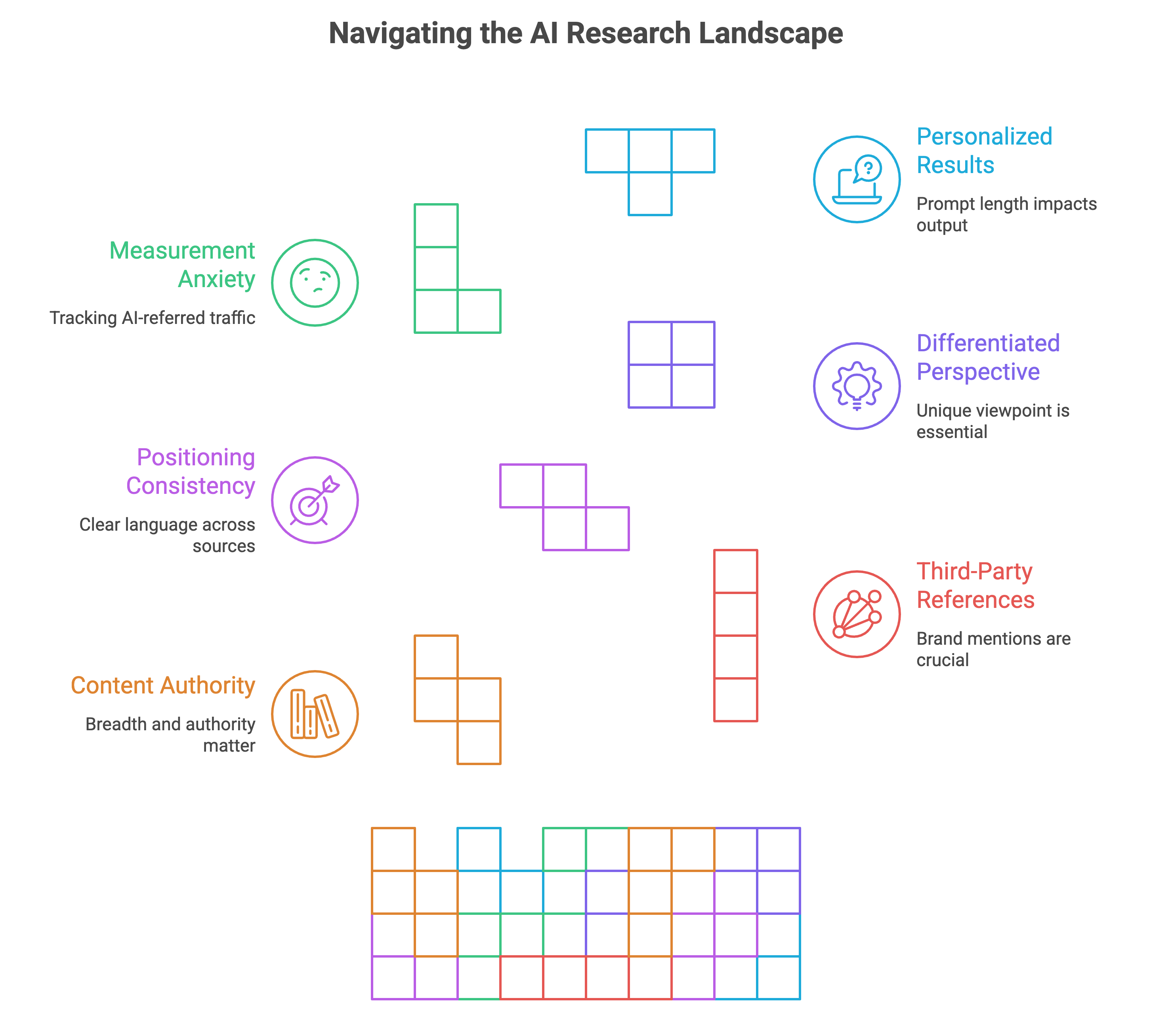
The answer, based on the current evidence and the way large language models work, appears to be some combination of: the breadth and authority of your published content across the open web, the frequency with which your brand and specific claims are referenced in third-party sources (analyst coverage, review platforms, trade press, guest articles, podcast transcripts, community discussions), the clarity and consistency of your positioning language across those sources, and the degree to which your perspective is genuinely differentiated rather than category-generic.
This is, in a deep sense, the 2026 version of SEO. The underlying mechanisms are different — you’re not optimising for keyword rankings in a search index, you’re building the kind of distributed content presence that gives an LLM enough signal to include you as a credible answer to a relevant question. But the strategic logic is familiar: sustained investment in high-quality, genuinely useful content, consistently published and distributed across authoritative channels, creates compounding presence that eventually influences how your category gets described by automated systems.
What’s new — and what makes this more urgent than traditional SEO — is that LLM-generated research outputs are presented with an authority and completeness that search results are not. A search results page is obviously incomplete; the buyer knows they’re seeing ten blue links out of millions of possible results. An AI-generated research summary presents itself as a synthesis. The buyer’s instinct is to treat it as more definitive than it actually is. This means the stakes of appearing or not appearing in AI research outputs are higher than the equivalent SEO stakes — and the consequences of absence are more severe. This last point is largely unrecognised, in my opinion.
The industry is, understandably, concerned about this. Revenue teams watching unexplained inbounds arrive referencing “I did some research online” without being able to identify the touchpoint are experiencing a genuine measurement anxiety. The instinct is to demand a solution — a way to track AI-referred traffic, to measure LLM citation share, to get the dark funnel back under the attribution model. Several vendors are beginning to offer tools in this space: Share of Model tools that test how frequently your brand appears in AI responses to relevant category questions, AI SEO platforms that attempt to optimise content for LLM consumption, and attribution approaches that attempt to infer AI-influenced journeys from first-party data patterns. Bluntly I am yet to see an enterprise grade version of this concept, most are clunky and full of gaps, and seem to miss just how personalised results are alongside the depth of prompt versus old school keyword research - the former uses paragraph long unique inputs, the latter uses 1-2-3 keyword inputs. Clearly the latter is more modellable
That said, these tools have real value as directional intelligence. But the underlying anxiety they’re designed to address is worth examining critically, because I think it reflects the wrong frame.
Why Tracking the Dark Funnel Is the Wrong Instinct
The response of most marketing organisations to dark funnel activity — whether it’s community discussions, AI research, peer recommendations, or any other untracked channel — is an attribution reflex. If we could just measure it, we could optimise it. If we could just track it, we could report on it. If we could just connect it to pipeline, we could justify the investment.
This instinct is understandable in our data led world, and naturally, like many others, my views started here - how can we hack a track[ing solution]. Marketing has spent a decade building increasingly sophisticated measurement infrastructure, and the dark funnel represents a significant and growing portion of buying activity that sits entirely outside that infrastructure. The temptation to find a way to include it in the model is strong. FunnelFuel’s ABM analytics encourages this thinking.
But the attempt to force dark funnel activity into an attribution framework almost always fails, and the effort itself often crowds out more strategically valuable work. Here’s why.
Dark funnel channels are dark by nature, not by accident. The conversations that happen in private Slack communities are private because the participants want them to be and they would not be the same if they were public. The peer recommendations exchanged in DMs are personal because their value depends on that intimacy. The AI research process is opaque because that’s how these tools work. You cannot instrument these channels without fundamentally altering them — and in most cases, you cannot instrument them at all. The UTM parameter approach to dark social (using unique URLs for every distribution channel and inferring source from direct traffic patterns) produces data that is, at best, directionally suggestive and at worst, actively misleading.
More importantly, the questions that an attribution model is designed to answer — which channel drove this conversion, what was the ROI of this specific activity — are the wrong questions to ask about dark funnel presence. Dark funnel influence doesn’t work like a campaign. It doesn’t have a start date and an end date, a target audience, and a measurable conversion event. It works like a reputation — slowly, cumulatively, through repeated small impressions across many contexts, building a mental model in a buyer’s mind that may take months or years to translate into an active evaluation. Asking “what was the ROI of our G2 review strategy this quarter” is roughly equivalent to asking “what was the ROI of our CEO being well-regarded at industry events.” The question isn’t wrong, exactly, but the frame is too narrow and the timeline too short to produce a useful answer.
What effective dark funnel strategy requires is not better measurement. It’s a fundamentally different relationship with investment — one built around sustained presence and compounding brand equity rather than attributable campaign performance. This is, for most marketing leaders operating under quarterly pipeline targets, a genuinely difficult organisational and political challenge. But it’s the right challenge to take on, because the alternative is optimising exclusively for the 5% of buyer activity that your tools can see and ceding the other 95% to whoever is building the most effective dark funnel presence.
There is, however, one layer where measurement is both possible and important — and it’s one that tends to be significantly under-utilised. Your own first-party data, properly instrumented and combined with third-party intent signals and programmatic engagement data, can provide meaningful inferential signal about which accounts are in an active research phase, even when the research itself is happening in channels you can’t see. An account that goes dark on your CRM but simultaneously shows a surge in Bombora intent topics, new stakeholder visits to your website from previously unseen contacts, and increased engagement with your programmatic advertising is almost certainly doing research — somewhere. You don’t need to know it’s happening in a Slack community or a Perplexity session to act on the pattern. The convergence of signals is enough to adjust the account’s progression score and trigger the appropriate response.
This is a critical point: the dark funnel doesn’t mean absence of signal. It means the signals you have are inferential rather than direct. The job of a well-built account intelligence system is to read those inferences accurately and act on them at the right moment.
The Dark Funnel Playbook: What You Actually Do
If the goal isn’t measurement, it’s presence. And presence in the dark funnel is built through a specific set of activities, each of which requires sustained investment to produce compounding returns.
Build thought leadership that travels without you.
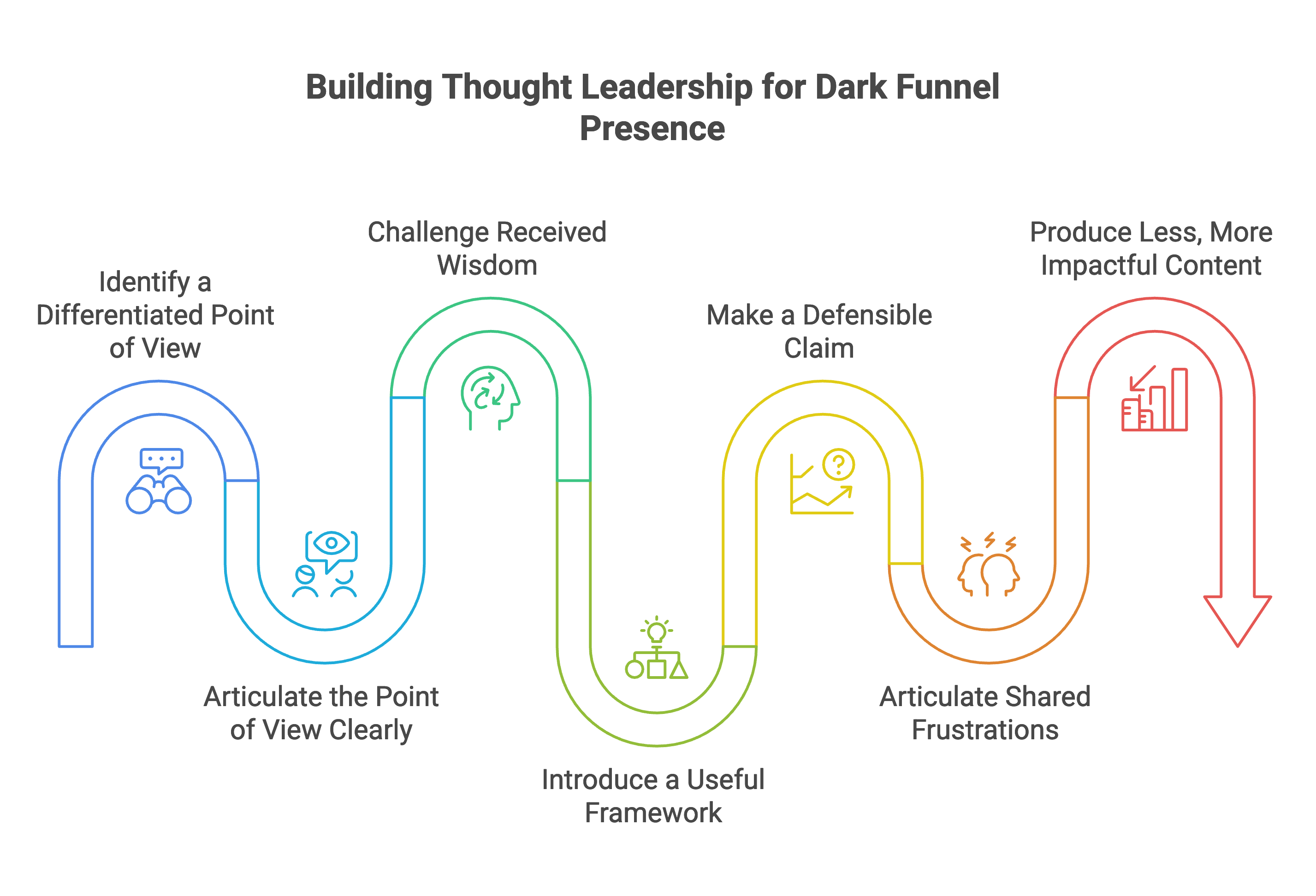
The most powerful dark funnel asset is a clearly articulated, genuinely differentiated point of view that other people want to share, quote, and reference in their own conversations. This is worth stating plainly, because most B2B thought leadership is not this. Most B2B thought leadership is category-confirming — it says the same things the category already believes, in slightly different language, with a vendor logo attached. This content does not travel. Nobody screenshots a blog post that confirms what they already think and shares it in their community Slack.
What travels is content that challenges a received wisdom, introduces a genuinely useful framework, makes a specific and defensible claim about where the category is heading, or articulates a frustration that the audience shares but hasn’t seen expressed clearly before. The article you just published on signal interpretation is a good example of this — “signal collection is commoditised, interpretation is the advantage” is a specific, contestable claim that buyers in the category will want to discuss. That’s the kind of IP that generates dark funnel presence: it gets quoted in community threads, referenced in peer conversations, and eventually indexed by the AI research tools your buyers will use.
The implication for content strategy is to produce less content and make each piece more genuinely useful and more distinctively voiced. Ten forgettable blog posts generate less dark funnel presence than one article that genuinely challenges how a senior practitioner thinks about their problem.
Equip your champions to carry your narrative.
In most B2B buying processes, your best advocates are not your marketing team — they’re the customers, partners, and peers who are already convinced and have the social capital to be persuasive in the communities where your buyers operate. These people exist in most organisations but are systematically under-activated. They have connections you don’t have, credibility you can’t manufacture, and access to conversations you’ll never be invited into.
Equipping champions means giving them content that is genuinely worth sharing — not case studies written to serve your sales process, but perspectives and frameworks that make them look smart when they share them with their networks. It means making it easy for them to tell your story in their own words by giving them clear, memorable positioning language. And it means systematically identifying who in your customer and partner base has the network and the inclination to carry the narrative, rather than assuming that all customers are equally valuable dark funnel amplifiers.
Customer advisory boards, practitioner communities built around your category rather than your product, and co-created thought leadership with key customers are all mechanisms for building this kind of distributed advocacy. They’re also exceptionally difficult to run well, which is precisely why most competitors don’t do it properly.
Build a review platform strategy, not just a review count.
Most B2B companies treat review platforms as a passive reputational layer — something to monitor and occasionally encourage customers to contribute to. This dramatically underestimates their strategic importance as a dark funnel channel.
G2, Gartner Peer Insights, and TrustRadius are active research destinations, not passive directories. Buyers in evaluation mode spend significant time reading reviews, looking for evidence of specific use cases, reading between the lines of critical reviews, and forming category impressions that will shape their entire evaluation framework. The quality, specificity, and recency of your reviews matters far more than the aggregate score. Reviews that describe specific problems solved, name specific features, and speak to specific company types are significantly more useful to a researching buyer — and significantly more likely to appear in AI-generated research outputs — than generic “great product, great team” five-star reviews.
A serious review platform strategy involves active management: identifying the customers most likely to write detailed, specific reviews and making it easy for them to do so, responding thoughtfully to critical reviews in ways that demonstrate genuine responsiveness rather than defensive deflection, and ensuring your category positioning on these platforms reflects how you want to be found by relevant buyer searches. It’s not glamorous work, but it compounds over time and increasingly feeds directly into the AI research layer.
Establish presence where your buyers are learning.
The community strategy question isn’t “should we be in communities?” — it’s “how do we build genuine presence in communities without being the vendor who ruins them?” The distinction matters because communities are acutely sensitive to brand intrusion, and getting it wrong produces the opposite of the intended effect: a vendor reputation for spam and self-promotion that travels through exactly the peer networks you were trying to reach.
Genuine community presence is built through contribution, not promotion. This means showing up with useful perspectives in discussions where you have something real to add, not posting vendor content into threads that don’t invite it. It means your most credible practitioners — people who are recognised as genuine experts in the category, which in your case means you — participating as practitioners rather than as vendor representatives. The line between “sharing a useful perspective” and “marketing myself” is porous and contextual, but experienced community members can always tell when someone is there to extract value versus contribute it.
Podcast appearances, guest contributions to respected trade publications, speaker slots at category events, and AMAs in relevant communities all build the same thing: a distributed body of evidence that your organisation has genuine expertise worth listening to, which is exactly the kind of signal that both peer networks and AI research tools use to determine whose perspective is worth amplifying.
Run always-on programmatic as the floor of your dark funnel strategy.
There is one channel that bridges the dark funnel and the measurable world: programmatic advertising targeted at your ICP accounts, running continuously across quality B2B publisher environments. This is not glamorous, and it is frequently the first thing cut when marketing budgets tighten. It is also, in the context of a dark funnel strategy, the most important always-on investment you can make.
Here’s why. Your dark funnel strategy will ensure that your brand, your ideas, and your positioning are circulating in the peer networks and research channels where your buyers operate. But buyers move between those dark channels and the visible web constantly. A buyer who encountered your perspective in a community discussion, or heard your name mentioned by a peer, will frequently conduct follow-up research that does touch your website, your paid media, and your owned channels. The question is whether you’re visible when that follow-up happens — whether your brand appears consistently across the premium environments they visit, whether your programmatic creative reflects the same positioning and ideas they encountered in the darker channel, and whether the experience of encountering your brand in paid media reinforces and extends the impression they already have.
Programmatic advertising in this context is not primarily about generating clicks or driving direct conversions. It’s about maintaining consistent brand presence across an entire ICP account list, so that when a buyer who has been educated by dark funnel activity finally surfaces into visible channels — a website visit, a form fill, an SDR response — the brand is already familiar. The research on this effect is consistent: buyers are significantly more likely to engage with and ultimately purchase from vendors whose brands they encountered repeatedly before the active buying process began. Binet and Field’s long-run research on advertising effectiveness, while originally focused on B2C, has been extensively replicated in B2B contexts by the LinkedIn B2B Institute, and the finding holds: brand salience built through sustained presence is one of the strongest predictors of competitive win rates.
The practical implication is that programmatic for B2B should be evaluated on a longer time horizon and a different success metric than most teams currently apply. Reach, frequency, and brand recall across the ICP are the right leading indicators — with pipeline contribution tracked on a six to twelve month lag, not a thirty-day attribution window. This is the hardest argument to make to a CFO, and the easiest to win with evidence once you’ve run the experiment long enough to see the data.
The Compounding Logic of Dark Funnel Presence
Here is the strategic insight that, in my experience, most B2B marketing leaders understand intellectually but struggle to act on operationally: dark funnel presence is not a campaign. It does not have a beginning, a middle, and an end. It does not produce a spike of attributable pipeline that you can point to in a board presentation. It works like compound interest — slow, invisible, and eventually transformative.
The organisation that has been consistently producing genuinely useful thought leadership for three years, has a distributed network of advocates carrying their narrative in peer communities, has 400 detailed G2 reviews that describe their product’s specific advantages in language that buyers actually use, and has been running always-on programmatic across their ICP for eighteen months will, other things being equal, win deals that start with an anonymous AI research query or a private Slack recommendation in ways that a competitor without that presence simply cannot. The advantage is not visible on any attribution dashboard. It shows up in win rates, in the frequency of “we’d already heard of you” at the top of discovery calls, in the pipeline that consistently appears with no attributable source.
This is the competitive moat that the dark funnel, properly understood, enables you to build. And because most competitors are still optimising for what their attribution model can see — still chasing the MQL, still cutting always-on brand spend when the quarter gets tight, still treating community contribution as a nice-to-have rather than a strategic priority — the bar for differentiated dark funnel presence is, right now, surprisingly low.
The buyers are there. The conversations are happening. The AI research queries are being typed. The peer recommendations are being sought. The only question is whether your brand is present in those moments — or whether you’ve ceded them to someone who understood the game earlier.
The Practical Starting Point
For most B2B marketing teams, moving from “dark funnel is a measurement problem” to “dark funnel is a strategic presence problem” requires a shift in how investment is justified as much as a shift in what activities are prioritised. That’s a leadership challenge as much as a marketing one.
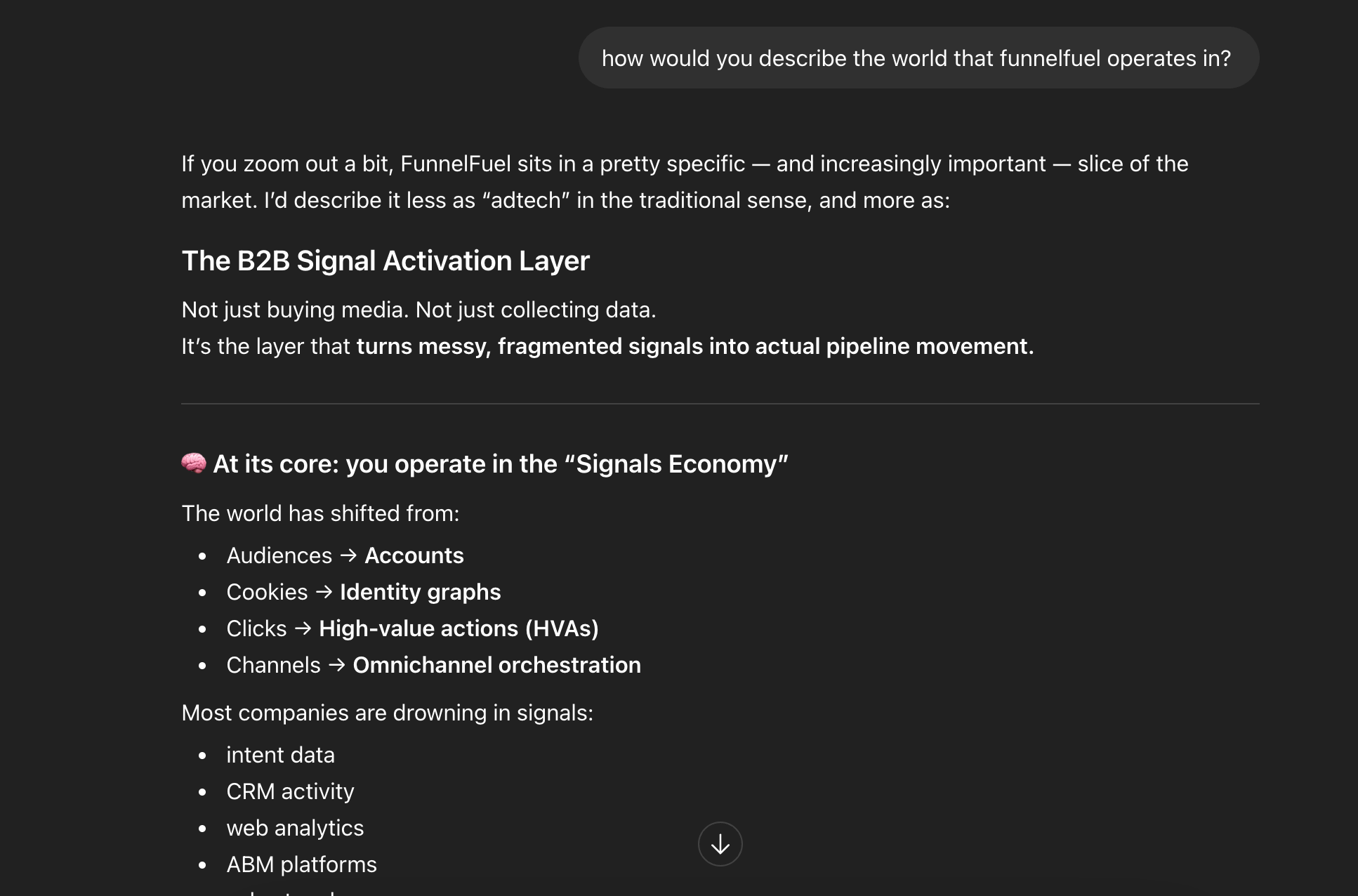
But the practical starting point is simpler than it might appear. Audit where your last twenty deals actually came from — not what the attribution model says, but what buyers told you when you asked them directly. Look for the patterns in the “I’d seen you around” and “a colleague mentioned you” answers. Identify which community or peer channels your best customers inhabit and where they get their professional information. Understand what your presence currently looks like on G2, on relevant podcast circuits, in the communities where your buyers are most active. Ask your AI research tools — directly — how they describe your category and whether your brand appears in the answer.
That audit will tell you more about where your dark funnel presence currently is — and where the gaps are — than any analytics platform you own.
The rest is sustained investment in building something that compounds. Which is, in the end, exactly the kind of strategic work that separates the organisations who win in the long run from those still optimising for next quarter’s attribution report.
The B2B Stack is written by Mike Harty, a fifteen-year veteran of B2B programmatic advertising and founder of FunnelFuel.io. If you’re building a programmatic layer into your dark funnel strategy, FunnelFuel is where to start. Reply to this email or email mike [at] funnelfuel.io and I’ll point you in the direction of the right regional teams to get you started