

Free report: “5 Things $39.6M in B2B Programmatic Spend Taught Us.” Three years of managed spend and a billion tracked page loads, turned into five findings platforms won’t put in a pitch deck. Subscribe free to unlock it, plus every new issue of The B2B Stack.
Join 1,600+ B2B marketers, including readers at Dentsu, HubSpot, 6sense, Informa and DirecTV.
What you’ll learn in this article:
Why “data intelligence” - a phrase getting a lot of air time at MadFest this week - actually means something specific, and why most of B2B programmatic doesn’t have it
Why pre-canned, single-vendor segments deployed buy-side are the ceiling most B2B programmatic is quietly stuck under
What a multi-signal, machine-learned approach to B2B audience construction actually looks like in practice
Why “agentic” isn’t a buzzword here either - it’s arriving now, and it needs a fundamentally different data foundation to work
How sell-side containerisation and auction pre-looks unlock B2B-relevant impressions your DSP currently can’t even see, opening up bidstream modelling to maximise what programmatic can deliver for you
Why precision, not scale, is about to become the metric that separates winners from everyone still buying by volume
MadFest London ran this week under the banner “The Human Touch” — built explicitly as a reaction against generic, AI-slop marketing, and a push for something with more genuine intelligence behind it. According to my team whoa attended, data intelligence came up constantly on the stages and in the side conversations. Everyone’s using the phrase. My sense is, almost nobody defines it.
That’s a problem, because “data intelligence” is not a synonym for “more data,” and it isn’t a synonym for “AI.”
It’s a specific, technical claim: that a system understands the confidence level behind what it’s telling you, because it has reconciled multiple independent sources against each other rather than trusting any one of them at face value.
By that definition, most of what gets sold as B2B data intelligence today isn’t intelligence at all. It’s volume with a dashboard on top.
Here’s the belief I want to pick a fight with: that the frontier of B2B programmatic is a better deal ID.
It isn’t. A deal ID is a container. What’s inside it is what matters, and right now, what’s inside most of them is exactly what’s been inside them for five years — a single vendor’s pre-built segment, packaged up, given a shinier wrapper, and deployed sell-side as if that constitutes innovation. It doesn’t. It’s the same bland, off-the-shelf intent taxonomy everyone else is buying, just curated into a nicer box. Call it AI-enriched if you like. It’s still one signal, alone, dressed up. The absolute biggest and best potential win doing this is a bit more scale and a more hygienic starting point for the signal, both of which are great nudges forward, but they are not the quantum leap that we’re discussing here today
The industry has spent so long fighting over access to signal that it’s barely started fighting over quality of signal — over actual data intelligence, in the strict sense. That’s the fight that actually matters now, and it’s the one most vendors aren’t equipped for.
Its THE fight because the agentic promise of tomorrow is fast arriving today, and this changes the programmatic game from valuing scale towards lining up behind a currency of outcomes - and outcomes requires quality whereas the former rewarded volume [behind a data segment. This is a night to day shift
The single-vendor ceiling
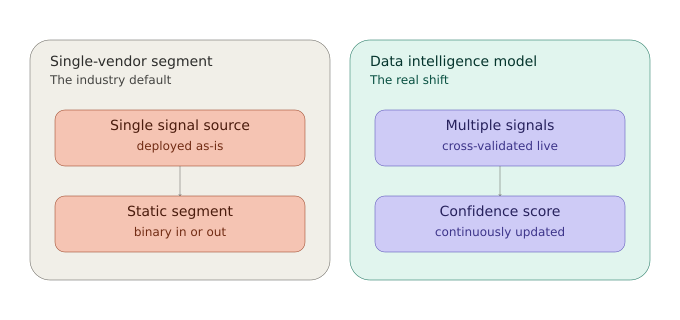
Every B2B data vendor sells you their view of the world. Intent data from one provider. Firmographic scale from another. A technographic layer from a third. Bought individually, or bundled by a platform that’s really just reselling the same handful of underlying sources with a different UI on top.
The problem isn’t that this data is bad. Some of it is genuinely good, and pockets of these segments are usually highly accurate. The problem is that any single vendor’s signal, taken in isolation, is a proxy — a best guess at in-market behaviour, built on whatever data that one vendor happens to have visibility into. Deploy it on its own and you’re not finding the accounts most likely to buy. You’re finding the accounts that look most like the vendor’s training set.
That’s the bland segment. It’s not wrong, exactly. It’s just low-resolution, and low-resolution is no longer good enough.
There is also a mis-marriage of intentions. Any vendor selling their data on a cost per thousand (CPM) will of course be rewarded for delivering scale. The more scale they can give you, the more you can spend against it and the more revenue they generate. When the buyer (the advertiser or agency representing them) wants to deliver outcomes, they need precision.
Part of the data intelligence game is identifying the pockets of the very most accurate and fresh signal within each data vendor, and leveraging that, filling in the gaps with the very best of the other data partners in a giant venn diagram. This delivers a rare premise - scale AND accuracy. It also involves getting your hands dirty, signing lots of contracts, taking on lots of fixed costs and doing a lot of quite challenging work. The reward though is a much more accurate data graph
What data intelligence actually requires
Therefore the alternative isn’t “more data.” It’s a different relationship with the data you already have access to and it’s considerably harder to build than anything a single-vendor segment requires.
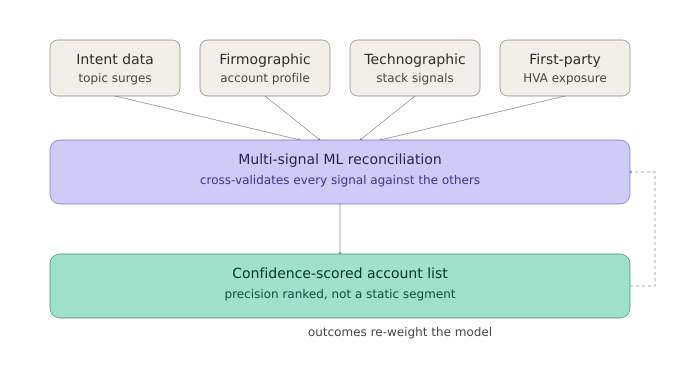
Take multiple signal sources — intent, firmographic, technographic, first-party behavioural, account-level exposure history — and instead of deploying any one of them at face value, machine learn across all of them simultaneously. This means building a weighted, probabilistic confidence layer that sits on top of the account graph: each signal is treated as an independent, imperfect estimator, cross-validated against every other signal for that account, with the model continuously re-weighting each source based on how well it has historically correlated with actual pipeline outcomes for that specific vertical, deal size, and buying-stage cohort.
An account showing Bombora-style topic surges and first-party high-value-action behaviour and a firmographic profile that matches your best closed-won cohort produces a compounding confidence score entirely unlike an account showing just one of those three in isolation, and that compounding, not any single input, is what data intelligence is actually referring to.
This is the actual gold-mining exercise. Not “which vendor has the most segments” but “which combination of signals, weighted and validated against each other via a continuously re-trained model, produces the highest-confidence account list, expressed as a probability rather than a binary in-segment/out-of-segment flag.” The output isn’t a segment. It’s a live model — one that gets sharper the more outcome data you feed back into it, because you’re measuring account-level pipeline progression against high-value actions, not proxying success from a click, and feeding that delta back upstream to re-calibrate the signal weightings themselves.
This is the part most “programmatic for B2B” content skips entirely, because building it requires the kind of infrastructure most vendors simply don’t have: a proprietary account graph to sit signals on top of, a machine learning layer to reconcile them against each other rather than deploying them one at a time, and enough closed-loop outcome data flowing back from CRM to actually validate the model rather than just assert it. Most vendors have one of those three. Very few have all three.
This also comes all the way back to the overarching premise that I have believed worked in this industry since 2011 - programmatic and ‘adtech’ focussing on the bigger and easier budgets behind B2C and not the smaller and complex world of B2B. Therefore the appetite to get into this sort of stuff, even by some of the slightly more B2B leaning generalists in the space is often lacking.
Below is what replaces the bland segment, and how it works in practice.