

I’d have put money on this one. Ask a room full of B2B marketers how many of their peers run out of home and I’d have guessed low, single digits maybe, a rounding error next to LinkedIn and paid search. I’d have lost that bet, and lost it badly. Forty six percent of B2B companies are already running OOH. That’s not a niche channel. That’s damn near half the market.
In case you’re wondering what I am talking about, here is an example that we ran in NY in August to support some innovation sessions
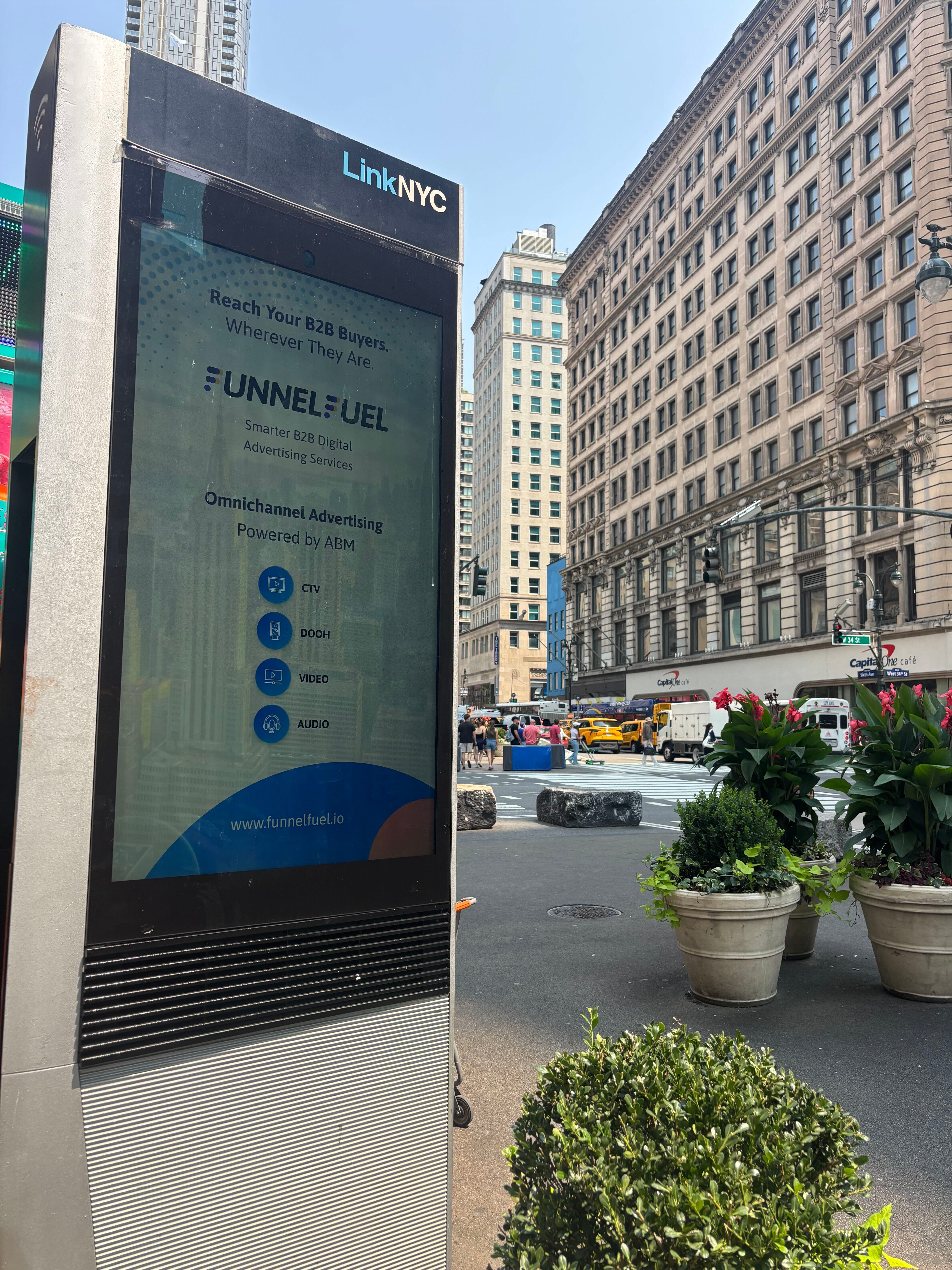
So the wrong belief isn’t “B2B doesn’t do billboards.” It’s the belief sitting underneath most B2B media plans without anyone examining it: that the channel itself is the barrier. It isn’t. The barrier is that almost everyone running it is buying a consumer product and hoping it behaves like a B2B one. Broad polygons. Generic footfall. Bought like reach, measured like nothing, aimed at nobody in particular. Ouch, fortunately there is a better way
This isn’t an abstract argument for me. We’ve been running DOOH ourselves this week in New York, supporting some big meetings on the ground. FunnelFuel on a billboard on 34th Street isn’t what you’d expect to see, and that’s exactly why it lands.
It meant nothing to 99.9% of the people who walked past it. It wasn’t supposed to. We were seeking impact from a small, incredibly relevant handful, and I’d take a passing glance from one of them as a big win. An array of m NY team have all been in pitches and innovation sessions this week that the same screens were deployed to run behind their efforts. It’s the kind of thing that’s aided pitches before, amplified events before, built credibility for us before. I’m a believer, and I want to make the case for why properly aimed.
New here? I’m Mike, founder and CPO of FunnelFuel, a B2B-native programmatic business. I’ve spent fifteen-odd years building the DSP, SSP and exchange infrastructure underneath the adtech everyone else buys off the shelf, and I write The B2B Stack from that vantage point: fewer hot takes, more of the plumbing.
If this is your first issue, two pieces sit closest to today’s topic. The Account Graph: Reach Graph or Proof Graph? unpacks the infrastructure this piece leans on throughout. Steering the Dark Funnel makes the parallel argument for paid media’s credibility role in the buyer journey, DOOH included.
Get next week’s argument on where B2B programmatic actually has an edge, straight to your inbox.
What you’ll learn in this article:
Why I think about DOOH as “in-the-moment advertising,” a close cousin of contextual, and what that framing actually buys you
Why the billboard is the oldest attention format in advertising, and what changed when it went digital
How programmatic DOOH targeting works today, and why “targeted” means something structurally different here than in display or CTV
The real adoption numbers behind B2B out of home, and why they complicate the easy “nobody does this” story
What a precise account graph, down to polygon-level company footprints and live event schedules, actually does to a DOOH buy
The mental math I run on attribution here, because it will never look like the clean 1:1 account-and-persona match you get elsewhere
What sharp, best-in-class location marketing looks like for a B2B vendor prepared to treat this as infrastructure rather than a stunt
In-the-moment advertising
I’ve always thought about DOOH in a similar vein to how I think about contextual, related, but not the same trick.
Contextual works by borrowing relevance from the content sitting around the ad: the ad next to the right article inherits a bit of that article’s credibility and reader impact.
DOOH works by borrowing relevance from the moment sitting around the person: a screen that catches someone walking to a meeting, already in a work frame of mind, already thinking about who they’re about to sit down with, inherits a bit of that moment’s seriousness.
Timed right, at the point a buyer’s already in motion, already turning the meeting over in their head, already at an event and switched into deal mode, that’s not broad reach doing broad-reach things. It’s a single, oddly specific touchpoint arriving at the one moment it could possibly matter. That’s why I don’t measure it the way I’d measure a channel built for scale. The job isn’t impressions. The job is showing up in exactly the right five minutes of somebody’s week.
A very old channel pretending to be a new one
Outdoor advertising is the oldest format in this industry by roughly two thousand years, depending how generous you’re feeling about ancient Egyptian government notices carved into stone.
The billboard as we’d recognise it starts later and more specifically: Jared Bell’s fifty-square-foot circus posters, printed in New York in 1835. That’s the format’s actual birth certificate, and it’s worth sitting with, because the poster wasn’t invented to build brand affinity. It was invented to tell a travelling public, at a glance, that something specific was happening nearby and soon. Location and timing, not reach, were the entire point from day one. I think us B2B marketers can learn something from that
By 1889 the twenty-four sheet format had emerged and the industry was becoming organised, and by the interwar decades (The 1920’s and most of the 1930’s) outdoor had entered what’s generally called its golden age, hand-painted, highway-adjacent, built for a country that had just put itself on wheels. The Highway Beautification Act of 1965 then did what regulation usually does to a mature channel: it fixed the format in place, tying billboard siting to commercial and industrial land use rather than letting it sprawl unchecked. Outdoor spent the next few decades as the industry’s most reliable, least sophisticated channel. Big, dumb, and everywhere.
The digital transition didn’t change what a billboard fundamentally does. It changed what a billboard fundamentally knows. A static poster reaches everyone who drives past it for the four weeks it’s booked. A digital screen can decide, impression by impression, who’s likely walking past right now and what to say to them. We’re moving from blunt to reach to principals which align closer to the ethos of digital marketing. That is exciting and represents a much bigger opportunity for B2B.
So the format is not shifting, it is still a big screen. But that age old format is acquiring a nervous system, and it’s what makes the in-the-moment framing possible at all. You can’t time a static poster to a meeting. You can absolutely time a digital screen to one.
What “targeted” means once the screen goes digital
This is where most B2B marketers stop paying attention, because the word “targeted” gets used loosely and it’s doing very different work depending on the channel. In display or CTV, targeted usually means something close to one-to-one: a cookie, a hashed email, a household ID, a specific person or device shown a specific ad. The Account Based Ads that built my business were predicated on our ability to reach individual committee members in individual accounts, and report that impact back, impression by impression. Its sniper rifle advertising, picking off targets one by one.
DOOH was never built to do that and modern programmatic DOOH doesn’t pretend to. Instead it triggers creative off conditions that make an impression more or less relevant at the moment it’s served: proximity to a point of interest like a stadium or a venue, live data feeds, daypart, weather.
The whole model runs on signals rather than static assumptions, and deliberately doesn’t rely on identifying the individual standing in front of the screen. It relies on relevance instead. That’s not a limitation bolted on after the fact for privacy reasons, though privacy compliance is a welcome side effect. It’s the structural nature of the billboard surface. A screen bolted to a building can’t know who’s underneath it. It can only know where it is, when it is, and what’s statistically true about that combination.
Programmatic buying now makes up over 30% of DOOH ad spending and the segment is forecast to grow around 19% year on year, and the whole category is projected to climb from roughly $22.5 billion in 2026 to $56 billion by 2034. That growth is coming almost entirely from the shift away from manually negotiated static bookings towards automated, condition-triggered buying across DSPs and SSPs. The infrastructure is maturing faster than the strategy sitting on top of it, and that gap is exactly where the B2B opportunity lives.
The paradox, in the actual numbers
Here’s where my starting assumption fell over. A study from OneScreen.ai and Wynter found 46% of B2B companies are already using OOH, with adoption strongest among mid-market firms between 201 and 5,000 employees. That’s not a rounding error. That’s a plurality of the market already writing cheques for billboards and transit screens.
But look at why the other 54% are staying out, and the complication in this story shows up. Seventy seven percent cite a lack of measurement as their main concern, and 57% had ruled the channel out because they doubted it would ever reach their actual ICP. This really caught my attention, and thinking about the FunnelFuel ads on 34th street in NYC in August, it has to be a valid ask. The measurement one is a different problem, and I simply think we have to be more comfortable, as B2B marketers in 2026 and beyond, to accept the dark funnel stretches to dark advertising, but the whole ‘50% works, 50% doesn’t and I don’t know which’ is as old as advertising itself, and sometimes we have to cast a trawler net alongside the harpoon gun precision of other digital tactics. Gosh I am on a roll with weapon related analogies today, and can only apologise, but hopefully the point lands.
And here’s the genuinely interesting part, the bit that should stop any B2B marketer mid-scroll: 52% of marketers separately believe OOH can reach their ICP effectively. That’s not a market that’s decided against the channel. That’s a B2B vendor market arguing with itself, half convinced it works and half convinced it can’t be proven, which is precisely the state you’d expect a channel to be in when the buying mechanics haven’t caught up with the medium’s actual capability.
Fifty nine percent of marketers still buy OOH inventory only through direct deals rather than programmatically, which tracks with what I’d expect from a channel most B2B teams are running as an occasional set-piece rather than an integrated part of the media plan.
And 42% of marketers specifically want to use OOH to “swarm” events, dominating the conversation in airports, hotels and transit hubs around a major conference, which is the single most B2B-native instinct in the whole dataset and the one the industry is worst equipped to execute precisely. It’s also, in my view, grossly under-utilised even within that 42%, because most of it is still guerrilla presence outside a venue rather than a coordinated pincer with the stand you’re already paying for inside it. Events matter enormously in B2B, and DOOH is one of the few channels that works both sides of the door, and which can, digitally, support these events. It is therefore odd that it isn’t deployed more, but perhaps there is a knowledge gap in terms of what can be done?
So the honest headline isn’t “B2B ignores DOOH.” It’s this: a large minority of B2B brands are already spending real money on a channel they don’t trust, buying it the way a consumer brand would, and getting consumer-grade results back, which then confirms the very doubt that made them cautious in the first place. That’s a worse position than not running it at all. It’s spend without conviction, feeding a measurement gap that then gets blamed on the channel rather than on how it was bought.
What precision actually requires
Everything above describes DOOH bought against a broad location. What changes the entire equation is DOOH bought against an account graph, and the difference between those two things is the whole argument of this piece.
A location is a postcode, a radius, a commuter corridor. An account is a specific legal entity, sitting in a specific building, at a specific floor if you can get that granular, with a known parent-subsidiary structure, a known headcount, and a known technographic and intent profile sitting on top of it. Some vendors like D&B’s Commercial Graph anchors that identity in the persistent D-U-N-S Number, and at FunnelFuel scale that means roughly 370 million company records as the base layer, not a sample, the whole global population of registered businesses. Layer polygon-level building footprints on top of that, the kind of geospatial precision that maps a specific office to a specific rooftop rather than to a three-digit postcode, and a billboard stops being a location buy. It becomes an account list with a physical address.
Add event schedules and the account graph gets a second, more valuable dimension: time. Knowing that a target account’s building sits within four hundred metres of a screen is useful. Knowing that six named accounts on your target list all have people walking to the same conference venue between 8am and 9:30am on a specific Tuesday is a different order of precision entirely. That’s the account-based geofence done properly: not “somewhere a relevant person might walk,” but “this specific set of companies, moving through this specific corridor, in this specific window, because we know their office and we know the agenda.”
This is also where the honest limitation shows up, and it’s worth naming rather than talking around. The available inventory for this level of precision isn’t guaranteed everywhere yet, and surrounding a single target building with placements at scale is still the exception rather than the rule on most programmatic DOOH platforms. There’s also real wastage in shared or multi-tenant buildings, where the screen reaches every employee in the building rather than just the roles on your target account list. An account graph fixes the targeting logic. It doesn’t yet fix the physical constraint of a shared lobby, and anyone selling you a story where it does is overselling the inventory reality.
The mental math: forget the 1:1 you’re used to
If you’ve spent any time in a modern B2B programmatic stack, you’re used to a specific shape of attribution. A device ID resolves to a person. A person resolves to an account. A hashed email confirms the match. You get something close to a clean 1:1 line between impression and buying committee member, and DealID-level reporting that tells you, with real confidence, which accounts saw which creative on which channel.
I can’t do any of that with DOOH.
I can’t frequency-cap it against an account journey the way I can with CTV or display, or anything else we run at FunnelFuel. I can’t precisely target the account or committee 1:1 like I usually do. Attribution is highly probabilistic at best: MAID proximity to the billboard, subsequent site visits tracked with our analytics, that kind of estimate.
But sometimes we let incomplete attribution get in the way of stuff you just know has an impact. That’s always been the ads game. Trying to track every touchpoint is unrealistic. B2B lives in the dark funnel, and we’ve seen and heard the impact of this firsthand, many times over.
So yes, there are limitations, and measured purely on impressions there’s doubtlessly tonnes of waste. How many people walking down 34th Street this week could give a damn about FunnelFuel? Realistically, almost all of them. Which is exactly why DOOH probably shouldn’t be more than 5 to 10% of any serious B2B media plan.
But if a buying committee member at a key account walked down 34th Street this week on the way to an innovation session we were running, and happened to see it, then what? I believe it would have anchored credibility at a key moment, made a talking point, and elevated FunnelFuel pre-meeting. In that guise, it might be the most powerful account-level touchpoint you can drive, and no attribution model I currently have access to would ever show me that it happened.
How B2B brands can win with DOOH
Put the pieces together and the playbook for a B2B vendor prepared to do this properly looks distinct from anything in the current adoption data.
Start from the account graph, not the map. Pick the named accounts you’re already running paid media against elsewhere in your stack, resolve their real office locations at polygon precision rather than postcode centroid, and only then look at what screens sit inside a genuinely walkable radius. This inverts the usual OOH planning process, which starts with available inventory and asks who might walk past it. Starting from the account list first means every impression you buy is already qualified before the creative decision gets made.
Layer event schedules on top as a second targeting axis, not an afterthought. The 42% of marketers already trying to swarm events are onto the right instinct, but most are doing it geographically, blanketing the airport and the conference hotel. The sharper version is temporal as well as spatial: knowing which of your named accounts are actually attending, when their travel windows are, and flighting placements to intersect with those windows specifically, rather than running a flat schedule across the whole event and hoping for overlap.
Treat DOOH as the proof layer sitting on top of a reach layer built elsewhere, not a standalone channel with its own KPI. Its job is to make every other touchpoint in the account journey land better, the CTV ad more credible, the outbound email less cold, the sales meeting less like a pitch and more like a continuation of something the buyer had already half-registered. Measure it as a contributor to those other channels’ performance, not in isolation.
And be honest with the buying committee, internally, about what this channel can and can’t prove. The teams currently sitting in that 54% who’ve ruled DOOH out over measurement doubt aren’t wrong that the proof is harder to get. They’re wrong that harder proof means no proof, and they’re leaving a channel that’s already touching decision-makers at exactly the moments that matter, walking to a meeting, arriving at a conference, standing outside a client’s building, to competitors willing to buy it on faith and directional data instead.
Forty six percent of the market has already worked out that DOOH belongs in a B2B plan. The share that’s worked out how to aim it precisely is a fraction of that. That gap, not the channel itself, is the actual opportunity, and it’s exactly the kind of underpriced attention this industry keeps walking past because the measurement doesn’t look like the spreadsheet everyone’s used to filling in.
Think this is overstating the case for a channel most B2B teams still treat as vanity spend? Tell me why in the comments, I’d rather have that argument than not.