

Every marketing leader I've sat across from in fifteen years believes the same thing about attribution: that the model isn't lying to them, it's just incomplete. It’s missing data. Add more channels, stitch in more touchpoints, buy a better platform, and eventually the truth surfaces.
It won't.
Last-touch attribution isn't an incomplete picture of a B2B deal. It's the wrong shape of picture entirely, built for a buyer who doesn't exist in B2B and never did. For all the areas that B2B diverges from its B2C cousin, attribution is quite possibly the greatest of them all
What you'll learn in this piece:
Why last-touch survived so long after it stopped fitting the buyer it was measuring
The specific mechanical reason a buying committee breaks single-touch credit, not just a statistical one
Why the dark funnel is the other half of the model, not a mystery outside it
What actually changes when you move from attribution to outcome modelling
A working framework for what good outcome modelling looks like at account level
New here? The B2B Stack is written from inside the DSP bid stream, not from the sidelines: 15+ years building B2B programmatic infrastructure, no vendor spin. If measurement and identity are your thing, start with the Reference Index for the full canon, or read Steering the Dark Funnel first, the piece this one builds directly on. Subscribe free
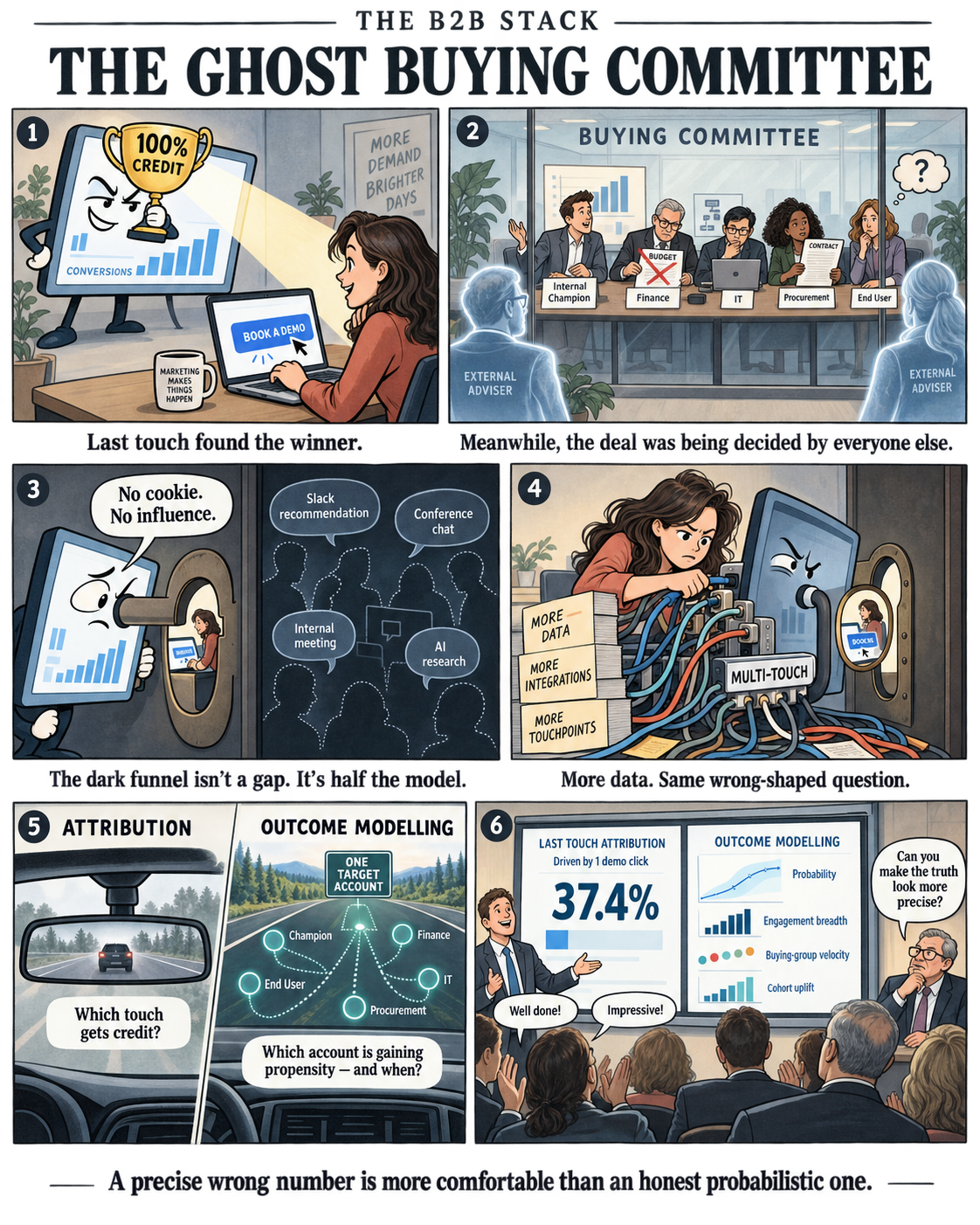
Why last-touch survived this long
Last-touch attribution was built for e-commerce: one buyer, one session, one decision, made in a window short enough that the last thing they clicked plausibly was the thing that swung it. In e-com it can stand true, and arguably the extension of the old adage of adtech keeping the web free since ninety-three extends deeper to commerce keeping the web free, because the transactional ad ecosystem is what has always driven digital advertising and it’s where B2B has always been left behind
Last touch survived the jump into B2B not because anyone tested whether it fit, but because it was already sitting in the analytics stack when B2B marketing started needing to report a number to finance. It was the inherited standard which needed retrofitting or bludgeoning into a board pack
That's the honest history. It wasn't chosen for B2B. It was inherited.
The problem is structural, not a measurement gap you close by adding more tracking. A single buyer clicking through a funnel and a buying committee working through a purchase are different objects entirely. You cannot bolt more instrumentation onto a single-buyer model and get a committee-shaped answer out the other end. The model is built to join a single persons dots not to join those alongside their fellow buying committees
The buying committee breaks the maths, not just the story
Forrester's State of Business Buying research puts the average B2B purchase at around thirteen people involved, including roughly nine external influencers most vendors never see directly. Gartner's figure for the core internal buying group, typically six to ten stakeholders spanning procurement, finance, technical evaluation and end users, tells a consistent story from a different angle: these people rarely speak to each other directly, let alone convert in the same session.
The rapidly expanding buying committee which is growing to include significant numbers of external stakeholders is threatening to break the whole B2B became ABM targeting model let alone attribution - because these 9 external stakeholders are almost a dark buying committee in themselves - separated from account level signal that were use to target and frankly unlikely to be in the attribution lens at all. They’re not going to hold the pen on the deal but their signal, if capturable, would be a significant piece of dark matter in the buying journey - one for another day
Last-touch attribution asks a much simpler single question: what was the last thing this person did before converting?
That question only means something when there's one person and one conversion event to anchor it to. In a buying committee, there isn't. The finance stakeholder who never clicked anything but killed the deal in a budget meeting doesn't exist in the model at all. Or conversely the same person may hold the pen when it comes to contract and they’re equally invisible. The model sees a ghost buying
The technical evaluator who saw four pieces of content over three months and became the internal champion gets collapsed into whichever touch happened to be temporally last, regardless of whether it mattered.
The model misses all kinds of intricacy that links to organisational structure, who does the work, who signs the paper and how different that is to someone choosing a new pair of jeans for themselves
This is where I'd push back on how most martech vendors sell multi-touch attribution as the fix. Honest hand-raise - when we started FunnelFuel we built this into our analytics. It was born from the idea that programmatic advertising would always be statistically underweighted in demo requests, lead captures and asset downloads, all the kinds of stuff we were tasked with helping drive.
Multi-touch still has one - the very same - Achilles heel for B2B.
Multi-touch still assumes you can see all the touches and just need a fairer way to split credit between them. Frankly a lot of it was developed to overcome Google Analytics bias towards Google channels like paid search and to help give a clearer view beyond the person shooting the fish in the barrel and trying to help understand which participants got said fish into the barrel to start with
That's a real improvement over last-touch, but it doesn't solve the deeper issue: a meaningful share of the touches that move a B2B deal never happen anywhere you can instrument.
If this is matching what you're seeing in your own pipeline data, reply to this email and tell me what your dashboard would need to show to make room for a stakeholder who never clicked anything. I read every reply, and it's usually the fastest way I find the next piece worth writing.
If this is something your wider team would get value from reading, please share the B2B Stack. The majority of our readers come from reader sharing within their internal Slack/emails/messaging. I greatly appreciate your help in spreading the word
Dark funnel isn't the mystery, it's the missing half of the model
I've written before about the dark funnel: the research, conversations, and internal debate that happen with zero digital footprint. A peer recommendation in Slack. A conversation at a conference. An internal champion pitching a shortlist in a meeting nobody logged and sure as hell didn’t share externally.
The mistake is treating that as an unfortunate gap in an otherwise sound model. It isn't a gap. For a lot of B2B categories it's the majority of the actual decision-making, happening in parallel with, not downstream of, the touches you can see. Throwing in the ever increasing LLM impact on buying journeys and its 24% conversion rate vs search and we can see that LLMs would Invariably become the last touch. So is LLM advertising the whole demand gen game? I’d say evidently not
Attribution models built on visible touches alone aren't measuring most of a committee's decision and guessing at the rest. They're building a confident, precisely-numbered story out of the fraction that happened to leave a cookie behind, and treating the omission as noise rather than the main signal.
That reframes what "better measurement" has to mean. You're not trying to see more of the funnel. You're trying to build a model that's honest about how much of the real decision it can't see, and stops pretending the visible slice is representative of the whole.
A quick caveat, because I don't want to overstate the case: none of this means visible touches are worthless. They correlate with outcomes, they influence the invisible conversations, and a strong programmatic and content strategy visibly moves pipeline. The argument isn't that instrumented touches don't matter. It's that crediting a single one of them with causing a multi-stakeholder decision is a category error dressed up as precision.
What "upgrading" measurement actually means
Most attempts to fix this reach for the same lever: more data. A CDP, a few more integrations, an intent signal layered on top, a slightly more sophisticated weighting model across the touches you already had. That's addition within the existing frame, not a change of frame. It gives you a more detailed version of the wrong question.
The upgrade that actually matters is moving from attribution to outcome modelling, and the distinction is worth being precise about because the two get used interchangeably and shouldn't be. A new feature on an attribution tool doesn’t catapult it to an outcome model
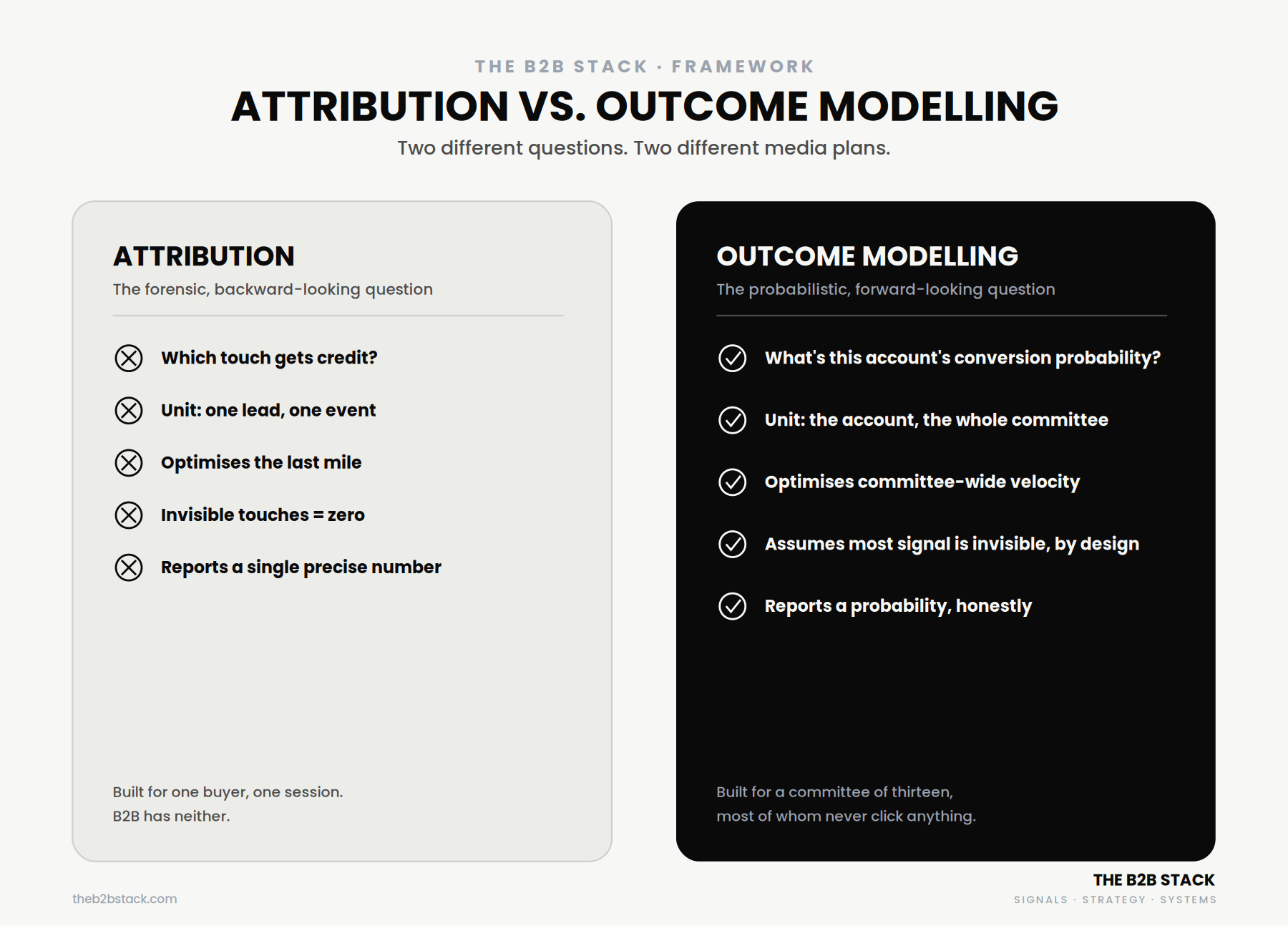
Attribution asks: which touch gets credit for this conversion? It's forensic and backward-looking, built around a single event.
Outcome modelling asks: given everything we know about this account's engagement pattern, what's the probability this account converts, and on what timeline? It's probabilistic and forward-looking, built around an account, not an event.
That single shift changes what you optimise for. Attribution optimises the last mile, whichever channel happened to sit adjacent to a form fill.
Outcome modelling optimises account-level engagement velocity across the whole buying group, which is a genuinely different media plan, not just a different reporting dashboard bolted onto the same one.
We've had to make this shift in our own delivery work at FunnelFuel more than once, usually when a client's existing attribution setup was actively steering budget toward the channel that happened to sit last in the journey rather than the channels doing the earlier, harder work of building committee-wide awareness. The fix wasn't a new attribution tool. It was accepting that per-touch credit was the wrong unit of analysis for what they were trying to buy. If you're mid-way through that same argument internally, that's a conversation I have most weeks, drop me a line at mike@funnelfuel.io.
What good outcome modelling looks like
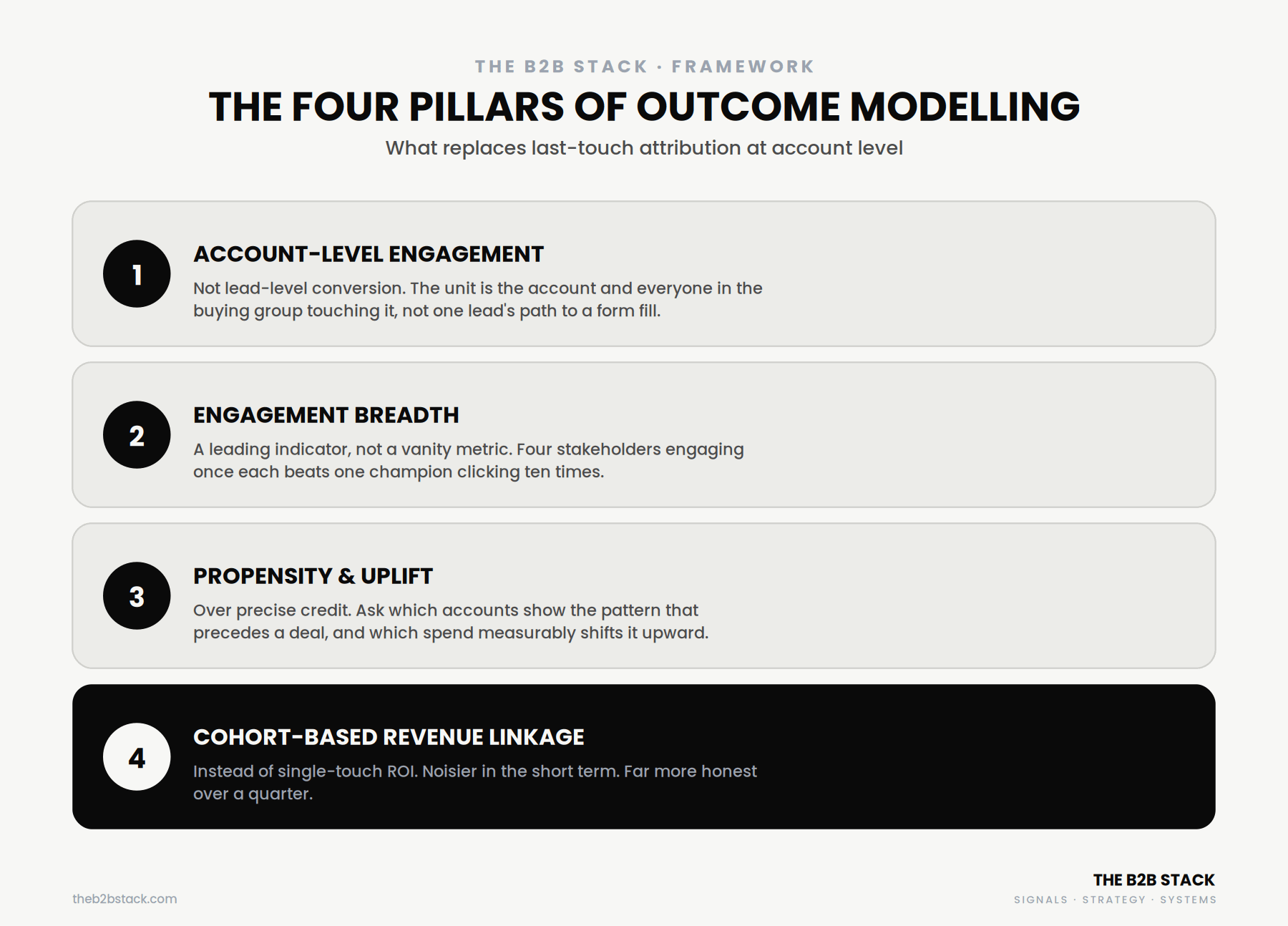
In practice, this means building around four things instead of one.
Account-level engagement, not lead-level conversion. The unit of measurement is the account and everyone in the buying group touching it, not any single lead's path to a form fill. A model that can't tell you three different job titles at the same company engaged with your content in the same fortnight is still measuring individuals, not committees.
Engagement breadth as a leading indicator, not a vanity metric. How many distinct people at an in-market account engaged, not how many times one person did. A single champion clicking ten times is a weaker signal than four different stakeholders each engaging once, and most attribution setups can't tell the difference between those two accounts at all.
Propensity and uplift over precise credit. Rather than asking which touch caused the conversion, ask which accounts are showing the engagement pattern that historically precedes a deal (this is where account level High Value Action tracking and scoring is golden), and which media investments measurably shift that propensity upward. This is a genuinely different modelling problem, closer to what a data science team would recognise as uplift modelling than to what a marketing attribution vendor sells.
Cohort-based revenue linkage instead of single-touch ROI. Compare pipeline and revenue outcomes across cohorts of accounts with meaningfully different exposure to a campaign, rather than trying to trace a straight line from one ad impression to one closed-won deal. It's a noisier-looking number in the short term. It's a far more honest one over a quarter.
None of this is exotic. Every piece of it exists in adtech and data science today. What's missing in most B2B marketing organisations isn't the technology, it's the willingness to stop reporting a single-touch number that finance finds reassuringly precise in favour of a probabilistic one that's actually true.
I'll say the awkward part plainly, the elephant in the room: most B2B teams keep last-touch attribution not because they believe in it, but because the alternative is harder to explain in a board deck. A precise, wrong number is more comfortable than an honest, probabilistic one.
That's a real organisational problem, not just a modelling one, and it's worth naming before you try to fix the maths underneath it.
If this is the first piece of mine you've read, subscribe below. I write one single-thesis issue a week from inside actual B2B programmatic delivery, not from the sidelines watching the industry from a content calendar.
Subscribe free below
So here's the question I'd actually put to you: if your attribution model can't name a single stakeholder who never clicked anything but killed your last deal, what exactly is it measuring?
This is a lovely piece, especially to someone that has been saying attribution is broken for the better past of 15 years. It is also correlation. You also can't measure what you can't track.
Buyer journeys also don't start when they engage. It stars way before then in the dark funnel, closed communities, exclusive industry events.
When the buying committee comes to the table, they come ready with a day one consideration list.
That now depends more on trust which is earned- buyers are super risk averse at the moment. That trust also happens with consistent brand promise which requires penetration and reach, not assuming their problem (we see this most with the companies we work in your space - you lost that deal, because you don't), and talking about value.
For measuring all of those, you need causality. Because B2B is non linear, an open system, highly probabilistic and time lagged. Attribution, incrementality, econometrics don't cut it anymore.
Causal AI does - with counterfactuals in real time. Not based on past data that is old and outdated for you to base any activity on.