

Free report: “5 Things $39.6M in B2B Programmatic Spend Taught Us.” Three years of managed spend and a billion tracked page loads, turned into five findings platforms won’t put in a pitch deck. Subscribe free to unlock it, plus every new issue of The B2B Stack.
Join 1,600+ B2B marketers, including readers at Dentsu, HubSpot, 6sense, Informa and DirecTV.
The concept of the “Account Graph” is quietly becoming the most valuable infrastructure in B2B marketing. It’s the connective tissue that decides whether your Target Account List (TAL) becomes a signal engine - or just another spreadsheet collecting dust. As the identifiers behind the companies you target fragment, our product playbook has to change if we’re going to retain the ability to target them.
The internet is changing. LLM’s are emptying the content web reservoir and B2B research media is amongst the most effected content online. Gartner thinks SERPs will be down 25% in 2026 but perhaps most concerning is that the AI overviews we increasingly see in search and cutting click through rates by 79%. We now need to use identity to lift harder to identify B2B users in a smaller, shallower reservoir - which is where account and ID graphs come in
But here’s the kicker: most “graphs” out there are either glorified CSV joins (think: CRM email x ad cookie), or overengineered identity graphs built for consumer data - which break under B2B complexity.
This piece explores what the next-generation Account Graph looks like, how product teams should be thinking about it, and why it’s the key to unlocking scalable, cookieless, and precise B2B targeting.
1. Identity Resolution in B2B Has a Structural Problem
Consumer identity resolution relies on consistency: one user, multiple devices, stable login behavior, aided by fast path to purchase
B2B identity is messier:
Shared devices, office IPs and a lot of network noise
Multiple users per account
Form fills from “@gmail.com” or unrecognized domains
CRM records that lag or get siloed
Core data which changes fast - work emails last 12-24 months versus 7+ years for personal email. Layoffs, job changes and other churn mean B2B users often verifiably disappear overnight and take all their addressability with them - emails, devices, locations etc.
Product Insight: The B2B Account Graph must shift from person-first to account-first resolution. The goal is not to identify who filled the form - it’s to understand which account is active, engaged, and potentially in-market. The company layer brings significantly more stability - a more persistent base set of identifiers (IPs, email structure, location). It’s the business that buys in B2B even if it’s the human layer signing the paperwork
This gives our identity product a foundation in a world where Hubspot report that the B2B email decay rate is 25-30% a year and average tenure in the US is now just 18 months
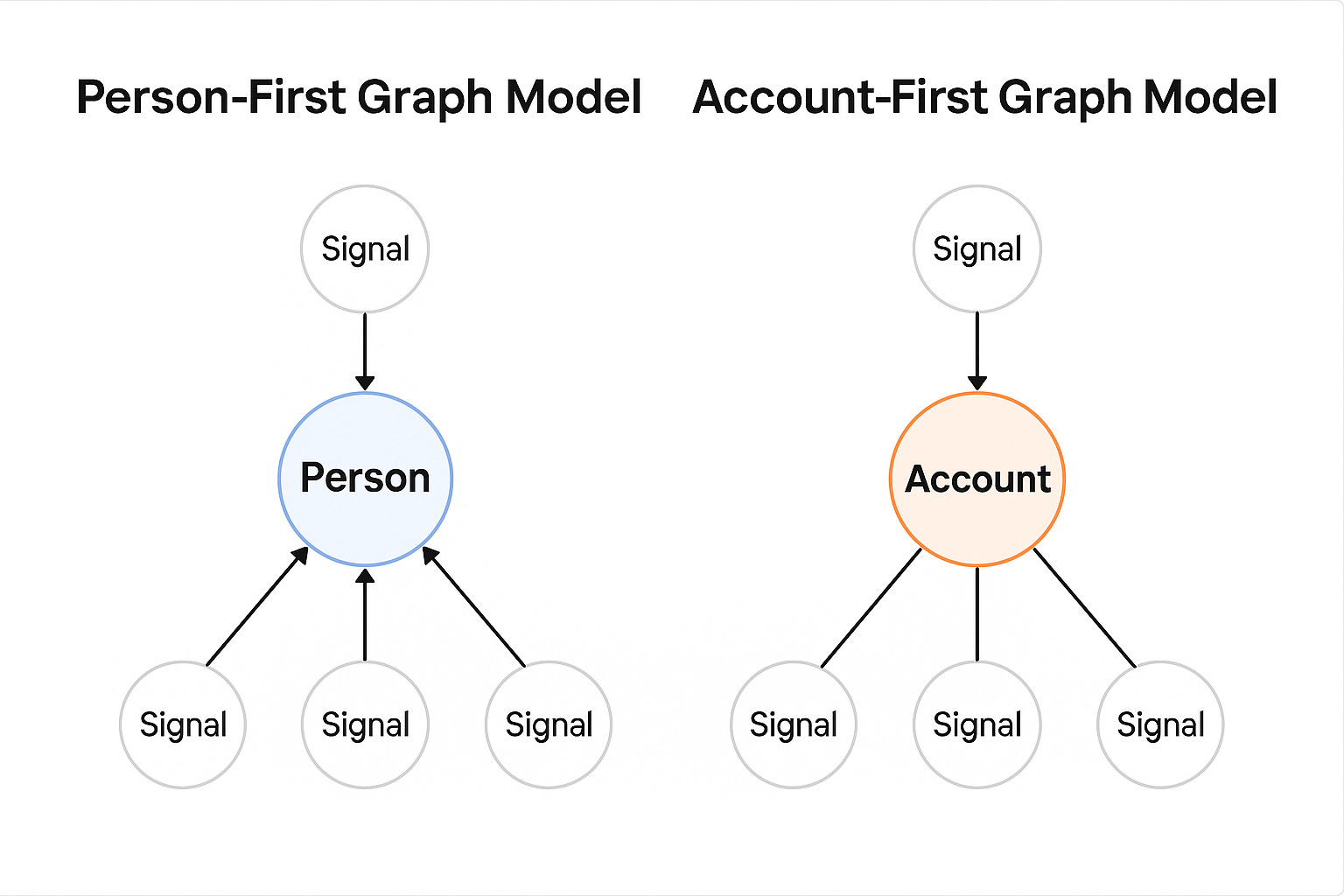
Mapping to the company layer gives us a level of persistency in our core models, and we can add individual and persona level data into a deeper signal layer
2. The Real Pivot Is from Domain-Based to Company-Based Resolution
Most ABM systems still resolve identity by matching email or IP to a website domain. But domains are a weak identity proxy. They miss:
Subsidiaries and brand aliases
Global business units (e.g. abcgroup.com, abc.de)
Mismatches between buyer domains and parent companies
Product Insight: A modern Account Graph resolves to a company entity, not just a domain. This includes:
Mapping IPs, devices, and hashed emails to a corporate identity
Resolving group structures and brand families
Tracking behavior across related domains and sub-entities
Below is how I’d build and use an account graph from a product point of view.