

For at least ten years the industry has treated the open web’s problems as repair jobs.
Third-party cookies went, so we built UID2, ID5 and at once stage around 200 others. Safari started deleting first-party cookies, so we moved to server-set ones. Consent strings broke match rates, so we bought bigger identity graphs. Each fix was clever, and each one assumed the same thing underneath: that the web is still where B2B buyers do their research, so it’s worth the repair bill.
The launch of iOS 27 brought another repair bill, and to put this into a car analogy, the web is starting to feel like an old banger - asking for one too many expensive fixes.
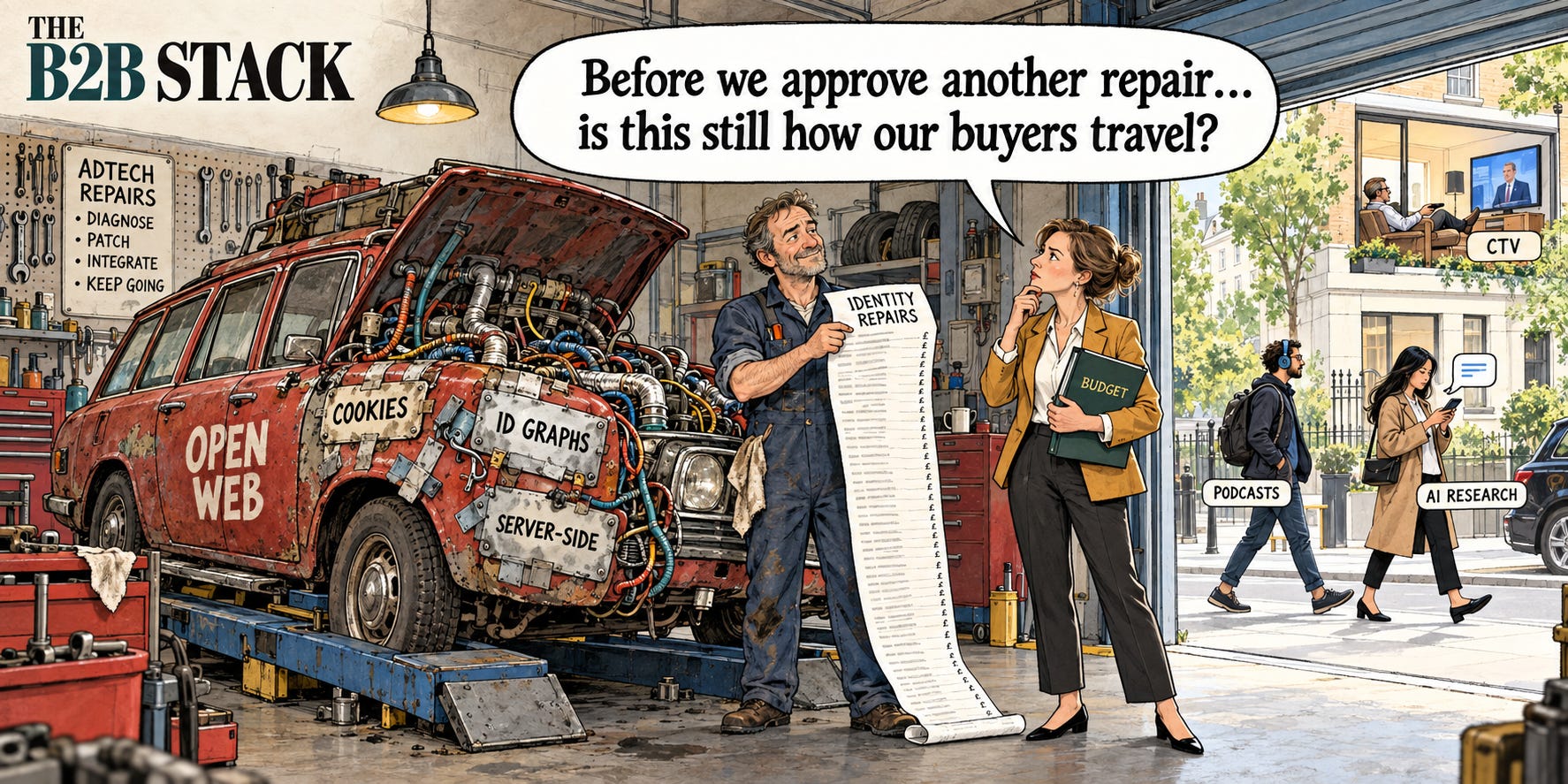
Staring ahead into 2027 and beyond it is hard to remain bullish on the open web. In other words - I don’t think that assumption of the repair bill being worth it holds any more. Not because the web is dying. It isn’t, across the content web and the ultimate gateway to it, Google.com, traffic is still UP. So the scale remains, but I am fast growing to see it, from the B2B advertising POV, as a legacy format, in the same way print is a legacy format: still real, still capable of doing a job, no longer the place a serious plan begins.
That’s a different claim from “the web is dead”, and it leads somewhere more useful.
And I say all of this running a business that spends a lot of client money in the display web still, not least because the signal given by programmatic is so strong and differentiated. Now that signal has grown to cover the old world of big memory building audio, location and TV, my appetite is changing with it, as I will explore today
New here? I’m Mike Harty. I’ve spent 15 years building programmatic platforms, first at PowerLinks and now at FunnelFuel, where we run B2B programmatic as a managed service across display, CTV, audio and out-of-home. This piece builds on three earlier ones: The Account Graph vs the Identity Graph, The Living Room Tax on CTV for B2B, and The Xerox Strategy on the dark funnel. If you’d rather start there, do.
Subscribe and join 1500+ B2B marketers and get The B2B Stack every Monday
What you’ll learn in this article
Why ten years of identity patches were fixing a format that was already losing its audience, and what Apple’s iOS 27 blocklist changes
Where B2B buyer research actually went, and why third-party intent data is the first casualty (and how to fix that)
My hollow middle theory: what the web looks like in 2031 and which parts of it survive
The honest counterargument, that the buyer is still there and you just can’t see them, and why it leads to the same conclusion
How the data models built for web programmatic now run television, audio and out-of-home, and why that’s where budget is going
What the open web is still for, and why there’s no longer an excuse for the long tail
Plus Field Notes: the ID5 chief executive’s response to Apple, IAB Tech Lab’s answer, and the week’s two best Reddit arguments.
Ten years of patching a format that was losing its audience
Take the identity story first, because it’s the one the industry has spent the most money on. And it is a lot of money
In mid-September Apple shipped iOS 27, which on the surface of things, shouldn’t really matter for B2B advertisers. Within a week The Trade Desk could no longer serve ads in Safari on updated devices, because its core ad-delivery domain, adsrvr.org, sat on a WebKit list of domains Safari refuses to contact. UID2, ID5, LiveRamp, Permutive and Audigent were on the same list. Google’s ads on the same pages loaded fine. Then AdExchanger reported, citing two sources with direct knowledge of the WebKit changes, that the short list had been replaced by a private library of hundreds of CDPs, data sellers and ID-graph operators which Apple can update remotely, with no OS release and no public process. iOS 27 came armed with a kill switch for addressable digital advertising on Apple devices.
Most of the commentary has been about whether The Trade Desk was blocked by mistake. That’s the wrong question. Even if TTD’s delivery domain comes off the list, which looks likely given Apple asked them to test an iOS 27.2 beta, the identity vendors have no such argument to make. Apple has written itself a kill-switch for person-level matching in Safari, and by extension every WebKit browser on every Apple device. It can flip it for any vendor it chooses, whenever it chooses.
That person level targeting is the great win of programmatic, and the exact reason that makes it worth considering running an auction one at a time, 1 trillion times a day. Programmatic is all about end individual user targeting using data to inform the decision. The precision that still makes it exciting to target banners, because we can target and report on the company and job role behind the impression, is slowly eroding on display - whilst exploding in positive possibility on the old-new world of TV, audio and out of home.
For a B2B marketer, that lands on a specific thing: any account list that depends on an identity graph to find people on the web now inherits a fragility it didn’t have in August. I’ve argued before that the account graph and the identity graph are different objects. Here’s the sharpest version of why. The identity graph is what Apple can switch off. The account graph is less exposed, because it resolves to the company rather than the person, though it carries its own weakness, which I’ll come back to.
Identity is only the loudest example. Run the same exercise on format standardisation (a decade of IAB specs that the walled gardens ignore), on viewability (a metric made-for-advertising sites learned to game), or on measurement (more on that below). The pattern is the same: a lot of engineering effort to keep an environment addressable, which only makes sense if the audience is still there. If it isn’t, we need to move to where the audience is
The research moved to LLMs, and it took the signal with it, especially the ‘intent’ signal
Here’s the number that matters. G2 surveyed 1,076 B2B software buyers in March and found that 51% now start their research in an AI chatbot more often than in Google. Eleven months earlier that figure was 29%, wo what will it be in Q4 2027? 2028?
Seventy-one percent use a chatbot somewhere in the process, and 69% say chatbot guidance led them to a different vendor than the one they’d planned on. However upwards of 80% of purchases will still come from a day one consideration set. So I may start looking at DemandBase, 6Sense and FunnelFuel to run my digital ads, begin thinking I will use DemandBase and Claude persuades me that FunnelFuel is the better bet. You get the idea. CaliberMind’s 2026 attribution report, from Scott Brinker and Frans Riemersma, puts roughly 81% of the B2B journey outside anything the CRM can see.
Those are software-buyer samples, so hedge them for infrastructure, industrial or financial categories. But the direction is not in doubt, and it has a second-order effect that I don’t think the market has priced in.
Third-party intent data is a derivative of the open web. The co-op and bidstream feeds that tell you an account is “surging” are built from page visits on publisher and vendor sites. If the research moves into ChatGPT, Claude and Perplexity, the pages that fed those models go quiet, and the surge signal thins out. That isn’t my theory. It was the sharpest comment in a 17-reply X thread this week in which outbound practitioners variously called enterprise intent a tiebreaker at best and a scam at worst. The intent vendors’ own numbers aren’t kind either: a DemandScience survey cited by MarTech had 87% of marketers calling intent signals unreliable or inflated. Intent is the canary, and it’s in danger of stopping singing. Knowing some of the major players, like Bombora, I’m sure they are capturing a vaster array of signal now and if not already, are looking at what they can get out of podcasts, YouTube, newsletters, and non-traditional publishing sources to refill the tanks. I’m bullish on them.
Now look at what happens when the ad industry tries to follow the buyer into the new environment. OpenAI has been selling ChatGPT ads since February. Its own 5 October update named 20 measurement partners and an image-led format, which tells you how early it still is. I ran a test on ChatGPT which underwhelmed me enough to pause the 3 tactics; and one by one they automatically/bugged and turned back on. The whole system feels like ad platforms from at least 10-15 years ago, basic and buggy. It will improve but this is very far from the inner workings of the best of breed adtech platforms.
B2B advertisers in the pilot report they can’t see which prompts served their ad, their legal teams won’t sign the tracking terms, and the ads only run on the Free and Go tiers. I’d assume these tiers aren’t loaded with senior B2B decision makers, but could be wrong, but really we need ads talking to the top tier users and enterprises before I’m jumping with excitement. One B2B SaaS study put 74% of SaaS marketers on paid ChatGPT plans (Omni Lab, June), which would mean the exact buyer you want has paid to opt out of the one ad format inside the room. OpenAI’s line at Advertising Week was that knowing who the user is matters less than enriching the conversation. That’s an honest description of a closed environment. It’s also the opposite of what a decade of identity investment was for.
The hollow middle - what and which websites survive in the next 5 years?
So play it forward five years. Do we still have websites?
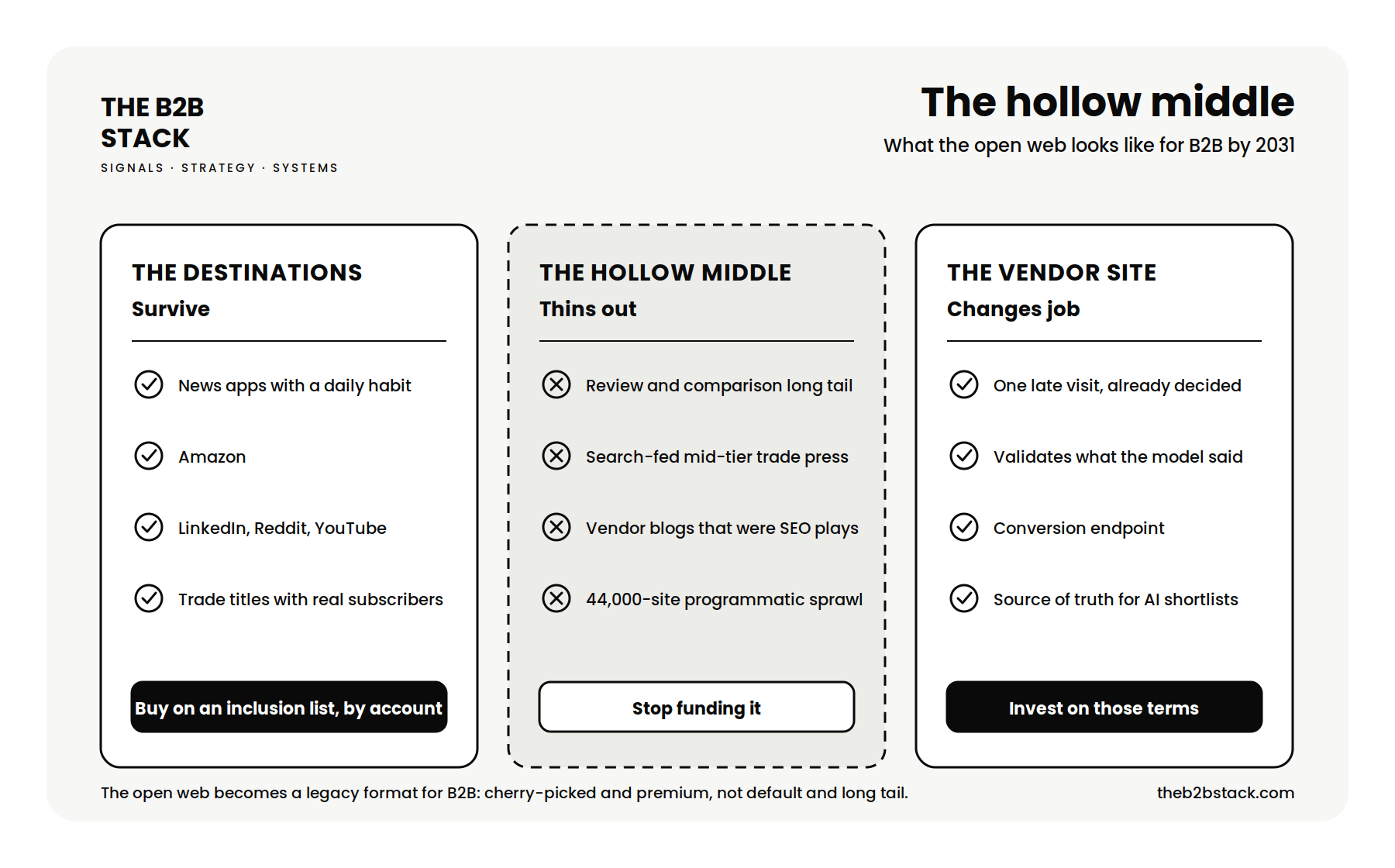
Yes, but the web gets hollowed out from the centre, and I’d put a name on the new shape: the hollow middle.
I believe the destinations survive. News brands with a daily app habit. Amazon. LinkedIn, Reddit and YouTube, which are more walled garden than open web at this point. Your own site survives assuming you are a vendor or agency, but its job changes from the place a buyer discovers you to the place a buyer arrives once a model has already shortlisted you, to validate what the machine said. One visit, late, decided in advance. The vendor website becomes a conversion endpoint and a machine-readable source of truth, and both of those are worth investing in.
I ran Claude over billions of page views that FunnelFuel has tracked across vendors in the last few years and found the above is happening today. 3+ years ago, we saw early account engagement on typical upper funnel pages, like blogs. Today, the first observed touchpoint is often as deep as pricing. Vendors keeping their pricing off their websites is creating a last mile that the agents can’t complete. We’ll see how that evolves
What thins out is the middle: the comparison sites, the review long tail, the second-tier trade press that lives on search traffic, the vendor blog that was really an SEO play, and the vast quantity of recycled content underneath all of it. That middle is where B2B contextual display grew up. It’s the inventory most B2B programmatic was built to buy, and it’s the inventory a buyer who starts in a chatbot has the least reason to ever touch.
The ANA’s 2023 supply-chain study found that participating advertisers’ programmatic ran across an average of 44,000 websites and apps, and that only 36 cents of each dollar entering a DSP reached a consumer on a viewable, measurable, non-MFA impression. I’d struggle to name 440 sites where a B2B decision-maker spends real time, let alone 44,000.
Or can you just not see them any more?
Here’s the counterargument, which of course deserves a proper hearing: maybe the buyer hasn’t left the web. Maybe your measurement has. There is no doubt that cookie banners, private browsing, VPS/VPNs and other such tools have made resolvable traffic thinner.
A practitioner audit doing the rounds this week claims that across 18.5 million events on technical B2B audiences, 41% of browser pixels failed to fire. One dataset, unverified, so treat it as directional. But it sits on top of a pattern that is well established. Safari’s tracking prevention caps first-party cookies at seven days, so a signup correctly attributed on day zero shows up as Direct when the contract is signed on day 14. PPC forums have been reporting 25 to 30% click loss and missing GCLIDs for months. An AdExchanger, Bombora and PrograMetrix study this spring found just 10% of B2B marketers very confident their audience data reaches the right accounts, and only half confident they reach even 50% of their target list. Vector’s October survey of 239 ABM marketers was blunter still: 91% not confident their ads reach the right people inside target accounts, 84% unable to show evidence of pipeline
So when LinkedIn, Reddit or display “doesn’t convert”, one honest reading is that the signal plumbing is broken, not the channel. I take that seriously. Some of what looks like channel death is measurement death. There’s a similar argument with content syndication and leads - tech and data has improved but leads conversion hasn’t. It could be that it isn’t the leads and is - at least partly - what the vendors do with them
But notice where it leads, no pun intended. Whether the buyer has left the browser or you’ve simply lost the ability to see them in it, the conclusion is the same: stop building the B2B plan around browser-level, person-level identity. Either the person isn’t there, or the identifier that would prove they’re there has been deleted by Apple, by ITP, or by the buyer’s own privacy shield. A planning model that only works when all three cooperate is a legacy model.
If you know someone still running a media plan that’s 90% web display because that’s what the DSP defaults to, this is the piece to send them.
The data models outlived the format
This is the part that gets lost in the “web is dying” conversation, and it’s the part that matters most to how I think about FunnelFuel’s work.
The thing programmatic got right was never the banner. Heck as long ago as the first ‘year of the mobile’, we started evolving that with native advertising, which almost but never quite flew.
The bit that was and still is very very cool and powerful is the buying model: an auction per impression, audience data applied in real time, frequency controlled at the account rather than the campaign, performance read back into the bid. Those models are the best thing adtech built, and they were wasted on 300x250s.
What’s happened over the last three or four years is that the same models now run on screens that do something a banner never could. Television has data-driven buying now. So does out-of-home. So does audio, including the best B2B podcasts. And the creative executions on those screens are emotive, memory-building, delivered when someone is actually paying attention, which is exactly the brand-memory job the dark funnel demands.
The budgets have noticed. In the ANA’s Q3 2025 benchmark, CTV reached 45.6% of participants’ programmatic spend, up from 28% at the end of 2024. A Demand Gen Report survey found 98% of B2B brands planning to increase CTV budgets and only 4% with no CTV plans at all; a vendor-run survey, so discount it, but the direction matches what we see in client plans. Advertiser Perceptions’ March survey had 82% of marketers and agencies buying audio programmatically, up from 41% in early 2022, and Madison & Wall expects automation’s share of audio to roughly double by 2030. In the UK, IAB UK reports DOOH at 67% of out-of-home spend, from 32% a decade ago, with programmatic the fastest-growing route in. VIOOH’s 2026 survey found 95% of marketers increasing programmatic DOOH spend were funding it from other digital channels.
The B2B question is whether these can be bought by account rather than by household, and the answer now is yes. Resolve a target account to its sites, its IP ranges and its known device clusters, and CTV, audio and out-of-home become account-addressable with no browser in the loop. A finance director watching the same streaming service as everyone else can be reached because of where she works, not because of a cookie she cleared last Tuesday. Out-of-home around the offices, the stations and the conference venues people still physically go to. Podcasts people still listen to on the commute. None of it depends on an identifier Apple can revoke.
This is also where the account graph’s own weakness needs saying out loud. IP-to-company matching degrades when people work from home, and the Vector survey found confidence in reach nearly doubled when visitor de-anonymisation sat at the centre of the stack. The best account graphs, like the one we built, don’t rely on this signal, they map enrichment to more portable device IDs, which can be enriched by office attendance but travel home with the B2B decision maker, ready to inform targeting on the commute and afterwards. So the account graph isn’t a magic replacement and one valid signal class is in decline, but it stands firm as a portal of addressability into the best of the ad worlds formats. It’s the resolvable thing that survives, and it needs first-party evidence underneath it. But it is the thing the next five years of B2B media get planned on, because it’s the only addressable layer that works across every screen a buyer still looks at.
What the open web is still for
None of this means pulling the web out of the plan. Legacy formats are extremely useful. Print still sells to people who read print.
It means the web stops being the thing a plan is crowbarred into and becomes the thing you cherry-pick. Buy the best impressions in the most premium, trusted environments where a decision-maker actually spends time: the FT, the trade titles with real subscriber bases, the specialist publishers whose newsletters get opened on Monday morning. Buy them on an inclusion list, against the account graph, with frequency capped per account, and treat them as the premium layer they are.
And stop buying the long tail. There is no longer any argument for it. The ANA benchmark shows what happens when advertisers take this seriously: MFA spend fell from 15% in 2023 to 0.39% among participants by Q3 2025. That didn’t happen through better exclusion lists. It happened because buyers switched to inclusion lists and simply stopped funding the noise. The same discipline applies to the premium screens, incidentally: Pixalate put invalid traffic in open programmatic CTV at around 18% in Q3 2025, so “CTV” on an insertion order is not a quality guarantee either. Premium is a supply decision you make, not a channel you tick.
If the buyer spends their research time in a chatbot, their evenings on a streaming service, their commute in a podcast and their working day in an office, meeting or event, then the media plan should look like that, with a thin and deliberate web layer on top. Anything else is building the plan around the measurement rather than the buyer.
What to change on the plan
Four things, in rough order of how fast you can do them.
Reclassify the website. It’s a late-stage conversion endpoint and a source of truth for the models that now write your shortlists. Invest in it on those terms: clean structured content, fast, demo-first, every claim verifiable. Stop measuring it as a discovery channel.
Move identity out of the browser. First-party data, server-set cookies, hashed email where you have consent, and account resolution that doesn’t need a third-party identifier to function. Assume any browser-side signal can be switched off by someone who isn’t you.
Rebalance toward the persistent behaviours. CTV, audio, YouTube and out-of-home, bought against the account list, frequency-managed at the account. Fund it from the long tail you should have cut already.
Cherry-pick the web. Inclusion lists only, premium environments only, account-level frequency, and read it as a brand-memory layer, not a click source.
Field Notes
Three items from the week, two of which land squarely on the argument above.
ID5’s chief executive has responded to Apple. In the first public statement from a blocked vendor, Mathieu Roche argued Apple’s real target is ad-funded publishing and said regulators should look at it. Worth reading in full. The practitioner point: a vendor on that list cannot engineer its way off it, because the list isn’t in the open-source WebKit build and the block applies to a domain, not a behaviour. For anyone whose B2B audience matching runs through ID5 or UID2 on Apple devices, this is already live in your delivery mix, not a future risk.
IAB Tech Lab’s answer is to leave the browser. Anthony Katsur has spent the fortnight telling publishers to move the ad stack onto Trusted Server, publisher-controlled infrastructure that doesn’t depend on the browser contacting third parties. Note what that is: the open web’s own standards body conceding that browser-side identity is no longer a safe place to build. It corroborates the thesis more neatly than I’d have liked.
The two best Reddit arguments this week aren’t about the web at all. r/gtmengineering spent 20 comments on whether GTM engineering is a real role or a temporary premium for wiring Clay together, with one thread already replacing Clay with Claude Code [LINK: r/gtmengineering, 9 and 10 Oct]. And r/revops had 21 comments on the fact that most teams still can’t tell a parent company from its subsidiary, then buy identity graphs that assume their CRM is right. Both are the account graph argument in disguise: before you buy another matching layer, check whether you can say who the buying entity actually is.
So here’s where I land. The open web isn’t going anywhere, and neither is web display. But it’s a legacy format for B2B now, and the sooner a plan treats it that way, cherry-picked and premium rather than default and long-tail, the sooner the budget gets to the screens where the buying group actually is.
Is the open web still where your buyers are, or just where your measurement is? If you think I’ve got this wrong, the comments are open.
Is your media plan still 80% web display because that’s what the DSP defaults to?
FunnelFuel runs B2B programmatic three ways: as a full managed service across display, CTV, audio and out-of-home; as a licensed signal product if you want the account graph inside your own stack; or as a bespoke fit for teams building in-house.
Connect with me on LinkedIn, send me a Substack DM, or reply to this email (mike@funnelfuel.io). Or see how we build account-based plans across every screen.
No pitch, no obligation. If it’s useful, we’ll talk.