

ChatGPT Ads, agentic buying and performance CTV all arrived with a measurement story. Here is the four-question log test to run before the money moves, because as we will see below, their dashboards rarely tell the full story.
Every new ad channel that launched this year arrived with a measurement story front and centre. ChatGPT Ads named 20 measurement partners on 5 October, which does a very good job of sounding like an open, measurable platform. IAB Tech Lab’s agent-to-agent buying standard has a whole section headed Reconciliation. Performance CTV comes with a CPA column because it fancies a chunk of Meta’s budget (and it is working). The belief underneath all three is that more reporting is the same thing as more accountability.
Having built an ad exchange and 4 Demand Side Platforms since 2011, I’d put the question differently. When you spent $50,000 on that channel last month, who counted what you got? If the only answer is the company that sent the invoice, your vendor has marked its own homework, and the one decision left to you is whether to believe the grade.¹
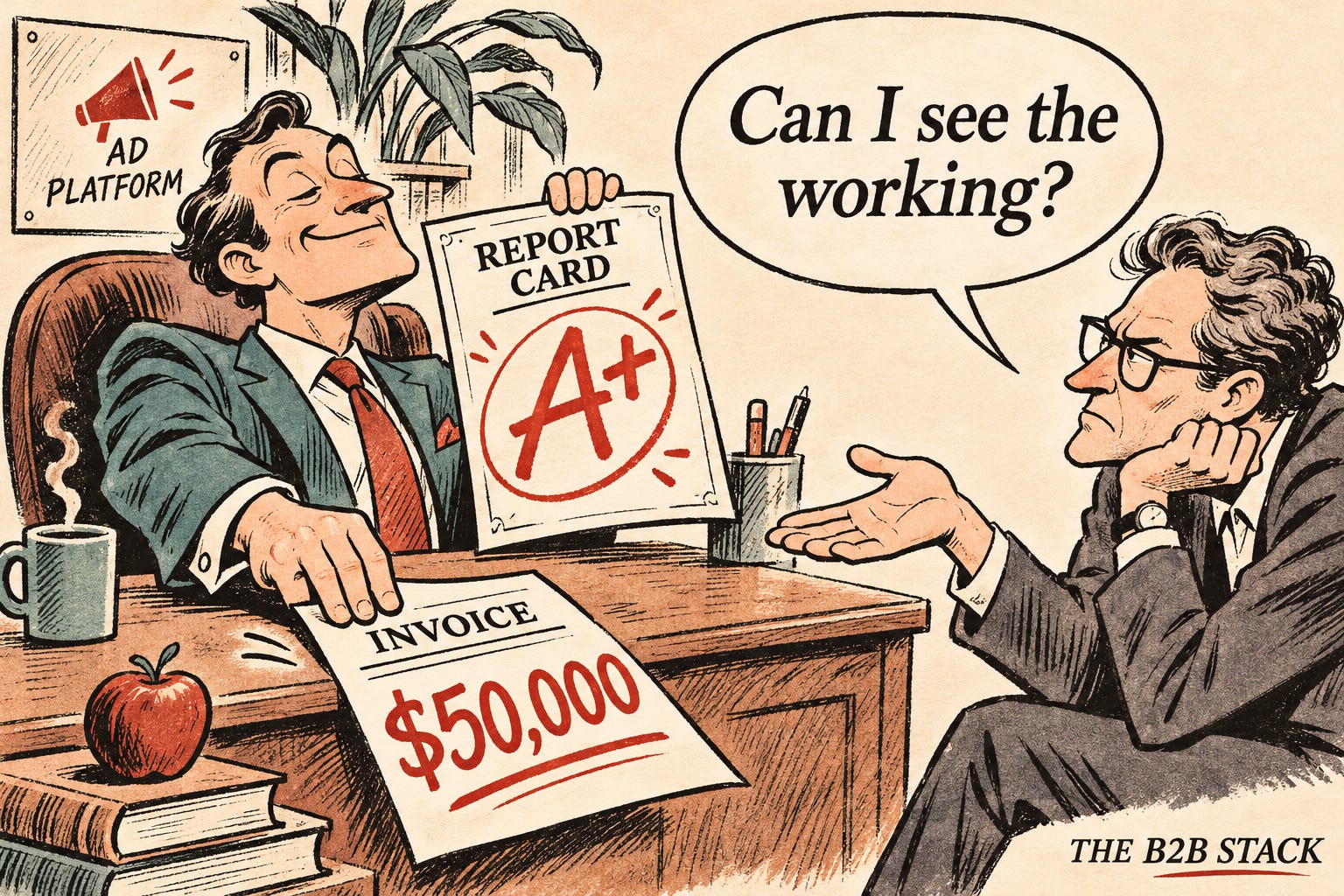
Fair warning: this piece goes fairly deep into the plumbing, through the newer workflows behind agentic buying, what sits behind ChatGPT ads, and the performance television that is increasingly pitched alongside Meta as a performance channel. The point of going that deep is practical. Enterprise B2B contracts get signed over DocuSign rather than at an e-commerce checkout, so the only way to work out which platform is delivering against your KPIs is to get to the raw data and form your own view of it. That cuts both ways.
The easy assumption, and I was guilty of this too, is that a vendor’s dashboard flatters the vendor. Further down there is a television platform under-reporting its own results by an order of magnitude: on its dashboard you’d have switched it off, and on the log you’d have scaled it. So this does cut both ways - don’t give up on a platform or channel too fast either.
New here? I’ve been building programmatic platforms since 2011. I’m a co-founder of FunnelFuel, where we run advanced account-based programmatic for B2B brands. The B2B Stack is where I write about the plumbing: one argument a week on B2B programmatic, ABM, intent and measurement, from someone who builds and runs it rather than commentates on it. If this is your first visit, The Account Graph Is Not an Identity Graph and Intent Data Needs an Expiry Date are the two to read next.
Subscribe: join 1,600+ B2B marketing readers, including people at Dentsu, HubSpot, 6sense, Informa and DirecTV. Free, one piece a week, and the Subscribers’ Toolkit comes with it.
What you’ll learn in this article:
Why programmatic always kept more than one count of every impression, and why that was the whole point
How ChatGPT Ads can name 20 measurement partners and still hold the only record of the click
Where IAB Tech Lab’s AAMP 3.0 draft loses the receipt between the proposal and the auction, and why the agentic tomorrow is not the agentic today
What a CRM match found that a DSP pixel missed, by a factor of eleven, and why vendors under-report as well as over-report
Why the join key is the other half of the problem, and what Apple changed on 19 October
The log test: four questions to put to any channel or vendor before the money moves
Plus Field Notes: three more vendors marking their own homework, including Google’s “optional” cap and a GEO dashboard with a 9% match rate
Why did programmatic always keep more than one count of every impression?
Follow the money in digital advertising and most of it runs through walled gardens. Google, Meta and LinkedIn are each a single platform running an end-to-end ecosystem: they serve the ad, count the delivery and report the result.
Programmatic is different because it addresses the open internet. It joins publishers to advertisers through advertising technology as middleware: supply-side platforms representing publishers, demand-side platforms representing advertisers, and sometimes still an exchange running the auction between them.
The thing people forget about real-time bidding is that it was built by parties who didn’t trust each other. Publishers and their SSPs didn’t trust ad networks. Networks didn’t trust DSPs. Nobody trusted the ad server. So the protocol was designed so that every impression produced more than one record: the SSP logged what it offered, the exchange logged the auction, and the DSP logged what it bid, what it won and whether the creative rendered. The ad server stats ran alongside
That gives the open web something a walled garden structurally cannot offer: more than one stream of log-level data on the same impression, which means an advertiser can see what happened behind the buy rather than take the platform’s word for it. These logs often contain complementary but different dta points - and this represents gold dust for smart B2B advertisers to lean into
When I was building an exchange, discrepancy was a daily conversation, and there was never one perfectly right answer.
The three counts never agreed to the exact unit, for entirely legitimate reasons: timeouts, dropped win notices, creatives that won the auction and never rendered. We set thresholds, usually a few percent, and billed to a reconciled number.² Nobody thought this was elegant, but it was the reason the market worked. Each side kept its own record, and the invoice was settled against both.
Log-level data is the buyer’s half of that arrangement, and with curation now so common, supply-side log-level data is usually available too. A proper DSP seat gives you a row per impression: timestamp, domain or app, the bid, the clearing price, which identifiers were present. It is the file you take to the seller when the numbers don’t match. It is also the file your analyst joins to the CRM to find the deals the pixel never saw.
There is one legitimate exception. If you booked on an outcomes basis, the billable event is the outcome you agreed in advance rather than impressions batched into ad units, so your claim on impression-level data is limited by the fact that you didn’t pay for impressions. You paid for an outcome. In every other case, anything short of full data, or at least very detailed reporting, needs a better excuse than the one you’ll usually be given.
I’ve started calling this the log test. Before the attribution model, before the dashboard, before anyone argues about incrementality, there is one question: does anybody other than the seller hold a record of what was served and what it cost? Fail that, and every number downstream is a claim, made by a party with a vested interest in you spending more.
Three exhibits from October fail it, each in a different place.
What can twenty third parties see when OpenAI holds the only log?
On 5 October OpenAI announced a visual ad format inside image generation, US testing from later that month, and what it called its first set of third-party measurement partners. Count the names once across its four lists and there are 18 measurement vendors, plus DoubleVerify and IAS building brand-suitability pilots: twenty third parties in one post. The list is long and familiar to anyone living in the weeds. Ten attribution vendors from AppsFlyer and Adjust through to Triple Whale and DV Rockerbox; Hightouch, Tealium and LiveRamp to pipe conversion data in; Fospha, Measured and INCRMNTAL for full-funnel work; Haus, Measured and WorkMagic for geo experiments. OpenAI also published early results: DV Rockerbox put WeightWatchers’ attributed CPA 15.3% below its blended paid-search benchmark, and Triple Whale found 93% of Portland Leather’s ChatGPT visitors were new to the brand.
Read the small print on those results and the pattern of this whole piece is already there. The benchmark behind the 15.3% isn’t defined, a high share of new visitors says nothing about whether they would have arrived anyway, and none of the figures comes with spend, dates, sample sizes or confidence intervals. Each reaches you through a chain of partner, then OpenAI, then press release. PPC Land also noticed one corporate group appearing twice in the same post: DV Rockerbox supplies the CPA figure and DoubleVerify runs a suitability pilot.
On the practitioner side the month looked different. The most substantial number came from TrafficGuard, a click-verification vendor, which on 30 September published an analysis of 40,021 ChatGPT ad clicks landing on 78 sites run by 47 enterprise advertisers between 24 August and 14 September. Invalid rates ran from 0.1% to 34% by advertiser. Clicks from datacentre, proxy or malicious IP space ran at 3.34%, against 0.92% on the same advertisers’ Google Ads campaigns over the same three weeks, and on the worst-hit account nearly 90% of flagged clicks came from server infrastructure with no human behind it. TrafficGuard’s own summary was that on established channels most invalid activity is repeat clicks from real people, while on ChatGPT it is machines. Smaller practitioner samples on r/adops and r/PPC around 13 and 14 October pointed the same way, with one refund vendor flagging 58% of 923 billed clicks as non-human, most of them from Azure ranges.
I must admit I had assumed these environments were clean because of the gated access and the payment models behind ChatGPT. However, the ad programme runs on the Free and Go tiers, where the signup journey is easy enough to automate, but I still can’t see who outside OpenAI gains from faking it. In programmatic, bot traffic was built by publishers trying to get paid for page views that never happened. There is no equivalent payout in ChatGPT ads, which is a reason to keep an open mind about how much of this is fraud and how much is crawlers, agents and infrastructure. My initial guess is there will be lots of crawlers running through it trying to understand brand citations and run optimisations - and they are likely following ad links as well as brand links. I would though take the chance to re-highlight that clicks are not the measurement unit for these formats, and actually tyhe already low clicks on citation links may be inflated by crawlers.
Before we cast aspersions, these are vendor numbers, unaudited, from companies whose product is finding bots, and we don’t know how good they are at telling a bot from a person. There is also PR noise in calling out big fraud numbers against ChatGPT and other LLMs which are front of mind at the moment for B2B marketing teams. Indeed, TrafficGuard’s own materials disagree with each other in places, don’t say how the 47 advertisers were chosen, and count clicks that reached the advertiser’s site rather than clicks OpenAI billed. The pushback in the Reddit threads was fair too: ChatGPT itself runs on Azure, so an Azure address may simply be OpenAI’s own infrastructure fetching a page. Google publishes an Invalid Activity Credit Report so an advertiser can at least see what it was refunded for. Nothing in OpenAI’s materials describes a counterpart, so the distance between a flagged click and a charged one cannot be known from outside, and the rumblings about traffic quality will stay rumblings until someone other than OpenAI can put two files side by side. In my experience playing with ads on ChatGPT, I found it reminded me how new they are - it all felt nascent and like going back in time, and Google has a good 20 year head start.
B2B testers reported a plainer problem: clicks arrived, demo bookings didn’t. The marketer is left working out whether the campaign was badly built, the message was wrong, delivery was off, or part of the budget bought traffic that was never going to book anything. Without the log, you can’t separate those four.
Now apply the log test. Every one of those twenty partners sits downstream of OpenAI’s pixel and conversions API. They can tell you what happened on your site after a click OpenAI says it sent. None of them can tell you whether the click came from a person, because the only record of the click lives with OpenAI. The vendor with the refund product has an incentive to find bots. OpenAI has an incentive not to. In programmatic that argument gets settled by putting two files side by side. Here there is one file, and the 5 October announcement said nothing about invalid traffic. I also can’t find a public ad library, which means you can’t even see what your competitors are running.
The market has already priced some of this in. PPC Land tracked ChatGPT ad CPMs from $60 at the February pilot to as low as $25 by April, and linked the fall in part to how little buyers could show for the impressions. A channel that can’t prove what it delivered finds its floor, which is a theme we’ll come back to with agentic buying.
There’s a B2B-specific wrinkle underneath. ChatGPT serves ads on the Free and Go plans. The people who sign six-figure software contracts tend to sit on Team or Enterprise seats their company pays for. So the person your ad can reach and the person who buys are separated by the pricing page. That’s an inventory gap, and no measurement partner can see it from where they sit. All of which should temper expectations of what ChatGPT ads can deliver for B2B right now.
“Share of Model” & LLM Citations Is Dark Funnel With a New Name

New here? I’m Mike, in adtech since 2011, building programmatic platforms (PowerLinks, now FunnelFuel) and writing about the gap between how B2B marketing actually buys media and how the industry talks about it. If this topic is up your street, you’ll also want
Where does AAMP 3.0 lose the receipt between the proposal and the auction?
This is the technical stretch, so bear with me; the wider point arrives shortly. Agentic advertising means taking humans out of the loop and letting agents negotiate between themselves to find the right placements at the right time for the advertisers they represent. There are several rival protocols in play, it is new and complex, and it lacks the maturity to jump into with both feet.
IAB Tech Lab published AAMP 3.0 on 22 September with a draft specification called OpenProposal. OpenProposal is the object a seller’s agent uses to describe what it is selling so a buyer’s agent can score it against a brief at machine speed: 71 fields under 11 headers, each carrying one of seven mutability markers (immutable, seller-set, selectable, settable, supplied, requestable, derived), and only three of the 71 needing a round trip with the other side. The design claim, in the repository’s own words, is that composition is constraint satisfaction rather than negotiation. The lifecycle runs Publish, Discover, Compare, Qualify, Negotiate, Bind and Execute, Report, and execution lands in whichever existing standard the line item maps to: OpenDirect 2.1, the Deals API or OpenRTB 2.6. Public comment was due to close on 22 October. A day later Tech Lab extended it to 10 November, citing overwhelming demand, and the first revision and the JSON schemas follow the close.
I want this to work. FunnelFuel is building agent-facing tooling over our own account graph, so what follows is an argument about where the log lives, not about whether agents should buy media. I’m for the agents.
The sharpest critique I’ve read came via a developer analysis that Deniz Genc summarised on 5 October. Once the accepted path is programmatic, execution is still an OpenRTB bid request and response on whatever exchange is already running. Nothing in that message pair identifies which proposal won. There is no proposal identifier and no pointer to the version of the brief that was scored. The worked example is CTV: a brief asks for 15 and 30 second spots, the proposal is scored on exactly those lengths, and the buyer’s agent then builds the auction call from a template that still carries a five-to-sixty second duration range. A DSP can legitimately return a 45 second creative. Every constraint agreed at the comparison stage disappears at the auction stage, and nothing in the protocol notices. These protocols need an agentic way of policing what happened - because otherwise a seller agent can tell my buying agent that they have 99% coverage of my TAL with high attention placements, and the site turns out to be kids cartoons.
Reconciliation is a header in the specification and a gap in the protocol. The Report stage flows back through existing reporting standards, which is a polite way of saying it flows back through whoever already holds the log. If the buyer’s agent can’t prove the impression it won is the line item it accepted, the settlement reference points at the seller’s record by default.
@pesach_lattin put the economics in one line on X: agents don’t raise CPMs, they find the floor. I’d add that the floor gets found by whichever party holds the more complete record, which is the ChatGPT CPM story again with the roles reversed. Agentic buying, in this draft, keeps the black box and changes who writes the proposal. The repository promises a written disposition for every comment filed, logged as accepted, accepted with modification, rejected with reason, or deferred. If a proposal handle in the bid request was asked for, the first revision will show whether it got in, and if it was rejected, why.
If you know the person who’ll be asked to “pilot agentic buying” next quarter, send them this before they sign the statement of work.If you know the person who’ll be asked to “pilot agentic buying” next quarter, send them this before they sign the statement of work.
Do you know someone who would appreciate the B2B Stack? The majority of our new readers come from friends and colleagues who forwarded a story to them. I really appreciate your help in spreading the word
How did a CRM match find eleven times what a performance CTV pixel counted?
David Nyurenberg of InterMedia Advertising wrote an open letter on AdExchanger on 13 October asking performance CTV companies to stop promising that television now behaves like Meta. If the product is a pixel, an attribution window and a CPA column, he argued, that doesn’t turn television into Google.
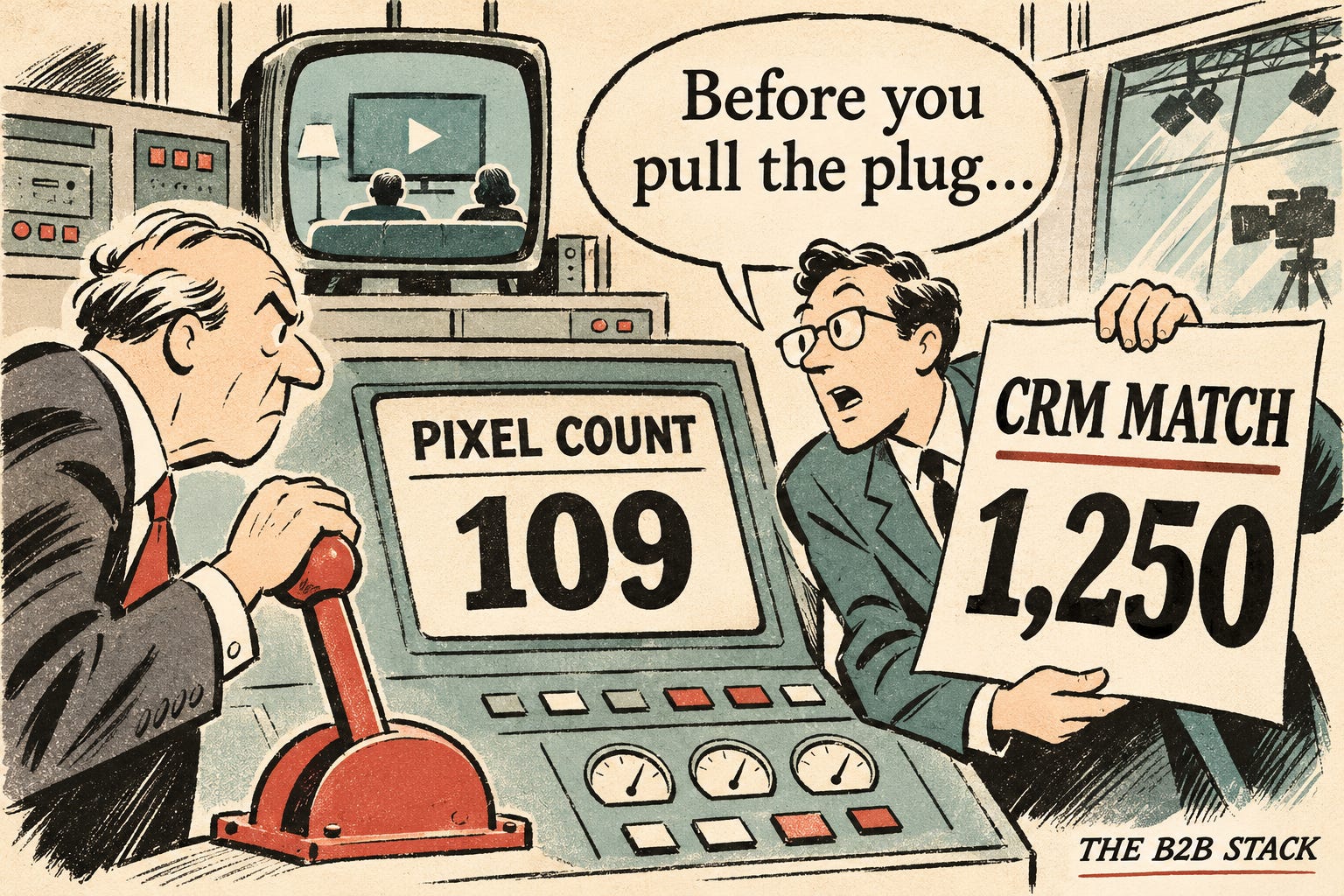
Two numbers in it matter here. First, InterMedia and Adstra tested IP-based ZIP code targeting and found only 23% of residential IPs reached the intended ZIP; device-level CTV identifiers held up far better. Adstra sells identity resolution, as Adweek noted when it covered the same study in July, which is the pattern of this piece again: the diagnosis usually arrives with a remedy attached. Second, for a DTC advertiser where 63% of purchases happen on an iPhone, the DSP pixel recorded 109 completed checkouts on a recent campaign. When the agency matched impression IPs against the advertiser’s own CRM logs instead, it found 1,250.
That anecdote is the log test in miniature. The pixel is the platform’s count, built on whatever identity match the platform could make. The CRM match is the buyer’s count. The buyer’s count was eleven times larger. Whichever number you believe, the decision to keep or cut CTV was about to be made on the small one, and the small one measures the pixel, not the television.
This is probably emblematic of measurement in 2026. Here is a television platform with every incentive to present itself in the best light, potentially under-reporting its own impact by an order of magnitude. On the platform’s own data you might switch the campaign off; on the log you might scale it up. Nyurenberg’s wider point is the same one: the channel closest to the receipt gets congratulated for the sale, and the channel that created the demand gets punished for sitting further from it. That is why the exercise is worth running in both directions, for over-reporting and for under-reporting, and why the only way to run it is with a file you hold.
For B2B the pixel catches even less. The conversion is a form fill three weeks later, on a laptop, from an office IP range that no household graph has ever seen, by a colleague of the person who watched the ad. The only count that means anything is the account-level one: did the companies we reached show up in pipeline at a higher rate than the companies we held out? That is a match you run yourself, against your own CRM, with your own list. It is also, in my experience, the only CTV number a CFO will accept twice.
Connected TV (CTV) for B2B: When It Builds Brand Memory and When It Backfires

B2B marketers have spent the last two years congratulating themselves for solving connected TV. The targeting got precise, the DSPs got clever, and identity graphs started matching households to job titles, so everyone assumed that was the hard part done and dusted. It wasn’t. Precision without respect for the viewer’s frame of mind doesn’t fix the CTV problem for B2B. It just moves the damage from “we wasted the budget” to “we actively annoyed the account we were trying to win.”
If you take one thing from this piece, make it that match. The B2B Stack is one argument like this a week, free, written from inside the plumbing rather than from the conference stage. [LINK: The Living Room Tax] is the companion piece on what television actually costs a B2B buyer.
Nyurenberg names the next problem himself: iCloud Private Relay already hid the iPhone IPs that connected a TV exposure to a mobile conversion, and Apple’s WebKit changes now reach LiveRamp, UID2 and ID5. Which brings us to the other half of the test.
There Is No B2B Funnel. There’s a Ghost Committee of 22, and Most of Them Have Never Heard of You.

Free report: “5 Things $39.6M in B2B Programmatic Spend Taught Us.” Three years of managed spend and a billion tracked page loads, turned into five findings platforms won’t put in a pitch deck. Subscribe free to unlock it, plus every new issue of The B2B Stack.
Who holds the key, and what did Apple change on 19 October?
Two things make a log worth having: who holds it, and what identifier it’s keyed on. On 19 October Apple moved the second one.
The WebKit team published an explainer for the identity-resolution blocking that ships in iOS, iPadOS, macOS and visionOS 27. The mechanism it describes is the one the whole post-cookie industry runs on: a third-party script on a login or newsletter form captures the email address, sends it to a central server, mints an opaque ID bound to that email and hands it back to the page. Logging out doesn’t remove it. Then comes the sentence that matters for every “first-party” identity pitch you’ve sat through. Even when the graph is scoped to a single company’s data, WebKit says, the central resolver is a third party operating as a clearinghouse. Safari now blocks those domains at the network level, and because the block sits on the domain rather than the request, a vendor can’t restructure the call to get round it.
Essentially, Apple is rug-pulling the identity fabric of the open internet.
The join key, the identifier that links a record on one site to a record on another, is what Apple has decided a tracker is. Server-side resolution was sold as the privacy-safe version of the same thing. Under this definition the location of the server is irrelevant. If a central resolver holds the key, it’s a third party, whoever’s data it holds.³
There is a second key in this story, and Apple holds that one. A month after the block first bit, AdExchanger noted there was still no published list of blocked domains and no way to appeal, and that in at least one documented case Google could bid on iOS inventory while The Trade Desk could not. The money noticed: Digiday’s analysis has iOS bid rates down 14% between 15 September and 8 October. A list you can’t read, held by a party that also sells ads, is the log test failing at the level of the operating system.
An account graph that resolves to companies sits on the other side of that line, which I argued at length in the account graph piece.
The Account Graph Is Not an Identity Graph

Most of the industry uses “account graph” and “identity graph” as if they’re the same asset wearing two names. They aren’t. One of them is a genuinely rare thing to build properly, and it isn’t the one that gets the coverage number printed on the sales deck.
The key is a firmographic entity. Nobody’s email address is involved. Its source is public record and your own CRM. You can hold it yourself. I run a company whose core asset is exactly that kind of graph, so weigh my enthusiasm accordingly, but the structural point stands without me: a key you hold, resolved to a company, survives 19 October. A key a vendor holds, resolved to a person, doesn’t.
The same custody question applies to the signals you pay for, including intent. One cold-email operator on X wrote in October that “surging on CRM software” usually means one intern googled something. The pushback from r/SalesOperations was that the real problem is data modelling and DataOps on the buyer’s side. Both are right, and they’re describing the same failure from two ends.
A signal that arrives without a source, a date and an expiry is a rumour. Put a rumour in a CRM field and an SDR will read it as a fact. That is what often happens with intent, and it is the whole argument of [LINK: Intent Data Needs an Expiry Date].
Meanwhile a sales-ops team on Reddit described paying Clay and ZoomInfo and still building its own job-change tracking in Claude, because so much enrichment traces back to the same handful of upstream providers. Three vendors, one underlying row, three invoices. Call that duplication, not diversification.
And this applies to managed service, mine included. If your programmatic partner won’t hand you the delivery file and an account-level match for you to map against your CRM, you’ve rebuilt the same problem with a friendlier logo on it. Ask for both. If you ask us, you’ll get both.
The log test: what are the four questions to ask before the money moves?
Before the attribution model, before the dashboard, before anyone argues about incrementality: does anybody other than the seller hold a record of what was served and what it cost?
Here is the test in full. Put it to any channel, platform or data vendor before the money moves.
Who holds the count? Is there a record of what was served and what it cost that the seller doesn’t control? A DSP seat with log-level data passes. A platform that bills on its own count of valid clicks, with no refund report, fails.
What does it reconcile against? Can the outcome be matched to something you own, such as your CRM or your own server logs? A pixel reconciles against nothing. A CRM match does.
Does the paperwork travel? Do the terms you agreed survive into execution, and does every signal carry a source, a date and an expiry? If the proposal has no handle in the bid request, or the intent score has no timestamp, the answer is no.
Who holds the key? If an identifier links your records to someone else’s, who holds it, and is it a person’s email or a company? Since 19 October that question has an answer in Safari.
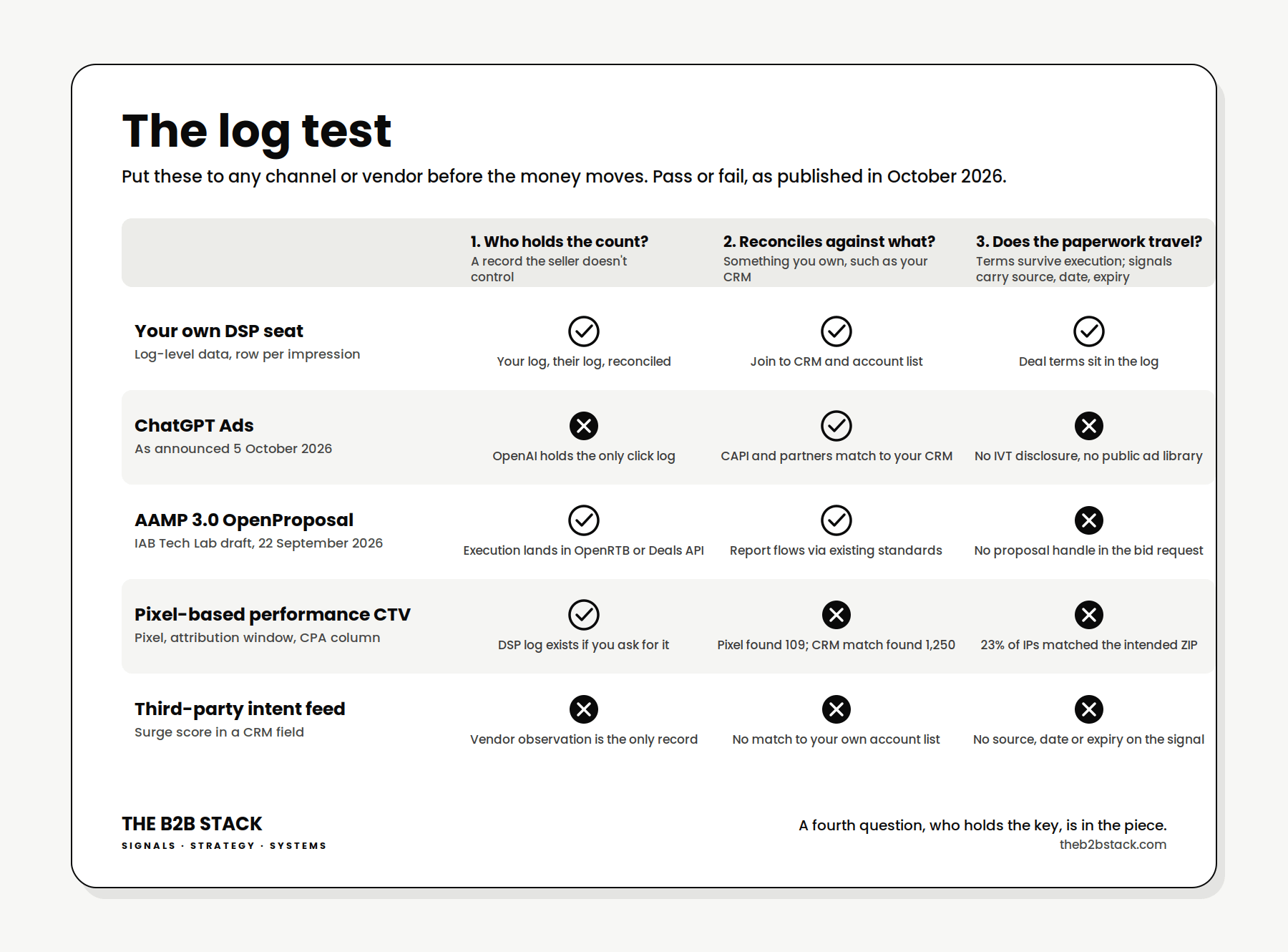
Two rules follow. A channel that fails questions one and two gets test budget to learn, never scale budget on the strength of its own CPA. A vendor that fails three and four goes into the CRM as a note, not a field.
Here’s where I’ll plant the flag. A channel that won’t give you a log you can reconcile isn’t a media buy. It’s a subscription with a dashboard. Most of the market will keep spending on those anyway, because the CPA looks good and the quarter is short, and I understand why. But if ChatGPT Ads showed you a CPA 15% below search and declined to show you the log, would you scale it? I wouldn’t. Tell me in the comments why I’m wrong, and what you’d need to see in the file before you did.
If you’d rather have the next test before the next invoice arrives, this is the place. One piece a week on the plumbing under B2B media: what to ask for, what the file should contain, and which numbers to stop believing.
[NATIVE SUBSCRIBE BUTTON]
Field Notes
Three more cases from the week of 13 October where the vendor sets the exam, sits it and marks it.
Google’s “optional” cap, 14 October. Google Ads introduced channel prioritisation and a percentage budget cap for low-priority channels such as search partners and the Display Network. Every cap above zero is described, in the blog post and the help page, as best-effort; only 0% is a hard stop. From February 2027, Search campaigns using Display migrate automatically, and Google’s suggested way to keep today’s behaviour is to set Display to low priority at 50%, which is also best-effort. Practitioners on r/PPC summed it up as “sure google, very optional”. A cap that aims rather than binds is a target, and the platform grades whether it hit it. Read alongside August’s change that steers budget-limited campaigns to their target CPA instead of letting them beat it, the pattern is clear enough: Google now decides what performance you’re allowed to have, and reports it to you.
GEO dashboards, threads from 16 to 19 October. Across r/GEO_optimization, r/aeo and r/DigitalMarketing, practitioners compared notes on AI-visibility tools. One agency found its roughly 200 tracked prompts matched real Search Console queries 9% of the time. Another worked out that appearing in four of ten runs gives a confidence interval of 17% to 69%. A third found 89% of URLs cited by ChatGPT were cited on a single day and never again. These are practitioner reports and much of the underlying data comes from the vendors themselves, so treat them as directional. The structure is the problem: the vendor chooses the prompts, then scores its own visibility against them. There is now a first-party file to reconcile against, since Search Console has carried a generative AI performance report since June, impressions only but Google’s own count. Before paying for AI visibility, ask for the prompt list and the overlap with that report. If the overlap is near 9%, you’re buying a horoscope with a login.
LinkedIn’s suggested audiences, X, 19 and 20 October. @kaleighf posted that LinkedIn’s suggested audiences beat her own ICP targeting; the measure was impressions. @Simon_Akrouche replied that more impressions may not mean more conversions. @kamilrextin then did the arithmetic that should sit on every B2B media plan: 1,200 target accounts times eight people on the committee is 9,600 buyers, so $5,000 makes you faintly familiar to a few hundred of them. When a platform grades its own suggestion on its own inventory, the metric it picks is the one it sells. The useful number is that denominator, and LinkedIn is one channel against it. I wrote about why the rest of the committee lives elsewhere in [LINK: The Buying Committee Doesn’t Live on LinkedIn].
Closing
The number one question in our client consultations this year has been “can we run ChatGPT ads?” The log test is one half of the answer. The other half is what ChatGPT, Gemini and Perplexity already say about you to the committee before any ad runs, and that is what The Advanced B2B AI Discovery Playbook is for: map the questions buyers ask, audit the answers, then use paid media to feed them. I built it to run inside Claude with very little manual work, and it is the companion to everything above. Subscribers get the discount code in the Subscribers’ Toolkit.
Are you about to sign off spend on a channel that hasn’t shown you a log? If you want to see what a proper delivery file and an account-level CRM match look like on your own accounts, I’ll walk you through ours. FunnelFuel runs B2B programmatic for the worlds leading vendors and their agencies. Hit me up below if you want to explore how we can help you do paid media better.
Three ways to reach me: connect on LinkedIn, message me on Substack, or email mike@funnelfuel.io.
No pitch, no obligation. If the log test is useful on its own, take it and use it.
¹ As a side note, if the answer is GA4, it is worth remembering that the ruler was built by one of the platforms being measured. I make no claims beyond that.
² Discrepancy thresholds were never standardised at the exchange level, but the working norm across the exchanges I dealt with was that anything under a few percent got billed to the seller’s number and anything over triggered an investigation. The direct-buy world did write it down: the 4A’s/IAB Standard Terms and Conditions v3.0, in force since 2010, name a controlling measurement and oblige both sides to reconcile when the two counts differ by more than 10%. The point was never the threshold. The point was that both sides had a number to compare.
³ Two weeks after the WebKit explainer, Apple’s CFO told analysts that Apple’s advertising business set an all-time revenue record in the September quarter. I’ll let you draw your own conclusion about a company that defines the tracker and sells the alternative. It doesn’t change the definition, which is the part that will outlast the headlines.
Sources: WebKit, Blocking Identity Resolution Infrastructure, 19 October 2026; AdExchanger on the unpublished blocklist, November 2026; Digiday, In Graphic Detail: What Apple’s identity block means for the ad money; David Nyurenberg, AdExchanger, 13 October 2026; Adweek on the Adstra and InterMedia IP study, July 2026; PPC Land on OpenAI’s 5 October measurement announcement; PPC Land on TrafficGuard’s ChatGPT click study, 30 September 2026; PPC Land on AAMP 3.0, 22 September 2026 and the extension to 10 November; Deniz Genc on the missing proposal handle, 5 October 2026; Google on channel prioritisation and budget allocation, 14 October 2026; PPC Land on the 17 August target-CPA change; 4A’s/IAB Standard Terms and Conditions v3.0; practitioner threads on r/adops, r/PPC, r/SalesOperations, r/GEO_optimization, r/aeo and r/DigitalMarketing, and posts from @pesach_lattin, @MrColdEmail, @kaleighf, @Simon_Akrouche and @kamilrextin on X, 13 to 20 October 2026.
The TV platform underreporting its own performance is the example that stuck with me. Everyone assumes vendor dashboards flatter the vendor, so a number that runs the other way probably gets ignored before anyone checks the raw data.
Raw logs over dashboards, always. With ChatGPT ads I'd also watch the answer sitting above the ad. That probably moves results too, and no report will show it.