

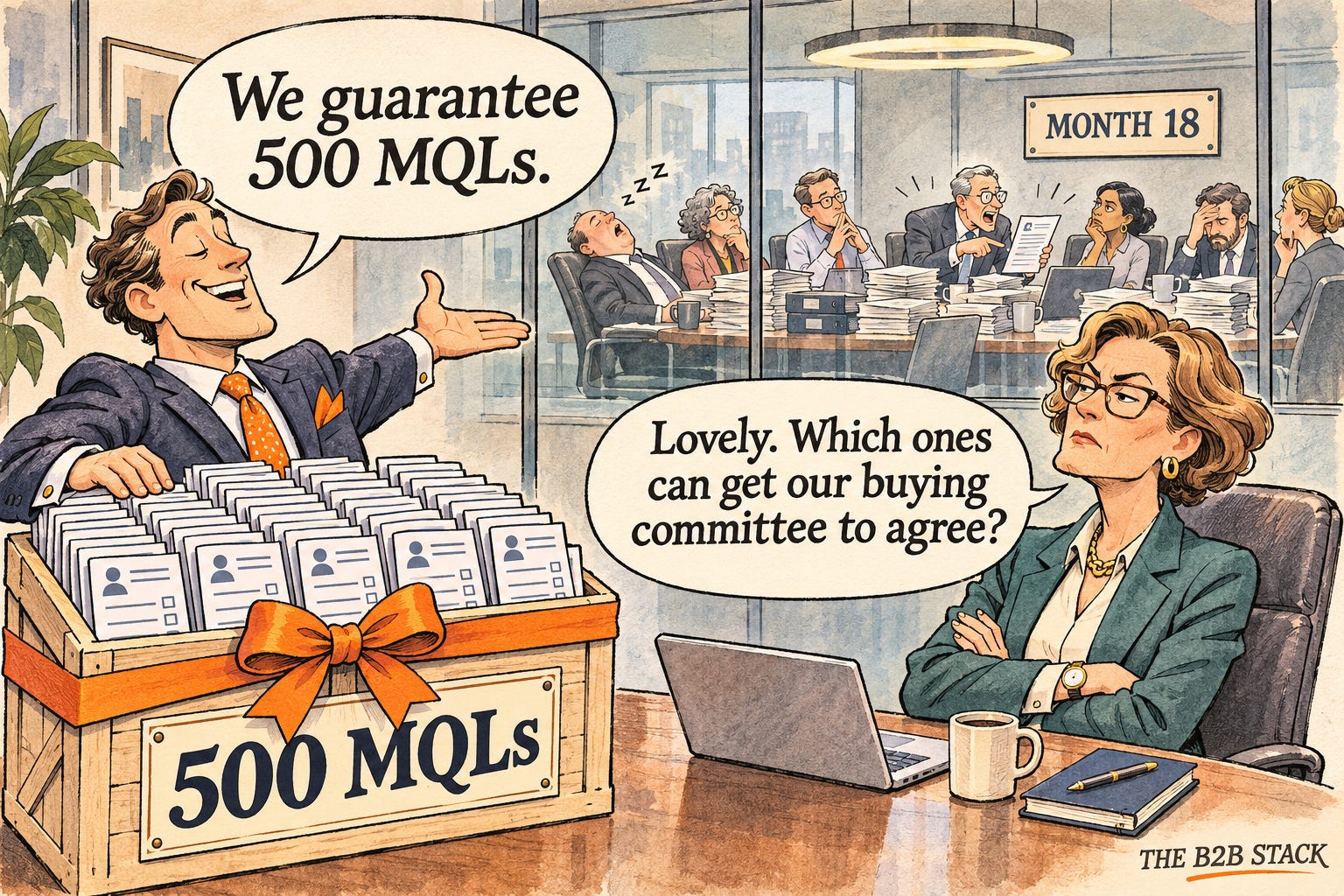
Guaranteed outcomes have become a big thing in B2C agency land, and it is spreading into B2B. In consumer marketing, it is often a sale or CPA, but what shape could outcomes take in enterprise B2B where there is seldom a checkout and we are facing buying journeys that can span upwards of 18 months? No ad impression will directly drive a B2B sale, but that does not rule outcomes out yet, as we will explore today.
This piece looks at the guarantees a B2B media agency or media owner can put its name to, the ones it should refuse, and what carrying the risk costs. It matters now because it’s budget season: finance and procurement want part of the fee at risk, “outcomes” is on every media owner’s slide, and agency teams are being asked to sign something new.
In a tough economic climate, including rising interest rates, two global wars, and a wider supply chain challenge, it’s no wonder that the guaranteed outcomes are particularly attractive as we stare 2027 in the face.
However, nearly every version of that conversation I hear starts from the same belief: that a guarantee means promising leads, pipeline or revenue. My view is that this is the wrong place to start, because those are the things an agency controls least, and a guarantee on something you don’t control is either a bet or a bluff. So let’s take it in order.
New here? I’ve been building B2B programmatic platforms since 2011. I’m a co-founder of FunnelFuel, where we run advanced account-based programmatic for B2B brands. For the measurement side of this argument, start with Your Media Vendors Are Marking Their Own Homework.
Subscribe and you’ll get the next issue, plus the Subscribers’ Toolkit.
What you’ll learn
Why performance incentives are at a 34-year low
What separates a guarantee from a target
Why the platform guarantees lock B2B out
Three guarantees a B2B agency can sign, and two it should refuse
Who carries the risk, and the measurement a guarantee needs
Why is everyone suddenly talking about guaranteed outcomes?
Start with the number that explains the mood. The ANA’s 2025 Trends in Agency Compensation study found that only 15% of marketers use performance incentives with their agencies, a 34-year low, down from 61% in 2013. Value-based pricing has fallen to 8%, from 20% in 2016.
Two flags: a sample of 99 marketers, and a linked article written by Decideware, a vendor, with the full report paywalled. The direction holds, though, because the same study has 86% of marketers planning to revisit agency compensation within 12 months, only 28% with adequate visibility into how their agencies make money, and 84% naming the absence of shared measurement as a barrier. Gartner’s 2026 CMO Spend Survey adds the pressure: paid media is now 31.4% of marketing budgets, “funded by cuts to agencies”.
The holding companies know it.
WPP’s CFO, Joanne Wilson, said in May that performance-linked fees now make up 20–25% of net sales. However, WPP’s CEO, Cindy Rose, says fully outcome-based pay is “a few years” away, and Publicis’ CFO put it at “roughly 10% of our total remuneration… still very early days”. Meanwhile, outcomes-focused buying technology like Viant is markedly outstripping the growth (or lack of) seen by the trade desk, and wider ad tech service businesses like Channel Factory have seen huge growth since adopting an outcomes-predicated buying model - all of which makes it fairly evident that there’s a market for this.
The gap between the talk and the contracts is measurement. MediaSense and the WFA’s June 2026 report (a Meta co-sponsored survey of 77 agency leaders, so directional) found 85% expecting outcome-based pay to grow, with attribution (69%) and data access (68%) as the barriers and hybrid models expected to win.
And measurement is the obvious bottleneck to all of this, not least in B2B. The reality is, attribution and tracking has only gotten more challenging as the privacy net has tightened and the funnel has gotten darker - meaning, one way or the other, more of a buying journey is happening in environments where we can’t place a pixel, so when we can’t infer the progress towards pipeline.
If the account can’t find your client, no guarantee will save the campaign. Agencies proving account-level outcomes also need to know whether the client shows up when buyers ask ChatGPT, Gemini or Perplexity for a shortlist.
The Advanced B2B AI Discovery Playbook is the only playbook I know of built for that problem the B2B way, and the Playbook Operator runs it inside Claude with very little manual work. Get the playbook.
What actually counts as a guarantee?
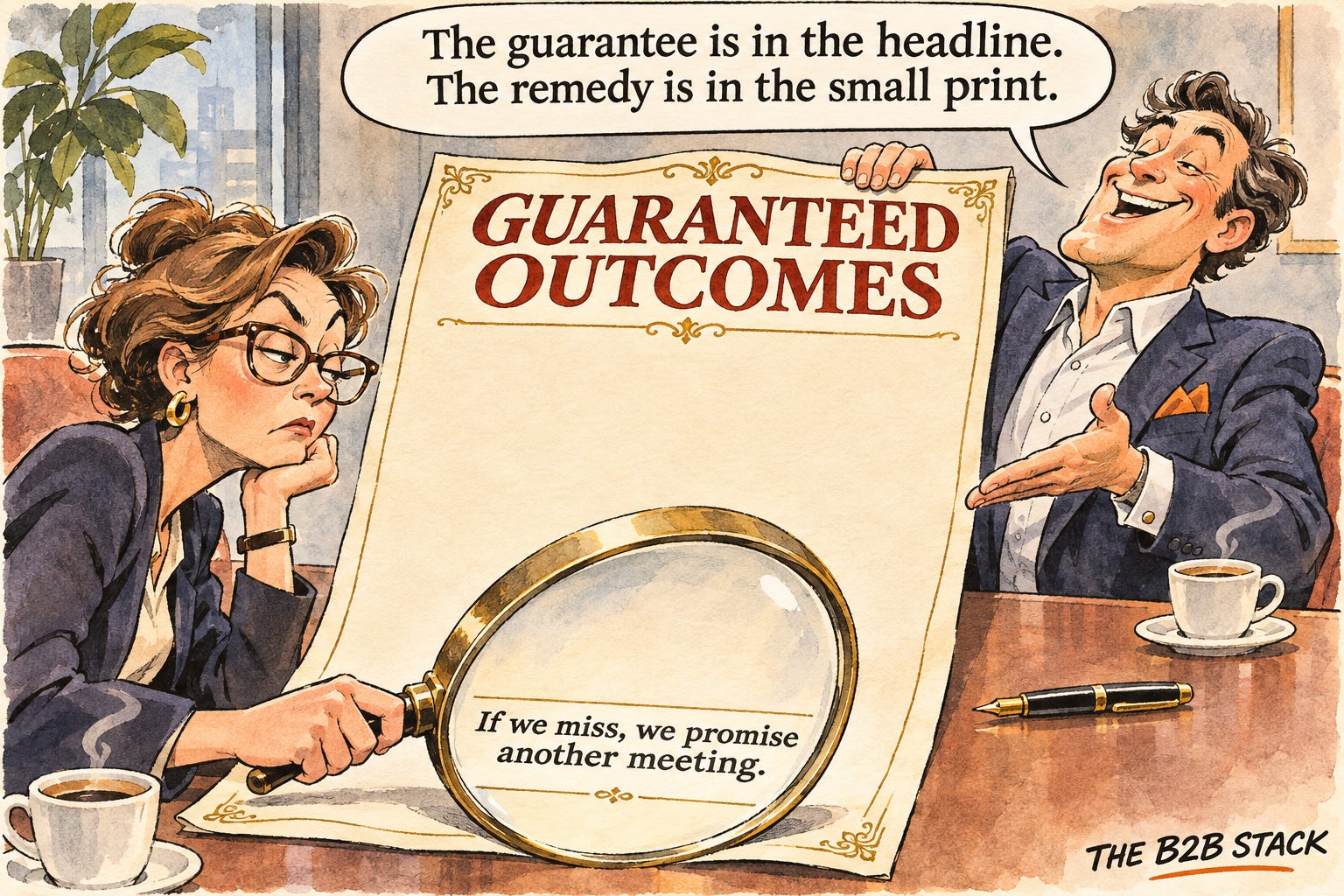
A guarantee has three parts, and most of what the industry calls one is missing the third: these three things are
A KPI - what is the outcome that we’re talking about?
An agreed way of measuring it
And a remedy if it’s missed.
Take away the remedy and you have a target. Take away the agreed measurement and you have an argument.
The clearest public template is Epsilon’s Ad Quality Guarantee: viewability of at least 50% and fraud at or below 0.99%, measured by IAS, with four make-good impressions for every failed impression. The small print: a $100k minimum spend per 30 days, make-goods that expire after 90 days, and an offer Epsilon can revoke.
Compare Amazon’s DSP terms, where below 70% viewable delivery the parties “use commercially reasonable efforts to agree upon the conditions of a makegood flight”. That is a promise to talk, which makes it a target.
Other agencies are only getting close to an outcomes model when a predefined flight of media on a regular CPM has been run beforehand.
This is creating a very clear divide between outcomes as an objective and guaranteed outcomes as a contract point
Xandr’s Guaranteed Outcomes is the third template, and it prices the risk: the buyer pays per view or completion, the seller is still paid on CPM, and Xandr sits in the middle carrying the risk for a 10% market-making fee. Beyond those three I found no true pay-on-outcome guarantee product from the big TV networks or the measurement firms; they mostly sell measurement and benchmarks, and a benchmark without a remedy is a target.
To be brutally honest, most of these “outcomes” are soft media metrics, or, in the case of viewability standards, it should be the de facto norm and not need guaranteeing anyway. So most of what we talked about above doesn’t really count as outcomes at all - which is why we’ll now move on to talking about outcomes in the way that I would see an outcome being, and line it up against B2B specifically.
The content continues below, but it’s only available to free subscribers. Subscribe today to get access to this content as well as our weekly posts, deep dives, and unqiue research - and join over 1,600 marketers from leading agencies like Dentsu and WPP, through to vendors like Salesforce.