

Every client conversation I have had since the summer has contained the same question, usually in the first ten minutes.
“Can we run ChatGPT ads?”
It arrives in different forms. Can we buy into Perplexity. What is Google doing in AI Mode. Is there a programmatic route. But the question underneath is always the same one, and it is a good instinct badly aimed. The instinct is that the buyer has moved and the budget should follow them. That is right. The aim is that the way to follow them is to buy the surface they moved to. That is where it goes wrong, and the evidence for why is better news than most marketers expect.
This is the piece I have been meaning to write all year, and it is the companion to something bigger that I will get to at the end.
New here? I’m Mike Harty. I’ve spent fifteen years building B2B programmatic platforms, first at PowerLinks and now as co-founder of FunnelFuel, where we run account-based media for B2B vendors and agencies. The B2B Stack is where I write down what the data is telling us before it becomes conventional wisdom. If you want the backdrop to this piece, start with The Observer’s Paradox in B2B and The Ultimate B2B Programmatic Glossary.
Subscribe and you’ll get the next issue, plus the subscriber toolkit with the discount code mentioned at the end.
1,600+ B2B marketers follow and subscribe, including teams at dentsu, WPP, Informa and Salesforce
What you’ll learn
The 2026 research on how B2B buyers now research, in one place, with the numbers that matter and the ones that don’t
What you can actually buy inside ChatGPT, Google’s AI surfaces, Copilot and Perplexity as of November 2026, and the B2B caveat nobody mentions
The 75,000-brand study that reframes the whole question, and why it points away from the engines and towards the media you already run
What paid media actually does for AI discovery, surface by surface
The answer I now give in the room
The buyer moved. Here are the numbers.
Everyone in B2B marketing knows this has happened. Very few have seen the evidence side by side, so here it is.
Start with our own data, because it is what made me take the question seriously. FunnelFuel tracks what identified accounts do when they land on a vendor’s website, across hundreds of millions of page views. A few years ago roughly 30% of account-based first touches landed on educational content: blog posts, guides, comparisons. The buyer was learning on the vendor’s site and the vendor could watch them do it. That share has collapsed. The first thing a target account does now is land on pricing, a demo request, a comparison written for people who already know the category, or the trust centre. The learning did not stop. It moved somewhere nobody can log a page view.
The market research says the same thing from the buyer’s chair.
G2 surveyed 1,076 B2B software buyers in March this year. Fifty-one per cent now start research in an AI chatbot more often than in Google, up from 29% eleven months earlier. AI chatbots have become the number one influence on which vendors make the shortlist, ahead of review sites and ahead of vendor websites. Sixty-nine per cent chose a different vendor than they had planned because of what a chatbot told them, and a third bought from a vendor they had never heard of before the chatbot named it.
6sense asked nearly 4,000 buyers about their last purchase. Ninety-four per cent used a large language model somewhere in the process. First contact with a seller now happens 61% of the way through the journey. And the number that should be on every CMO’s wall: the vendor that won was on the buyer’s shortlist on day one 95% of the time, up from 85% two years earlier.
Forrester’s State of Business Buying 2026 puts 13 internal stakeholders and nine external participants on the average purchase, and finds generative AI the single most cited “meaningful interaction” in the research phase. Its buyers do not trust the AI output on its own; they validate it through colleagues, peers and industry experts before acting. Procurement arrives earlier than it used to. Trials are a precondition.
Gartner’s headline prediction for 2026 is that by 2028, 90% of B2B buying will be intermediated by AI agents. Dreamdata’s 2026 journey benchmarks put 81% of the B2B journey before a lead enters any tracked pipeline, up from 70% a year earlier. And on the Google side, Ahrefs’ February study of 300,000 keywords found the top organic result loses 58% of its clicks when an AI Overview appears, up from 34.5% ten months before.
Put those together and the shape is clear. The consideration set is drafted inside an answer engine, by a committee that is larger and more cautious than it used to be, before anyone visits a website. If you are not in that first draft, the research says you will spend the rest of the cycle trying to displace someone who was. That is the problem the client in the room is feeling when they ask about ChatGPT ads. They are right to feel it.
What you can actually buy inside the answer
Here is the honest state of play. I have dated it, because it has moved every quarter this year and it will move again.
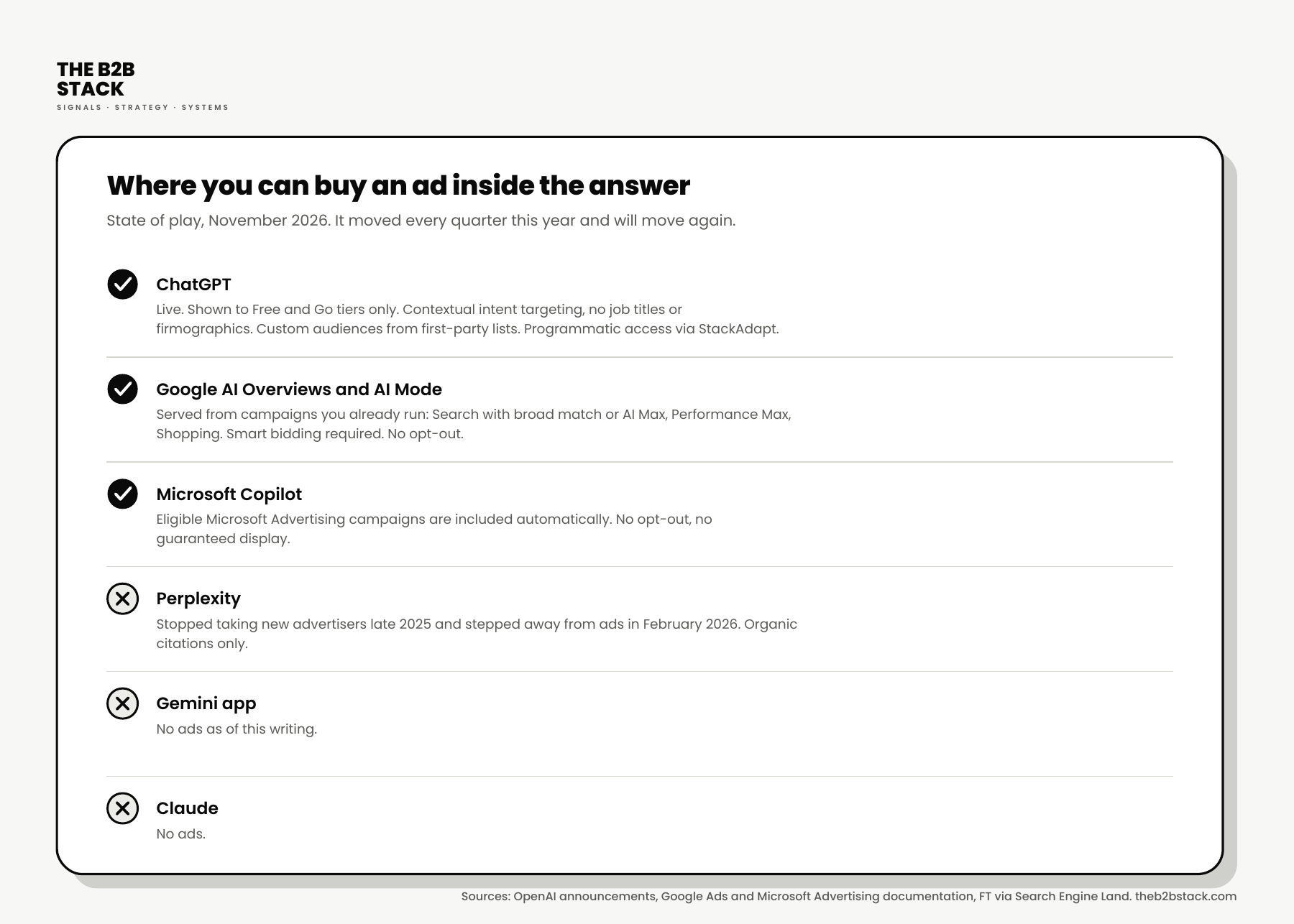
ChatGPT. OpenAI started showing ads in the United States in February, opened a self-serve Ads Manager in May and extended to the UK and other markets over the summer. Ads appear only for users on the Free and Go tiers, which is the first B2B caveat: a meaningful share of senior buyers sit on paid plans and will never see one. Targeting is contextual intent matching against the conversation. No keyword lists, no job titles, no firmographics, no account lists in the ABM sense, though custom audiences from first-party data arrived in May. Bidding is CPC. StackAdapt was reported in May as the first programmatic platform with ChatGPT inventory, which is the first sign of this surface entering the DSP world and the thing most of my clients are really asking about.
Google AI Overviews and AI Mode. You are probably already there. Ads in Google’s AI surfaces are served from campaigns you already run, with Search broad match or AI Max, Performance Max and Shopping all eligible, smart bidding required and no opt-out. The practical move is an audit of what you have, not a new budget line.
Microsoft Copilot. Eligible Microsoft Advertising campaigns are included automatically. No opt-out, no guaranteed display. If your buyers live in Microsoft 365, your existing spend is in there.
Perplexity. Stopped taking new advertisers in late 2025 and, per the Financial Times in February, stepped away from advertising altogether. It is an organic-citation surface only, and for B2B software it is the most review-site-heavy engine of the lot.
Gemini and Claude. No ads.
So the direct answer to the client’s question is: yes, in ChatGPT and in the Google and Microsoft surfaces you already buy, with real limits on who you can target and who will ever see it. A small, ring-fenced test is sensible. I would structure it around the intent clusters your buying committee actually prompts with, land it on proof pages rather than demo forms, and judge it on identified target accounts arriving rather than on clicks.
But that is the answer to the wrong question. The right question is what moves the needle on being named in the answer in the first place. And the data on that points somewhere else entirely.
Know someone who has asked for a ChatGPT ads budget this quarter? Send them this before the budget meeting. It will either save them the money or make them spend it properly.
The study that reframes the question
In 2025 Ahrefs analysed 75,000 brands to find out which measurable factors correlated with a brand being named in Google’s AI Overviews. In December they repeated the exercise across ChatGPT, AI Mode and AI Overviews. The results are the most useful numbers I have seen on this subject, and they are not the numbers the AI-SEO industry leads with.
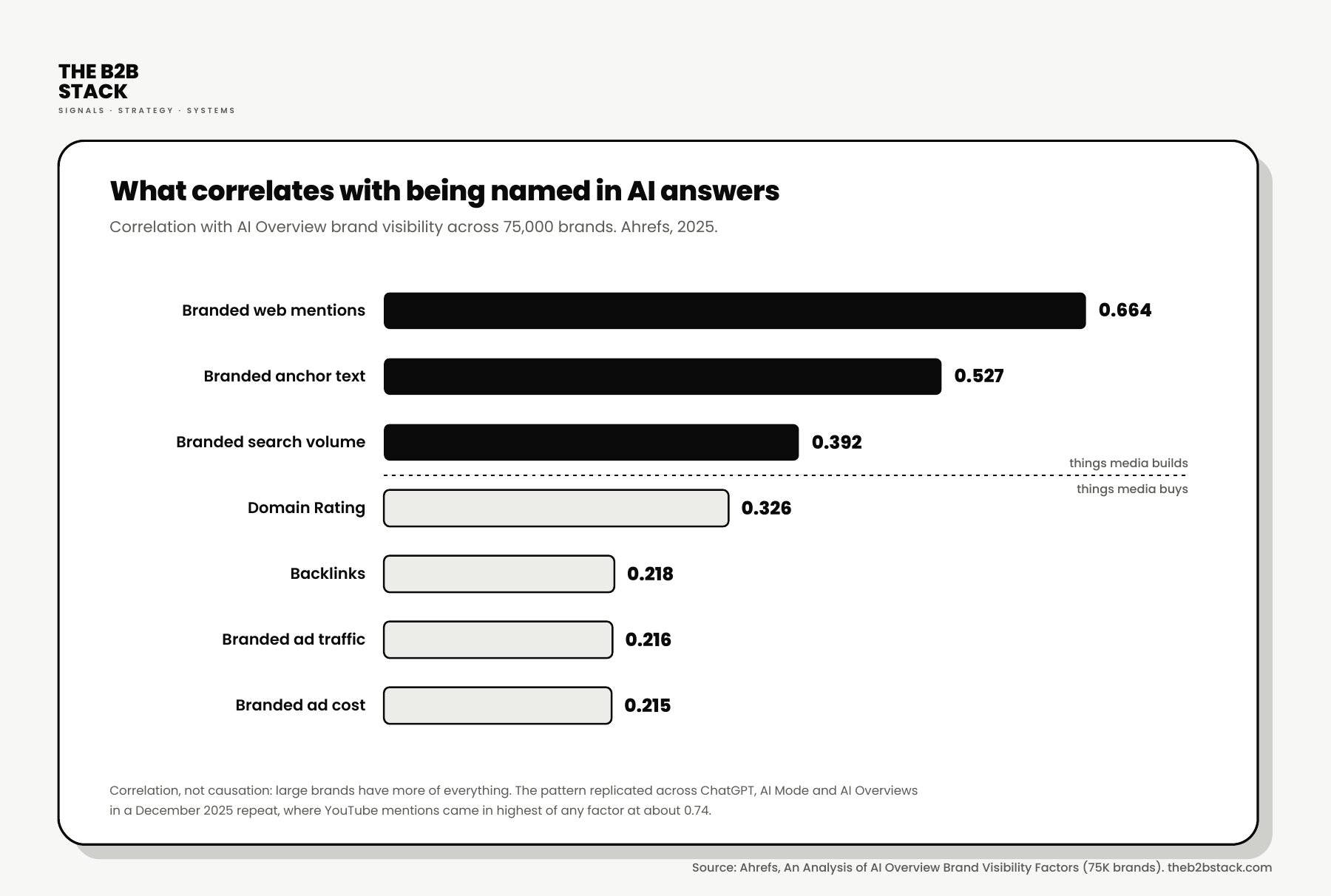
The factor most strongly correlated with AI visibility was branded web mentions, anywhere on the web, at 0.664. Branded anchor text followed at 0.527 and branded search volume at 0.392. Then the things SEO has spent twenty years optimising: Domain Rating at 0.326 and raw backlinks at 0.218.
And at the bottom, the two factors most marketers reach for first when they hear the word “paid”: branded ad traffic at 0.216 and branded ad cost at 0.215. Ahrefs wrote plainly that throwing money at paid search would not necessarily help.
Twenty-six per cent of brands in the study had zero mentions in AI Overviews. Brands in the top quartile for web mentions earned up to ten times the AI mentions of the quartile below. When the exercise was repeated in December, branded mentions correlated at 0.656 to 0.709 across the three engines, and YouTube mentions came in highest of any factor at around 0.737. A separate analysis by Kevin Indig found brand search volume correlating at 0.334 with chatbot mentions.
Two cautions, both of which Ahrefs made itself. These are correlations, not controlled experiments. And large brands have more of everything, so some of the relationship is size. Nobody has yet published a trial showing that adding mentions moves AI visibility. What we have is a replicated pattern across a very large sample and a mechanism that explains it, which I will come to. I treat that as strong enough to plan on and weak enough to measure.
Here is the reading that matters for the client in the room. The factor with the weakest relationship to being named in AI answers is paid traffic to your own site. The factors with the strongest relationships are people mentioning you, people searching for you by name, and video about you. Every one of those is a downstream effect of people having heard of you, talked about you and gone looking for you. And every one of those is what a brand-to-demand media programme is built to produce.
Why mentions matter and clicks don’t
The mechanism is worth a paragraph, because it tells you where to point the money.
An answer engine has two places to get information from. The first is what the model learned in training: the open web, over years. If your company has been written about, reviewed, discussed and compared across the web, the model has a representation of you before anyone types a prompt. This is why a brand can be named in an answer with no link attached, and why a brand with no footprint can be absent even when its content is perfectly retrievable. The second is what the engine fetches at the moment of the question, from a live index, in a handful of sub-queries. This is where citations come from, and the 2026 citation studies agree on what gets fetched: Reddit is the most cited domain across every engine, with YouTube, LinkedIn, Wikipedia and the editorial press behind it. AirOps’ estimate is that 85% of top-of-funnel brand mentions in AI answers come from domains the brand does not own.
A click from a paid search ad to your pricing page teaches the model nothing about who you are. A thousand people recognising your name in a comparison thread, searching for you after a podcast, or watching a demo on YouTube, teaches it a great deal, and leaves behind the third-party pages that the retrieval step then fetches. Paid media does not buy you a citation. It builds the conditions under which a citation becomes likely.
What paid media actually does for AI discovery
Once you see it that way, the media plan reorganises itself around the buying committee rather than around a channel budget, and each surface has a specific job.
LinkedIn’s most useful format here is not the brand ad. It is amplifying the long-form, dated, specific posts from your executives, your employees and the creators you work with, because LinkedIn content is cited in roughly one in seven ChatGPT search answers and named human statements are what survive retrieval.
YouTube is the single most under-used surface in B2B. It leads citations in Perplexity and AI Overviews, and video mentions carried the highest correlation with AI visibility of anything Ahrefs measured. Paid distribution of chaptered demos and honest comparison walkthroughs builds view velocity on the one video domain every engine trusts.
Programmatic display belongs on the publishers the engines cite. Your citation audit tells you which trade titles and comparison publishers feed the answers in your category; that list is a publisher list, and a sponsored data piece on one of those domains is a mention the engines will retrieve.
CTV, audio and digital out-of-home are the roles LinkedIn under-reaches: the economic buyer, finance, procurement. They build brand memory, and brand memory is branded search, which is the 0.392. In our own client work, accounts exposed to sustained account-based brand campaigns show more pricing-page first touches and more branded search than unexposed accounts on the same list. That is our data, directional, and we are building the holdout tests to make it harder evidence.
Paid search keeps a job, and it is not the one it used to have. It is retrieval protection: making sure your pricing, comparison and alternatives pages are what ranks on Google and Bing for the committee’s evaluation queries, because classic rank still predicts what the engines fetch. Do not expect it to move the brand’s presence in answers. The data says it won’t.
Then close the loop. AI referrals are about 1% of sessions and convert several times better than organic search, because the engine has already done the qualifying. Resolve those visitors to accounts and retarget at account level with the next piece of proof, not a demo ask. That is where an AI discovery programme and an account-based media programme become the same programme, and it is where the interesting work is right now.
The Advanced B2B AI Discovery Playbook, 2027 Edition
The full playbook for getting your brand named in AI answers, built around the buying committee.
Subscribers get $30 off via the Subscribers’ Toolkit page.