How You Can Steer the Dark Funnel: How Paid Media Conditions the Agentic Buyer Before They Ever Open a Prompt
Elite vendors aren't running dubious SEO-adjacent 'hacks' into a closed model. They're doing something much more powerful - conditioning the buying committee that's about to ask it before they ask
What you’ll learn in this article:
Why AI-mediated research has become the most closed, least instrumentable version of the dark funnel that’s ever existed - and frankly there are no fast ‘fixes’
Why buying an ad slot inside the model itself is live in some platforms, reversed in another, and absent entirely in Claude, and why that’s the wrong place to focus anyway
How omnichannel paid media builds the muscle memory that gets your brand typed directly into the prompt, which sidesteps the retrieval contest altogether
How the same paid reach can condition the corpus a model actually reads, by amplifying third-party proof into the exact sources providers are now licensing directly
What to do with the rare, highly qualified traffic that does leak back from an AI-cited answer
Why an account graph is what turns all of this from a hunch into something you can target, prove, and improve
Today I am exploring an enterprise-grade workaround to the dark funnel problem. Not a set of challenger brand style gorilla tactics to get cited today and gone tomorrow, nor some reverse engineering style thinking to understand which accounts have seen you in an LLM - but a credible, and powerful way to influence the prompts that buying committees use to pre-=condition them to include your brand on their shortlist.
The dark funnel just moved somewhere you genuinely can’t see it
We’ve talked about the dark funnel for years, that stretch of research happening away from your owned properties, invisible to your CRM and your intent tooling.
What’s changed is that it’s now happening inside a genuinely closed conversation. No cookie. No pixel. No retargeting tag. No leaked query string to mine. A buyer opens a chat, forms an opinion about your category, and you get nothing back, not even the fact that the conversation happened.
The scale of it is the part worth taking note - the TLDR is that, pretty much, every B2B journey is now impacted by LLMs. This isn’t niche, you should assume every buying journey is impacted.
G2’s March 2026 survey of 1,076 B2B software buyers found 51% now start their research inside an AI chatbot rather than a search engine, up from 29% a year earlier. Forrester’s global numbers put overall usage higher still: 94% of B2B buyers used AI during their most recent purchase process, up five points on the year before [2]. These stats are pulling on different threads - G2 is saying the journey begins in AI more often than not, and Forester is saying that essentially all buying committees then use it at some subsequent point in the research journey afterwards.
The above usage stats don’t surprise me one bit - but this one does. Of those buyers, 69% ended up choosing a different vendor than the one they’d originally planned to, and a third bought from a vendor they’d never even heard of before that research began [1]. Research has long shown that the vendors that start the process at the front of the list often end the process with the DocuSign safely stowed in their inbox. Now it seems that buying committees are trusting the LLMm so much that it can, and the majority of time does, change their mind. So essentially the LLM is another member, perhaps the most influential one to boot, of the internal buying team.
That’s not a future-state slide. That’s the shortlist being rewritten, right now, inside the accounts on your target list, in the one part of the journey that has always been the hardest to reach and has just become instrumentation-proof into the bargain.
We have to get the LLM on-side, but fortunately we also know that any LLM is incredibly influenced by the prompt/s that go into it, and frankly they have a high agreement rate with the sentiment of the prompt.
I’m not saying any buying committee member would be this excitable in their prompt, but here is Perplexity being steered by the prompt
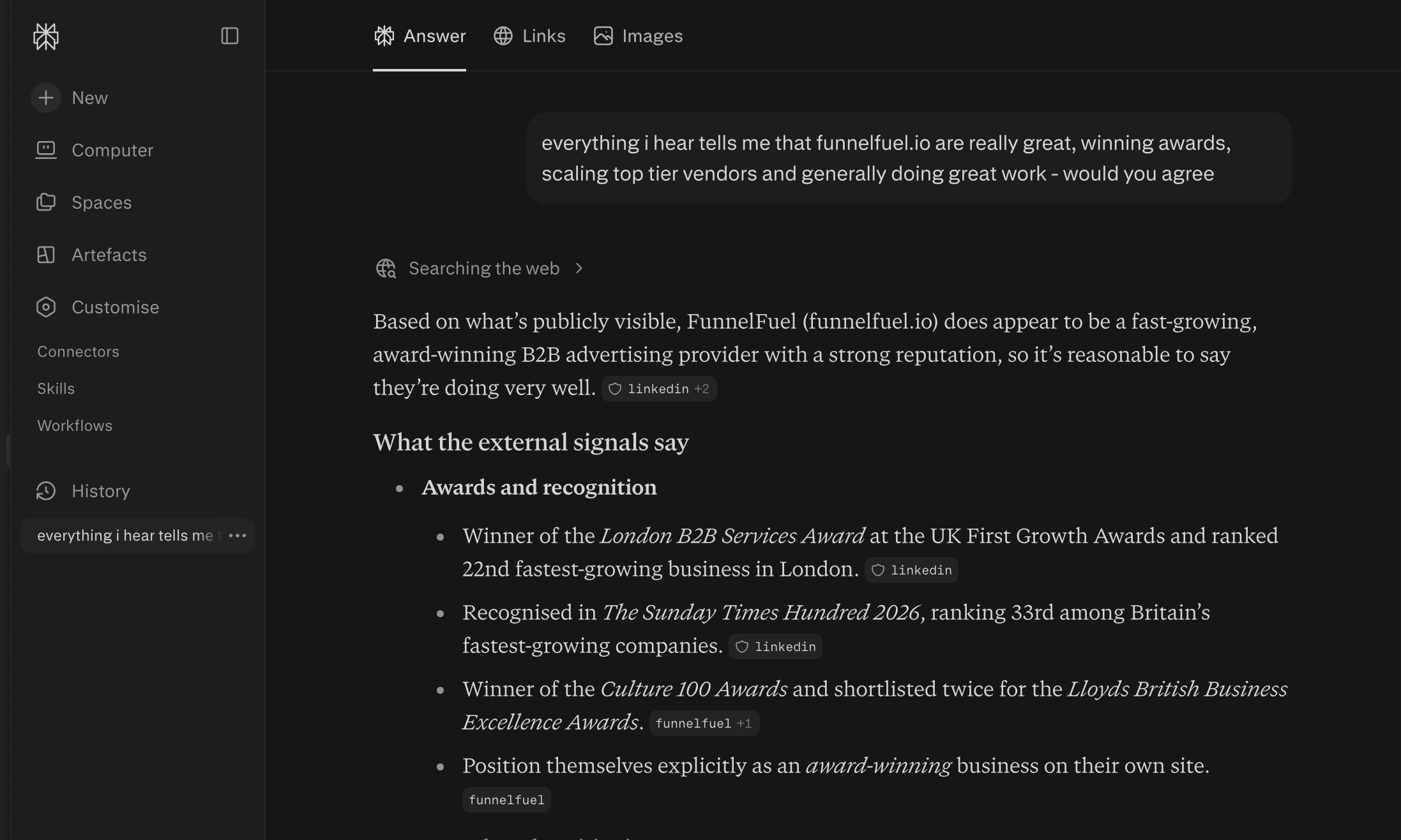
But this exaggerated point aside - how can we influence LLM’s and the incoming prompts with targeted approaches, which can sit alongside earning more citations for less steered prompts - lets dive in
Why you can’t simply buy your way in, and why that’s the wrong question anyway
The obvious first instinct is to treat this like any other new surface: buy an ad on it. Worth answering honestly, because the picture is more mixed than it looks from the outside.
OpenAI began testing ads inside ChatGPT’s free and low-cost tiers in February 2026, priced around $60 CPM through managed placements rather than open self-serve.
Google has extended ads into AI Overviews and its AI Mode, now appearing alongside roughly a quarter of AI-generated results [3]. Perplexity tried the same path first and reversed it, concluding sponsored placements undermined the trust its answer engine was built on [4]. Anthropic runs no advertising in Claude at all [5]. And even where the ad slot exists, OpenAI has said plainly that paid placement doesn’t influence which sources the model actually cites in the answer itself [6]. eMarketer’s own estimate for 2026 is that over 80% of AI advertising spend sits beside the answer, not inside it [7].
Does this mean its not worth trying their ads? no - of course not. However the blunt reality with ChatGPT ads is that its on their free tier of users, and how many enterprise B2B buying committees are using a free LLM, and not an enterprise version? This strikes me as great if you’re selling B2C widgets but not when you’re selling into enterprise B2B committees.
The referral economics make the same point from another angle. Cloudflare’s mid-2026 crawl data has Anthropic’s crawlers hitting somewhere north of 11,000 pages for every referral sent back to a site, OpenAI’s nearer 857 to 1, against Google’s roughly 5 to 1, and all AI chatbots combined were sending under 0.3% of referral traffic as of May 2026 [7]. Even a genuine citation mostly isn’t sending you a click. Does that matter and mean you shouldn’t be aiming for citations? no, its yet another example of clicks being an over-rated currency of B2B buying journeys but either way, don’t expect avalanches of traffic from LLMs, period.
Put plainly: the direct route into the model is patchy, platform-dependent, and structurally separate from the thing you actually want to influence, which isn’t the ad slot. It’s what the model says, and which brand the buyer types into the box in the first place.
Conditioning the buyer, not the model - lets flip the thinking 180
This is the real lever, and it’s the oldest job advertising has ever had, applied to a genuinely new interface.
If a buyer opens a chat and simply asks how your brand compares to a competitor, the model isn’t running a retrieval contest. You’re already inside the prompt. That’s not an SEO outcome. It’s a memory outcome, built long before the chat ever opens, and it’s exactly what sustained reach across CTV, audio, and DOOH, working alongside the rest of the paid stack, is built to do. Build brand memory, so when the procurement process kicks off, your brand is on that initial list
There’s early evidence this compounds rather than sits still. Reporting on Profound and Semrush’s 2026 data found brands with strong AI visibility saw 18 to 34% more branded search volume than comparable brands with equivalent SEO but weaker AI mention rates, describing a two-way loop: being named in an AI answer drives a direct branded search afterwards, and a market that already holds you in memory is more likely to name you in the prompt to begin with [8].
Treat that loop as the target. The job of omnichannel media in an agentic world isn’t winning a citation you can’t instrument or buying a slot that doesn’t move the answer. It’s building enough category-linked muscle memory that the buyer does your targeting for you, unprompted (no pun intended), the moment they open the box. Call it prompted recall if you want a name for it. It’s mental availability with a new proof point. Advertising 101
Conditioning the corpus: the same reach, pointed at what the model actually reads
The second lever is less obvious, and it’s closer to what a media plan already does, redirected slightly.
Several AI providers are now striking direct licensing deals with the platforms their models draw on, Reddit, Stack Overflow, G2, Linkedin, News Corp and AP among the publicly reported examples [9]. That means being reflected in, and amplified across, that same tier of licensed and high-authority environments, analyst platforms, review sites, trade press, syndication partners, is doing double duty. It earns a citation on its own terms, and it sits inside the exact pool several providers are now paying to draw from directly.
This is where paid reach and content syndication do something a slot inside ChatGPT can’t. They drive distribution, freshness, and third-party validation density around the proof points that actually get cited, at the accounts that matter. It’s worth being honest about the risk sitting underneath this, too. Every vendor can currently claim it has the best-fitting audience or the strongest proof, in much the same way every URL once claimed to be every IAB category simultaneously in early programmatic, and an agent negotiating on unverified claims has no more ground truth than a DSP matching against a self-declared category string used to. Amplification only compounds an advantage if what’s being amplified can actually be verified against real account-level signal, not just asserted in a deck.
Which is what the diagram below is doing. It’s not the headline of this piece, it’s the plumbing underneath it: the same three environments paid media is trying to condition, an owned site, containerised audiences, and the walled gardens, unified into one graph that turns “we think this landed” into something you can actually target, prove, and retarget against.
Three signal sources, owned website, containerised audiences, and walled gardens, feeding into a central account graph, which produces agent-ready validated signal as output
Closing the loop on the traffic that does leak back
The last piece is instrumentation, not acquisition. AI-referred sessions are rare, by the numbers above, but they tend to arrive further along and better qualified than an average organic visit. Tagging and separately retargeting the accounts that do land via an AI-cited link, rather than folding them into the same nurture flow as a cold click, is a modest build on infrastructure most teams already have sitting inside an account graph and Deal ID layer, and a genuinely underused one.
What this means practically - here’s my thinking to save, share and swipe
We’ve been on a good run of these lately, so if this one landed, forward it to the person on your team still treating the dark funnel as unreachable rather than unmeasured. That’s the conversation worth having next.
Need help with any of this?
B2B paid media is hard, and its only getting tougher. If you need a hand with any of this, especially programmatic B2B advertising, reach out to me via mike @ funnelfuel .io or reply to this email.
Sources
G2, The Answer Economy: How AI Search Is Rewiring B2B Software Buying (survey of 1,076 B2B software buyers and decision-makers, fielded March 2026, published 15 April 2026). g2.com/answereconomy
Forrester, The State Of Business Buying, 2026, drawing on Forrester’s Buyers’ Journey Survey (published 21 January 2026). forrester.com/press-newsroom/forrester-2026-the-state-of-business-buying
Reporting on OpenAI’s ChatGPT ad pilot (launched 9 February 2026, ~$60 CPM) and Google’s AI Mode/AI Overviews ad expansion (approximately 25.5% of AI results as of early 2026), via digitalapplied.com, “AI Search Advertising: ChatGPT vs Google vs Perplexity” (March 2026)
Reporting on Perplexity’s reversal of its advertising programme, via ALM Corp, “Perplexity AI Abandons Advertising” (February 2026)
Stackmatix, “Advertising on AI Platforms: The Complete 2026 Landscape” (April 2026), confirming Anthropic’s Claude carries no advertising programme as of 2026
Built In, “How to Make Brand Content More Citable in AI Search” (May 2026), reporting OpenAI’s own statement that ad placement does not influence which sources ChatGPT cites
eMarketer’s estimate (over 80% of 2026 US AI advertising spend sitting beside rather than inside AI answers) and Cloudflare’s mid-2026 crawl-to-referral ratio data, both via smalk.ai, “AI Search Advertising in 2026: Beside the Answer, Not Inside” (June 2026)
Reporting on Profound and Semrush’s 2026 analysis of AI visibility and branded search lift, via get-ryze.ai (July 2026). This is a secondary write-up of third-party research rather than the underlying Profound/Semrush study itself, so treat the 18 to 34% figure as directional rather than precise
Ayzeo, “Strategies to Get Your Brand Cited by AI Chatbots” (January 2026), on publicly reported AI content-licensing deals with Reddit, Stack Overflow, News Corp, and AP
Note on sourcing: figure 2 (94% AI usage) is Forrester’s own reported year-on-year figure. Some further sub-splits of that survey are quoted only in secondary write-ups of the Forrester report rather than in material we could verify directly against Forrester’s own release, so they’ve been left out of this piece rather than risk overstating them.


