

Most account-based programmes still run on the same two-step lookup. Step one, build the target account list. Step two, find the CIO or the CTO (or insert other pre-canned job titles) inside each account and point the media at them.
It feels like precision because it’s specific. It isn’t precision. It’s arbitrary and often self constraining, and in a meaningful share of the accounts on any real target list, the title you’re searching for doesn’t exist on that org chart at all or doesn’t map into the accounts organisational structure. This approach totally disregards how organisations all set up differently; with different decision making processes and procedures, and assumes they are all the same.
Average tenure in a US role is now around 18 months, and B2B email addresses decay at roughly 25 to 30% a year. Even where the title does exist, the person holding it by the time your campaign goes live is frequently not the person your list was built against.
The key point is, we can not guess how each of our target accounts runs its procurement, who is involved at what stage and why, where job titles can diverge from common expected norms around their roles and a host of other factors. We can though so observable signal from the wider internet and infer buying groups out of behaviours to make a more scientific approach that is bespoke to each vendor.
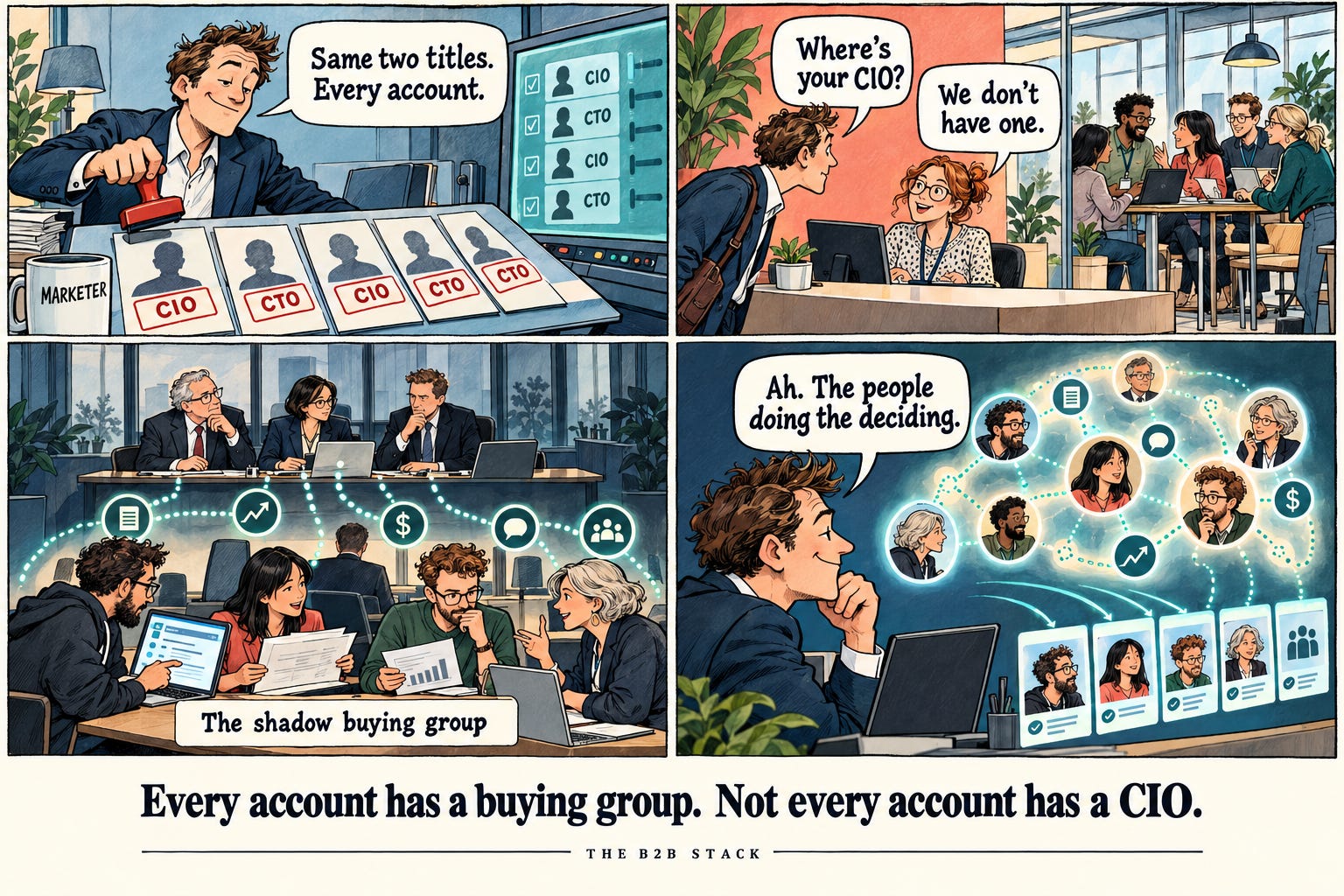
There’s a radically better way which lets you find each companies buying groups and then target them, bringing the value of a more 1:1 ABM with the scale of 1:many
New here? This piece is a direct sequel: it grew out of The New B2B Account Graph: A Product Perspective on Targeting in 2025, the account-first, company-not-domain argument that first ran on this newsletter back when it had a fraction of today’s readers. If that argument is new to you, start there. For the harder distinction underneath both pieces, The Account Graph Is Not an Identity Graph is worth the extra few minutes.
Subscribe free and the next issue lands in your inbox, not your feed.
What you’ll learn in this issue:
Why targeting fixed titles like CIO or CTO breaks the moment an account doesn’t have one
What I’m calling the shadow buying group, and why it matters as much as the formal committee
How device-level signal, first and third party, infers who’s actually in a buying group instead of assuming it from a title
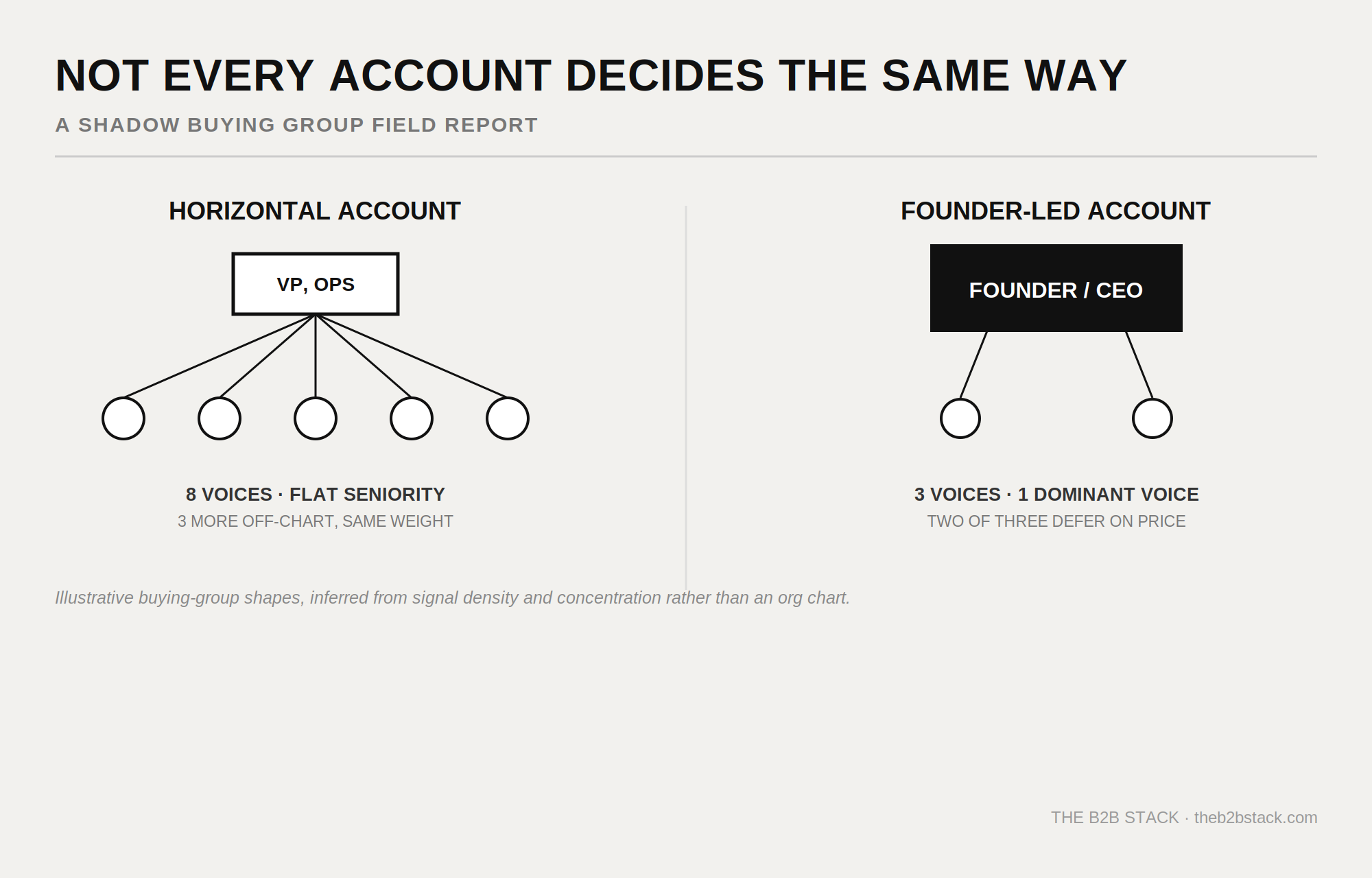
Why some accounts decide horizontally and others are run by one dominant voice, and how signal tells you which is which
Why B2B’s economics, high transaction value against a low marginal cost per person, make a wider net the rational move rather than the wasteful one
How signal-orchestrated buying groups become the account graph’s next frontier, beyond company and persona resolution
What this actually unlocks for a paid ABM programme built to drive pipeline influence, not just impressions
Targeting job titles assumes every company is organised the same way
Job-title targeting has one structural flaw underneath it: it assumes an org chart that’s the same shape everywhere. It isn’t. Some businesses are horizontal and democratic, where a purchase like a new CRM gets input from six or eight people across ops, sales enablement and finance, none of them especially senior. Others are autocratic and founder-led, where a founder CEO carries a disproportionate share of the final call and the rest of the room is there to execute, not decide. Neither shape shows up reliably in a CRM field, and a title-first target list has no way of telling the two apart before it’s already spent budget on the wrong three people.
That’s the real cost of premeditated targeting: deciding who matters before you’ve looked at the account, rather than letting the account tell you.
This creates great wasted impressions (targeting irrelevant people) and even greater opportunity cost - the latter is significantly worse in a world of digital media where the unit cost of reaching a handful more people is low but the cost of missing them out could cost you a 7/8/9 figure deal.
What I’m calling the shadow buying group
Call it the shadow buying group: the sphere of influence operating and orbiting around the formal buying committee, made up of people who never show up on an org chart or a CRM record but who shape the decision anyway.
Every procurement process has a committee you could name if pushed, and a wider ring around it you couldn’t. The person the CFO quietly asks before signing off. The engineer whose opinion the VP always checks before committing to a vendor. None of that shows up in a lookup by title. All of it shows up in signal, if you’re reading the right layer of it.
Forester also indicates that the growing complexity behind the ever growing buying committee has extended the sphere to an average of 13 internal and 9 external consultant aids. The buying group can now extend beyond the FTE’s in a business, and the only hope we have of capturing these influential extras is to be open to letting signals shape our targeting even when they can’t reliably be connected to an account.
How signal actually finds the buying group
This is the part that moves the whole discipline forward from where the original account graph argument left it. First-party signal, someone completing a high-value action on a brand’s own site, researching pricing, downloading a spec sheet, returning three times in a fortnight, self-declares that device as plausibly inside the buying group or its shadow. Third-party signal, a device reading procurement-adjacent content across the open web, or watching a specific run of YouTube videos on the category, adds topic-level and individual-level intent from outside the brand’s own walls. Stack the two together at the account level and you’re no longer looking up a title. You’re watching a buying group and its sphere of influence assemble themselves in the data, procurement process by procurement process, for something specific like a Salesforce CRM renewal rather than for the account in the abstract.
A job title tells you what someone’s badge says. Signal tells you who’s actually in the room, doing the work, and forging the accounts perspectives
That’s the shift worth sitting with: not “find this list of accounts, then find the CIO inside each one,” but “find the buying group inside each account, built from what its members are actually reading, watching and doing, for this specific procurement process.” Persona and job title become an output of that signal, worked backward, rather than the filter applied before any signal gets read at all.
Why B2B’s economics make the wider net the rational move
In B2C, casting a wide net is expensive relative to what you get back: most of the audience will never buy, so precision earns its keep by trimming waste. I remember back around 2018 when the programmatic world was obsessed with reducing waste, and movements like viewability were driven by this agenda.
B2B inverts that maths. The value of a single won account can run into hundreds of thousands of pounds, while the marginal cost of including one more plausible buying-group member in the media plan is small change by comparison.
That asymmetry is the argument for casting the net wide enough to capture the full committee and its shadow group, rather than narrowing to two or three titles and hoping they’re still the right ones. Missing a genuine influencer costs far more than reaching one extra person who turns out not to matter.
The account graph’s next frontier
The original version of this argument, back in July 2025, was built around two upgrades: account over person, and company over domain. Both hold up. This is the third: buying group over persona. Not just resolving which company is active and in-market, but which specific group of individuals inside it is running a specific procurement process, reconstructed from signal rather than assumed from a title list, refreshed continuously rather than looked up once and left to decay for 18 months.
That’s what a paid account-based media programme actually needs to drive pipeline influence rather than reach: not a bigger list of the same three titles, but a live, per-account, per-procurement-process reconstruction of who’s actually deciding.
The manifesto, shortened
Job titles are a lagging indicator of who decides, in an org chart that decays within 18 months and was never guaranteed to have the title you’re looking for in the first place. Signal, first party and third party, device by device, is a leading indicator not a lagging one. Stack the two together and you stop targeting a guessed committee and start targeting the one that’s actually assembling itself around a specific procurement process, shadow group included.
Every account has a buying committee. Not every account has a CIO. Build the targeting around the one that’s actually there.
If you want a second opinion on whether your current target account list is still built around titles that have already changed, reply to this email and tell me the account. I read every reply myself.
If a colleague on your ABM or demand gen team is still buying media against a fixed persona list, send this their way, the share button’s right there.
This is exactly what FunnelFuel built to do. Its TAL Intelligence module and buying-committee scoring exist precisely to reconstruct a shadow buying group from first- and third-party signal, account by account, rather than hand you a persona filter and hope it’s still accurate. If you want someone who has built this rather than sold a slide about it, get in touch or see how it fits together at funnelfuel.io.
Is your own target account list built around a job title that might already be out of date, or a signal-derived group you’ve actually watched assemble itself? Drop your answer in the comments.
Subscribe free to The B2B Stack for the next issue straight to your inbox.