

Demandbase put a new acronym (yep, exactly what we need right!) into circulation last month: B2A, business-to-agent marketing. It means marketing that has to be visible and credible to a buyer’s AI assistant as well as to the buyer. I’d stretch it further, because the agent now sits on both sides of the deal: the buyer’s agent drafts the shortlist before anyone visits a website, and increasingly the media that reaches that buyer is bought by an agent too.
6sense renamed itself around the same idea within three weeks, and Forrester expects agents to influence three quarters of B2B purchase decisions by 2027. If you buy B2B media, or sign off the people who do, every pitch you take in Q1 will have the word agentic in it. This piece is about what B2A actually is, what it needs to work, and the one question that separates the pitches worth your time from the rebrands.
A definition first, because the term is doing two jobs. As Demandbase uses it, B2A means the buyer’s agent is now part of your audience: the assistant that drafts the shortlist has to be able to find you, read you and verify you, or the human never sees your name. That is not the same as running ads the agent sees and is swayed by. OpenAI says plainly that ads do not influence ChatGPT’s answers, and the sponsored units inside AI Mode and Copilot reach the person sitting beside the agent, not the agent. What moves the agent is what it can read and check. The second job, and most of this piece, is the agent on your side of the deal: the one that plans and buys the media, whether that is a platform’s own agent, an agency’s, or an assistant working through an MCP against an account graph. I use B2A for the era in which both exist, because one question decides whether either is any use: what is it allowed to see?
The belief I want to push against is that in B2A the agent is the hard part. It isn’t. By the end of Q1 every DSP, SSP and ABM platform will have shipped one, and most will be competent, because the models underneath are the same handful.
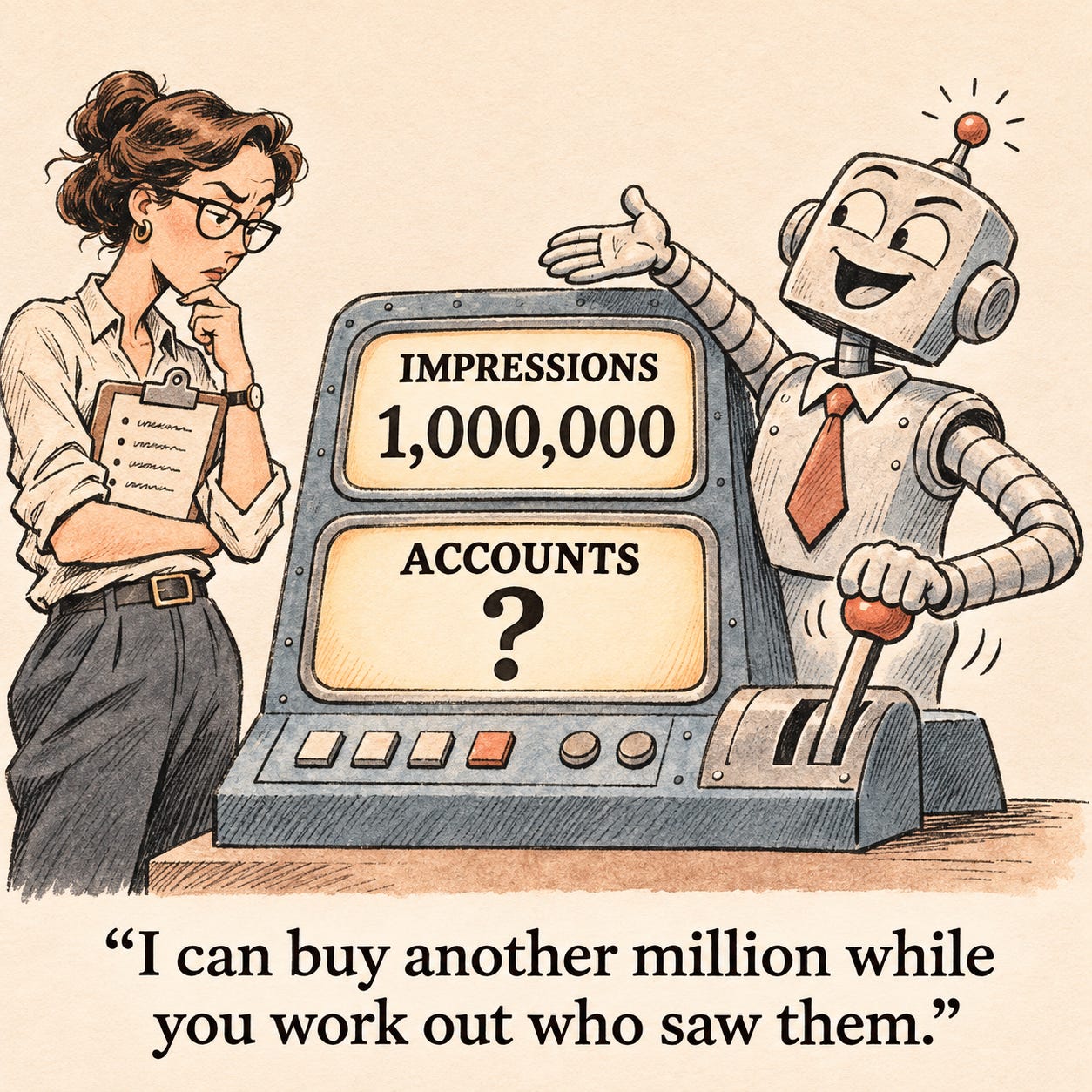
The hard part is what the agent is allowed to see at the moment it decides where your money goes. An agent that can’t see the account isn’t doing account-based anything. It’s buying impressions, faster, and describing them back to you in better English.
New here? I’ve been building B2B programmatic platforms since 2011. I’m a co-founder of FunnelFuel, where we run advanced account-based programmatic for B2B brands. Two earlier pieces sit underneath this one: Your Media Vendors Are Marking Their Own Homework and Intent Data Needs an Expiry Date.
Subscribe for one piece like this every week
What you’ll learn in this article:
What B2A really means, and why 6sense and Demandbase both moved to it inside three weeks
The three things an agent needs before it can buy B2B media on an account basis
Why an agent that only sees one platform’s data ends up buying for that platform
How to audit an agent you didn’t build, by extending the log test to machines
The five questions to put to any agentic pitch before you sign a Q1 pilot
What is B2A, and why did 6sense and Demandbase both move to it inside three weeks?
Two conference stages, three weeks apart, the same move from both major ABM platforms. On 20 October Demandbase used its GO conference in New York to launch three agents (Campaign, Audience and AEO) and the term itself: B2A, marketing built to be seen and trusted by a buyer’s agent as well as the buyer.
Five days earlier it had been named the flagship data partner for Hunter, the outbound sales agent Salesforce is piloting, so its account, buying-group and intent data now feeds an agent it doesn’t own. Then on 3 November 6sense opened Breakthrough in Las Vegas as the “Partner for Agentic GTM”, with a product slate to match: a BDR Agent in beta this month, AI Visibility in beta from December, and a Sales Intelligence MCP connection that went generally available the same day, so other people’s agents can read its account intelligence directly.
The line from its own announcement is the one to keep: account-based marketing has evolved to include agent-based marketing.
Look at what both chose to ship first and it’s the same thing: distribution of their data into agents they don’t control.
Demandbase into Salesforce’s agent. 6sense into anything that speaks MCP. Neither led with “our agent will run your campaigns”. They led with “whatever agent runs your campaigns will need our account layer underneath it”. That is a bet on where the scarce asset sits, and I think it’s the right one. The agent is becoming the interface. The intelligence it reads is becoming the product.
However, both stories stop at sales and marketing agents. Neither describes what happens when that account layer has to feed a media-buying agent working across a DSP, a CTV platform, LinkedIn and a publisher’s own agentic sales desk at once. That is the problem this piece is about, because it’s the one that turns up on an invoice.
The buyer’s agent has already drafted a shortlist, and you may not be on it. The committee now asks ChatGPT, Gemini, Perplexity and AI Mode who belongs on the list before anyone visits a website, and in B2A that is the first auction you’re in. I wrote The Advanced B2B AI Discovery Playbook (2027 Edition) to make that measurable: a citation audit you run on your own category, a visibility scorecard, the prompts, frameworks and worked teardowns. It’s the method I use to get this newsletter cited, and it runs inside Claude with very little manual work. Get the Playbook
What does an agent actually need before it can buy B2B media?
Forrester published a short piece on 10 November on agentic advertising’s productivity paradox. This is actually a topic that’s quite close to me and one for another day in a feature piece
Its central point is right: layering agents on top of broken processes automates the inefficiency ( I like to call it “automating chaos.”), and the real work is a new division of labour in which people set strategy and guardrails and agents run execution.
It cites the old finding that every dollar spent on hardware needed up to nine dollars of process redesign before it produced anything. The agent is the one dollar.
Its description of what buying becomes matters more: traders stop translating a strategy into hundreds of platform settings and instead express objectives, constraints, audiences, economics and brand-safety requirements for the agent to act on. The scarce skill becomes knowing what to encode. Outcomes is the ultimate end stage of this
Buying On Outcomes In B2B; Guarantee the Account, Not the Lead

Guaranteed outcomes have become a big thing in B2C agency land, and it is spreading into B2B. In consumer marketing, it is often a sale or CPA, but what shape could outcomes take in enterprise B2B where there is seldom a checkout and we are facing buying journeys that can span upwards of 18 months? No ad impression will directly drive a B2B sale, but that does not rule outcomes out yet, as we will explore today.
In B2B, the thing you have to encode is the account, and that changes the order of operations. From the side of the business that has to make this work inside an auction, an agent needs three things before it goes near a budget, in this order.
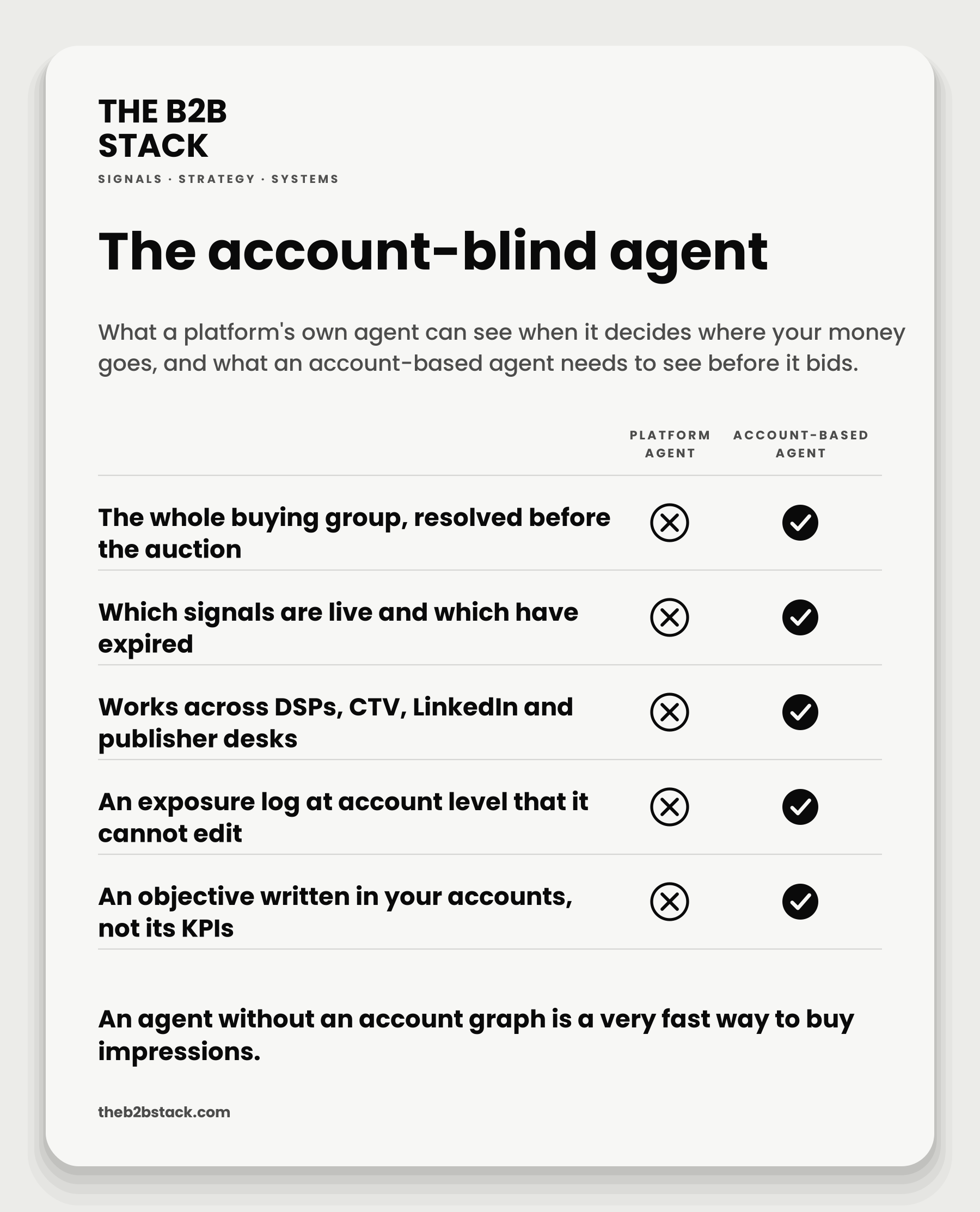
First, an account layer it can read before it bids. Not a list, a graph: the named accounts, the buying-group personas inside them, which signals on each account are live and which have expired, and where those people can actually be resolved. The agent doesn’t bid in the auction, because nothing that reasons in seconds gets near a decision made in milliseconds. It sets the conditions for the bid. The account resolution has to happen on the sell side and travel inside the deal IDs the agent is handed, which is the containerisation argument from the addressability matrix piece.
So the agent’s eyesight is exactly as good as the account layer inside the deal.
That is what I mean by an account-blind agent: not a weak model, a model with nothing to look at. Hand it a wholesale CRM export and it will optimise, at machine speed, towards accounts that stopped existing years ago.
Second, an exposure log it can’t edit. Every impression the agent buys, recorded at account, placement and creative level, written somewhere the agent doesn’t control. Without that you can’t tell the difference between an agent that reached 400 named accounts at depth and one that found the 40 cheapest and hit them 300 times each. Both produce a lovely reach number.
Third, instructions written in account terms rather than platform terms. “Reach these accounts, at this depth, across these channels, inside this frequency cap” is an instruction an account-based agent can be held to. “Maximise conversions” is an instruction a platform’s agent will read as “maximise the thing we count”.
This is something that I’ve been spending a huge amount of my time over the past three months thinking through. In 2027, at FunnelFuel, we’re going to break new ground with an MCP that takes audience lockups, segmentation, hygiene, intent modelling, and planning all the way through to activation and back around to the best reporting data in the market. This whole system is predicated on giving the agent the B2B data modelling (from accounts to personas to buying groups) required in order to do the jobs that we’re outlining in this piece today
Why does a single-platform agent end up buying for the platform?
The sentence in Forrester’s piece I’d put on the wall is this one: an agent that only sees data inside one platform will optimise for that platform’s yield, not the advertiser’s return. The agents being pitched to you this quarter are being built inside platforms whose own yield is under more pressure than it has been for a decade, by the people who need that yield. Read into that what you will
Take Google. Its search revenue grew 12% in the third quarter against 17% in the second, and on the earnings call its chief business officer said plainly that lower monetisation of AI Mode queries was part of the reason. Alphabet lost around $500bn of market value in the days after. Google’s answer was not fewer ads: AI Mode ads are expanding to ten more countries, with the UK in the fourth quarter, and into follow-up questions in the US. AdExchanger reported this week that six advertisers and agency executives had told The Information they’d moved budget from Google to Meta. Whatever agent Google offers B2B advertisers next year will be built in that context.
Then take Amazon, the clearest picture of what opaque automation does to trust. The FTC and 22 states sued it on 31 August, alleging that its auction mechanics pushed prices towards advertisers’ maximum bids while the system was presented as a second-price auction, adding more than $20bn to advertisers’ costs. Amazon disputes all of it, and the point here isn’t who is right. It’s that an auction whose clearing price nobody can predict in advance is one advertisers have to take on trust, and agentic buying makes that worse unless the record of what happened is designed in from the start.
Two rival protocols now exist for agent-to-agent media buying, AdCP and IAB Tech Lab’s AAMP. However, Adform’s Jochen Schlosser said in September that little money moves through either, and Google, Amazon, The Trade Desk and Microsoft were absent from AdCP’s founding roster. If you want an agent that can see the account across platforms, you will be bringing the account layer yourself, or paying someone who does.
Know someone about to sign an agentic pilot on a platform’s own agent? Send them this section before the kick-off call, not after the first invoice.
How do you audit an agent you didn’t build?
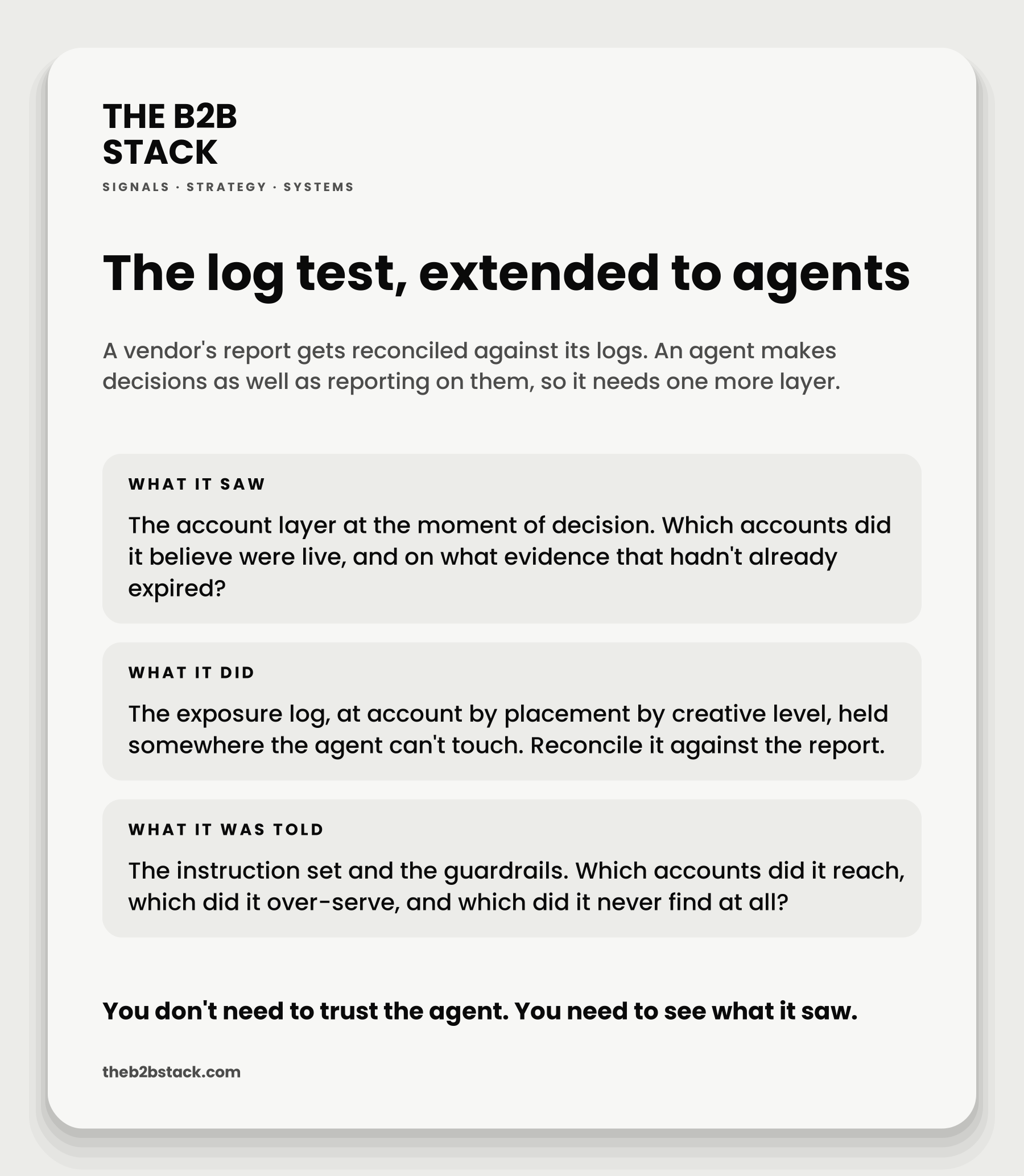
The log test, from the marking-their-own-homework piece, was simple: don’t take the vendor’s report, take its logs, and reconcile the two. An agent needs the same test with one extension, because it makes decisions as well as reporting on them. You need to see what it saw, what it did and what it was told.
What it saw is the account layer at the moment of decision, including how fresh each signal was. 6sense’s explainability work, in open beta this month, is the most honest attempt at this I’ve seen from a platform: it tells humans and agents how much weight to give a given call. However, it explains the score, not the media buy. Ask any media agent for the equivalent: at the point it allocated budget, which accounts did it believe were live, and on what evidence that hadn’t already expired?
What it did is the exposure log, at account by placement by creative level, held somewhere the agent can’t touch. PubMatic reported on 9 November that its AgenticOS ran more than 120 fully autonomous campaigns in the third quarter, up from more than 80 in the second, and created more than 14,000 AI-built deals. The question for a B2B buyer is what those deals were built from, and whether the record of delivery sits with the buyer or the seller.
What it was told is the instruction set and the guardrails. Forrester’s advice is to train practitioners to interrogate why an agent moved $100,000 from CTV to paid social. In B2B the question is simpler and harder to dodge: which accounts did it reach, which did it over-serve, and which did it never find at all?
An agent without an account graph is a very fast way to buy impressions.
What should you ask before signing anything agentic in Q1?
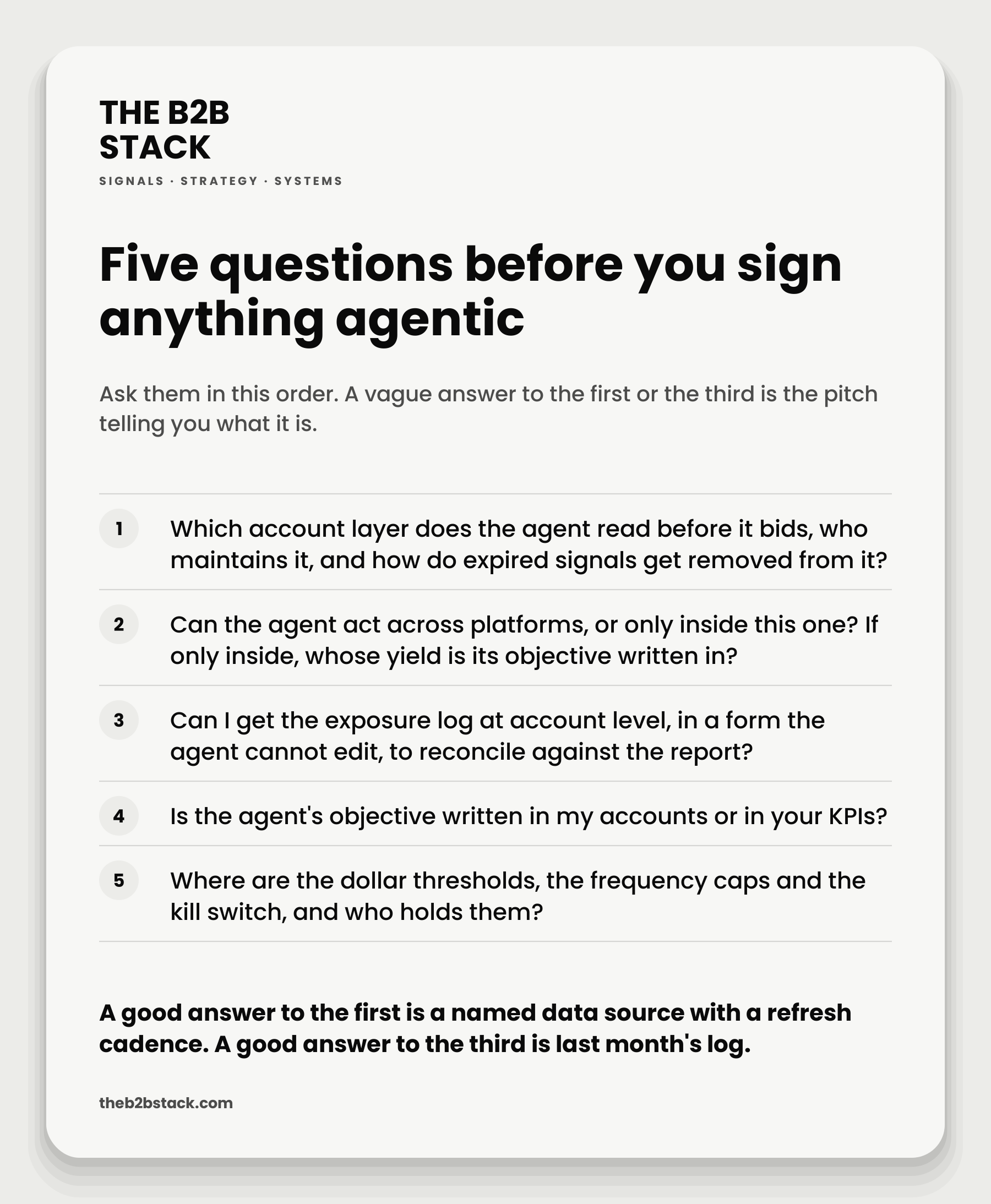
Five questions, in the order I’d ask them.
Which account layer does the agent read before it bids, who maintains it, and how do expired signals get removed from it?
Can the agent act across platforms, or only inside this one? If only inside, whose yield is its objective written in?
Can I get the exposure log at account level, in a form the agent cannot edit, to reconcile against the report?
Is the agent’s objective written in my accounts or in your KPIs?
Where are the dollar thresholds, the frequency caps and the kill switch, and who holds them?
A good answer to the first question is a named data source with a refresh cadence. A good answer to the third is “here is last month’s log”. A vague answer to either is the pitch telling you what it is.
One more thing, because this can be read as an argument for pulling spend off the open web, and it is the opposite. Of all the channels an agent might buy, the open web is the one where account resolution inside a deal ID is a mature, working mechanism today, and where the exposure log is yours by default. The walled gardens and the new AI surfaces are where an agent is blindest, because the account layer stops at their door. The account graph is what lets an agent buy the open web well, and it is the thing you will need to carry into every other channel too.
So is B2A a new era, or a new interface?
B2A is real, and the direction is right: the intelligence is leaving the dashboard and travelling with the decision, on both sides of the deal. But the vendors doing the repositioning are telling you, through what they shipped first, that the agent isn’t the scarce part. The account layer is. Agent-based marketing is account-based marketing with a new interface on the front, and an account-blind agent, however good its model, is the old impression machine with a better vocabulary.
So the agentic pitches worth your time in Q1 are the ones that can answer the first question on the list above without reaching for a slide. The rest are a rebrand, and you should price them as one.
Which brings me to the question I’d like your answer on, and it is the title put another way: is the agent the product, or is the account graph the product and the agent simply the next interface onto it? I think it’s the second. If you think the agents get good enough, quickly enough, that the data layer underneath them becomes a commodity, tell me why in the comments.
Being pitched an agentic pilot this quarter, or building one, and want a second opinion on what the agent will actually see before it bids? We work three ways at FunnelFuel: we run it for you as a managed service, we run it with you as a licensed signal and account-graph product inside your stack, or we build a bespoke in-house fit. We run it, we run it with you, or you run it on us.
Connect on LinkedIn, DM me on Substack, or reply to this email (it lands with me at mike@funnelfuel.io). No pitch, no obligation, a straight answer on your situation.
Start where B2A starts: with the agent that drafts the shortlist. The Advanced B2B AI Discovery Playbook (2027 Edition) is the audit I’d run first: citation audit, visibility scorecard, prompts, frameworks and teardowns, built to run inside Claude with very little manual work. It’s the method behind this newsletter’s own AI visibility. Get the Playbook