

B2B marketing has spent the better part of a decade getting more precise about identity. It’s a positive part of the digitisation of B2B advertising. Intent data, buying committee scoring, account level signals from network IPs to hashed emails, the account graph itself: all built to answer one question with more confidence than a demographic guess ever could.
Underneath - and arguably propping up a lot of the above - and its precision sits a filter almost nobody questions, the SIC or NAICS code that decides whether a company even makes it onto the list in the first place. The SIC filter that brands are using to find new prospects and create TAL-lookalikes. The filter used to validate ICP match against the TAL. That filter is 89 years old. It was built for an economy that still ran on assembly lines and freight yards, and it is still deciding which accounts your creative, your budget and your sales team ever get introduced to.
Precision downstream of a blunt filter is still blunt. You can build the most sophisticated account graph in the category and still be feeding it a target account list assembled by a code invented for a different century.
New here? If the account graph itself is new to you, or you’d rather see the infrastructure argument made in full before trusting it with your firmographic filter, two pieces from the archive go deeper:

and this piece on native advertising is the same signal-first thinking applied to a different channel:

Subscribe free and the next issue lands in your inbox, not your feed.
What you’ll learn in this issue:
Why SIC and NAICS codes still gatekeep most B2B target account lists, and why that’s ageing badly
What I’m calling classification debt, and why it compounds quietly on every list nobody revisits
The real, verified SIC codes behind Dell, Microsoft and FunnelFuel itself, and what each one misses
Why indexing a brand’s own website beats waiting for a better government filing
How that indexing turns into a reverse account-based marketing programme, without manual tagging
Why context is the cookieless targeting lever most competitors aren’t using yet
What tonality and phrasing in a podcast or video reveal about a buying committee, and how to act on it before they fill in a form
A filing system built for factories is still deciding your target account list
The Standard Industrial Classification code was built in 1937 by an interdepartmental committee in Washington trying to make government statistics comparable across agencies. The very name, with industrial in it, speaks to an older age and the use case has absolutely nothing to do with accurate advertising in 2026.
It got its first real list of industries in 1938, extended to non-manufacturing activity in 1939, and was last substantially revised in 1987. The UK adopted its own version in 1948, and Companies House still runs on it today, on SIC 2007, with a 2026 update from the ONS now working its way through the system. NAICS replaced SIC for official US government statistics in 1997, jointly developed with Canada and Mexico specifically because SIC had aged out of a service-and-technology economy.
None of that killed SIC off. Dun & Bradstreet still assigns it. Every major ABM and intent platform, ZoomInfo, 6sense, Demandbase, still lets you build a target account list by filtering on it, because it’s the one firmographic key everyone’s data happens to share. A code drafted for an economy of foundries and freight yards is still, in 2026, deciding whether a company makes your buying committee’s radar.
Call it classification debt: the gap between what a SIC or NAICS code says a company does and what it actually sells, compounding quietly every year nobody revisits the filing.
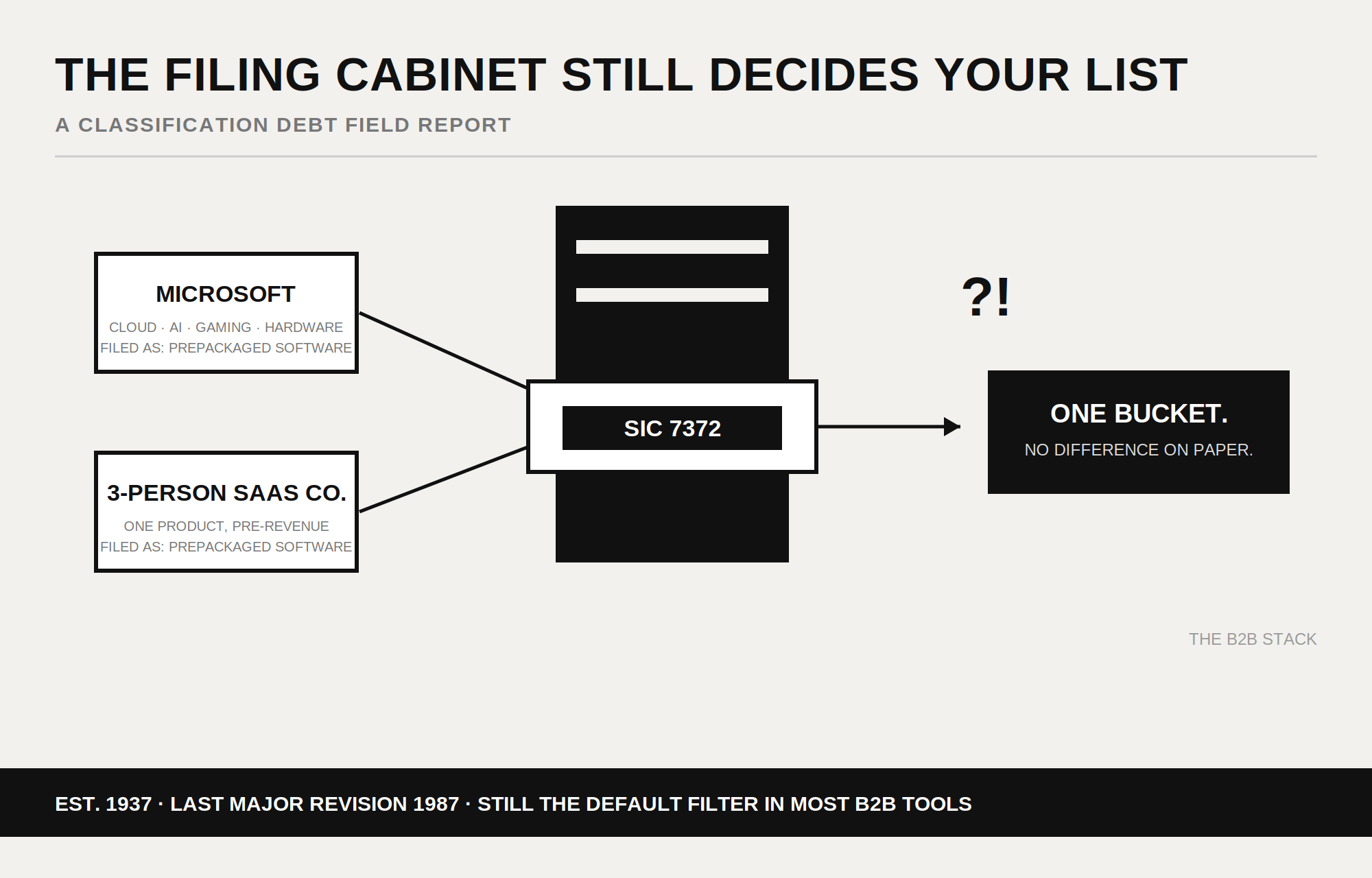
Companies pivot. They launch new product lines, acquire their way into new categories, retire the thing they were originally incorporated to sell. The code filed at incorporation almost never gets revisited unless a regulator forces it, because updating a SIC code has never been anyone’s job. That’s how the debt compounds: silently, unpriced, and invisible right up until it’s the reason your target account list missed the exact account that mattered.
Three real filings, zero nuance
Pull three real filings and the gap stops being theoretical.
Dell’s SIC code, per its SEC and Dun & Bradstreet classification, is 3571, “Electronic Computers.” Today Dell sells hybrid cloud infrastructure, edge computing and AI servers to hyperscalers, alongside enterprise services that have nothing to do with a desktop box.
Microsoft’s own SEC EDGAR filings still carry SIC 7372, “Services, Prepackaged Software.” Azure, Copilot, LinkedIn, Xbox and Surface hardware sit underneath a filing bucket built for shrink-wrapped floppy disks.
And I’ll declare the closest thing to a conflict of interest this newsletter carries: FunnelFuel’s own SIC code, filed at UK Companies House, is 62090, “Other information technology service activities.” It’s the classification equivalent of a shrug. It says nothing about programmatic media, nothing about a 75 million company account graph, nothing about contextual or identity data. Filter a prospect list by SIC code looking for a B2B advertising infrastructure business and you will not find us. You’ll find us filed next to a company that fixes printers.
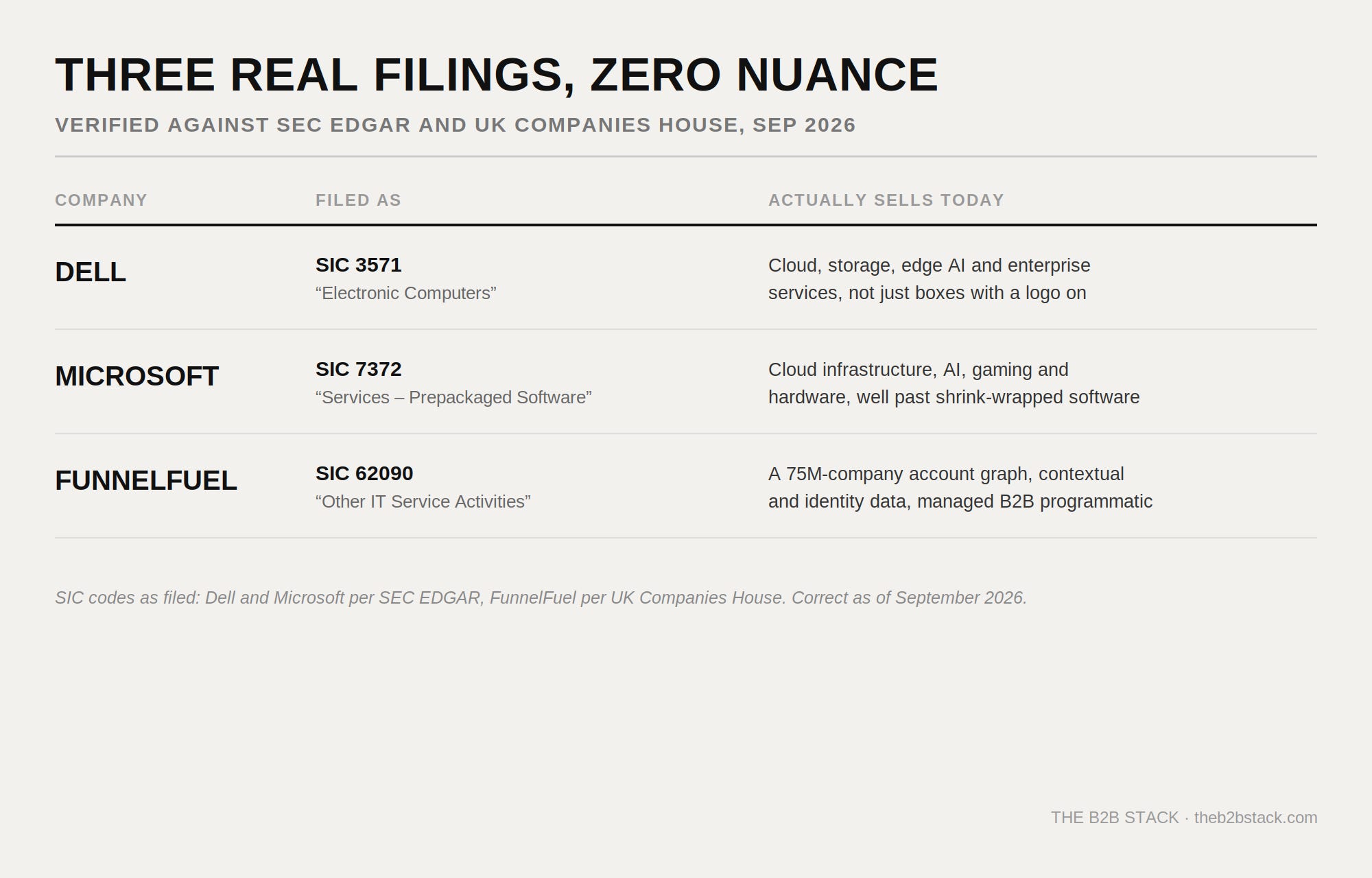
If a code can’t accurately describe the company that sells the fix for classification debt, that’s not an edge case. That’s the whole argument.
The fix isn’t a better code. It’s indexing the thing itself
Waiting for a better filing system is not a strategy. Governments revise these things on a decade-plus cycle, and even the platforms that still lean on SIC and NAICS as a firmographic key aren’t about to rebuild their schema around a code that’s barely a year old.
And frankly, the technologist in me has absolutely zero interest in sitting around waiting for the government to fix something, and least of all when their fix will have no consideration for the accuracy of paid digital B2B advertising. This needs fixing differently
The fix that actually works right now is indexing the thing itself: a company’s own website, read directly, in its own language, rather than through a filing that’s years, sometimes decades, out of date. And then re-reading it, re-indexing it and re-analysing it periodically because companies evolve, and launch new solutions.
Done properly, that means aligning taxonomy and keywords to the precise nuance of what a brand’s product lines actually do, then classifying that against the pages themselves rather than a static four or five digit bucket. It’s self-updating in a way no filing has ever been. The site changes when the business changes; the SIC code changes when someone remembers to file a confirmation statement, which in most companies is never.
This is the exact problem FunnelFuel has been building against with its alignment with Contxt Media’s contextual URL-classification technology. Rather than reading a SIC filing that’s decades out of date, you read the pages a company actually publishes, updated every time the site changes rather than every time a director files paperwork. It’s the difference between asking a company what it filed in 1994 and asking it what it shipped last quarter.
This sort of contextual understanding opens up an array of wider use cases which I’ll explore below.
Most of the readers of The B2B Stack came via referrals. Readers who forwarded the email to colleagues or contacts who they felt would benefit from reading what we talk about. If you have colleagues or contacts who would value you this contact, please forward it on or share with the below link.
If you are reading this because it was forwarded to you - subscribe below to get our weekly digest on the latest and greatest B2B paid media strategies
Turning your own website into a reverse account-based marketing programme
Once taxonomy and keywords are properly aligned to a brand’s product-line nuance, the same classification layer can run in the opposite direction. Instead of only indexing your own site, you index the wider internet for pages that align to each specific product nuance, not the brand in general, the exact feature, the exact use case, the exact language a buyer would recognise.
Bid to win every opportunity you get on those precisely aligned pages. The account graph then does the second half of the job: revealing which named companies, and which named contacts inside them, actually saw those placements. That’s a product-level account-based marketing programme built automatically, aligning high-value actions and on-site behavioural intent against specific product lines algorithmically, without a person manually tagging a single page.
Context is the cookieless lever most competitors are sleeping on
Alignment has always been one of the most reliable levers in digital advertising: the right message, to the right person, in the right context. What’s changed is that context now does that job without needing a cookie or an identifier to get there. You’re buying against the page itself, which means you can win impressions your competitors are sleeping on, because they’ve built their entire targeting stack around identity and have nothing left to bid with once an identifier goes missing from the auction.
Context was cookieless before cookieless was a category anyone had to plan around.
Let’s not sleep on the reality of digital advertising and identity in 2026 and beyond. The blunt reality is not every impression is going to carry useful identifiers, and we have two options:
We build our entire targeting strategy around identity alone and miss out on upwards of 70% of available impressions.
We take the smart approach, which is blending cookieless targeting capabilities like contextual alongside identity in order to fill in the missing jigsaw puzzles and open up deeper addressability on the open internet.
What tonality tells you about a buying committee
Contextual technology is also starting to read tonality, inference and phrasing well enough to tell whether a piece of audio or video is talking about a brand favourably or not. That’s a new input for scoring models at both the persona and account level, not just a trending topic.
Picture the scenario directly. FunnelFuel targets advertising agencies as well as brands. Say a procurement-side decision maker at an agency like WaveMaker sits inside one of my priority buying groups, and twenty-seven minutes into a podcast they’re listening to, a guest says FunnelFuel is a no-brainer to be looking at, one of the reasons the vendors already winning in this category route their programmatic spend through us. That’s a positive signal worth feeding straight into that account’s score. A negative mention is exactly as useful, just pointed the other way.
In B2C, that signal barely matters. Lose a handful of listeners to a lukewarm mention and you shrug it off against a total addressable market in the millions. In B2B, a target account list might be a couple of dozen companies, or a few hundred, or a few thousand at the outside. If one of those specific accounts has just been exposed to something unflattering about your brand or your category, that’s worth fighting, not absorbing.
Say the mention is that FunnelFuel is expensive. Fine, that’s the account to serve creative that meets the objection directly rather than pretending it wasn’t said: yes, the CPM is higher, because the account graph underneath it is built by stacking scores of data partners who all need paying, rather than trusting one vendor’s guess. That’s the difference between spray and pray, where “B2B audience” quietly turns into an impression next to a potty-training app, and paying a few dollars more in CPM for something closer to deterministic. I’m comfortable being the expensive option in that specific comparison. This is an objection I can handle, but it only needs handling when you're aware of the objection and the fact a prospect has been exposed to it. This is the power of contextual in 2026
The manifesto, shortened
Classification debt is real, and it’s compounding on every target account list built from SIC or NAICS alone. Fixing it isn’t about waiting for a better government code, committees move slower than product roadmaps ever will. It’s about indexing the thing itself: a brand’s own site, a prospect’s own site, the actual pages people read, watch and listen to. That gives you a live, self-updating account graph instead of a filing that’s decades behind, a cookieless targeting lever most competitors aren’t using, and a sentiment signal you can act on before a buying committee ever fills in a form.
A code from 1937 was never going to describe a company that didn’t exist in 1937. Context was always going to have to do that job instead.
If you’re weighing how much classification debt your own target account list is carrying, or you want a second opinion on what your specific SIC or NAICS filter is quietly missing, reply to this email and tell me the code. I read every reply myself.
If you’ve got a colleague on a growth or demand gen team who’s still filtering target account lists by SIC code alone, send this their way, the share button’s right there.
This is exactly the infrastructure argument behind FunnelFuel’s investment in Contxt Media. We didn’t want to license someone else’s contextual classification and hope it stayed current. We wanted to own the layer that reads a company’s actual site instead of its 1937 filing, and build it into the account graph as a permanent node, not a rented one. If you want someone who has built this rather than sold a slide about it, get in touch or see how it fits together at funnelfuel.io.
Where’s the classification debt sitting on your own target account list right now, and would you even know if nobody had told you? Drop your answer in the comments.
Subscribe free to The B2B Stack for the next issue straight to your inbox.
I love this. I have been saying the same thing for years. ABM created the illusion that you can signal everything about a buyer.
Firmographics they pull these from combined with inaccurate third party data vendors that I won't name but looking at the segments wanted me to pull my hair out, is outdated.
I think contextual nuances and the sentiments are more towards how the SaaS buying committees operate.
All the average 22 people get into the journey all together at the same time = legal doesn't wait for procurement to ask for 3 RFPs while the champion and the end user are heavy deep in POC.
Also all the buying committees engage when they have a first set deal consideration list already.
So from where I am looking at marketing talks personas, sales talks ICP, boards talk segments. Same product different definitions.
Combining contextual signals works wonders because they give you more back knowledge about the buyer.
Great piece!