

FunnelFuel runs the analytics behind a lot of B2B vendor websites: roughly 263 million B2B visits have been tracked with our kit, and that has a whole load of insight baked into it.
This autumn I have put a fixed panel of 12 randomly assigned sites, tracked continuously for two years, through a set of hypotheses about what AI is doing to the way buyers arrive, and took a second cut across scores more sites with meaningful AI traffic to see where the assistants send people. This is the first round of findings, set against the wider research, because with planning in full flow for 2027, some of this info feels very useful.
The question I hear most from marketing teams is some version of “how much of our buying journey has moved into AI?” The usual way to answer it is to open the analytics, find the AI referral line, see a number under 1% and conclude: not much yet. I think that reading is wrong. The evidence that buyers have moved into the assistants is in the same report, just not under the heading anyone is looking at.
New here? I’ve been building B2B programmatic platforms since 2011. I’m a co-founder of FunnelFuel, where we run advanced account-based programmatic for B2B brands. If this is your first visit, the two pieces that set this one up are “Can we run ChatGPT ads?” is the wrong question for now and The Psychology of the 2027 Buying Group.
Subscribe free and join 1700+ B2B marketers from Dentsu, Informa, Salesforce, and scores more from across the ecosystem
What you’ll learn in this article
Where a third of B2B search traffic went, and why the direct line is where to look
How much of the loss AI referrals account for (about 3%)
Why AI-referred visitors skip the homepage, and which pages they engage with most
Why fewer journeys start on the blog, and what that means for content
Why pricing-first arrivals didn’t show up site-wide, why your analytics under-counts AI traffic, and what to build for 2027
Where did a third of B2B search traffic go?
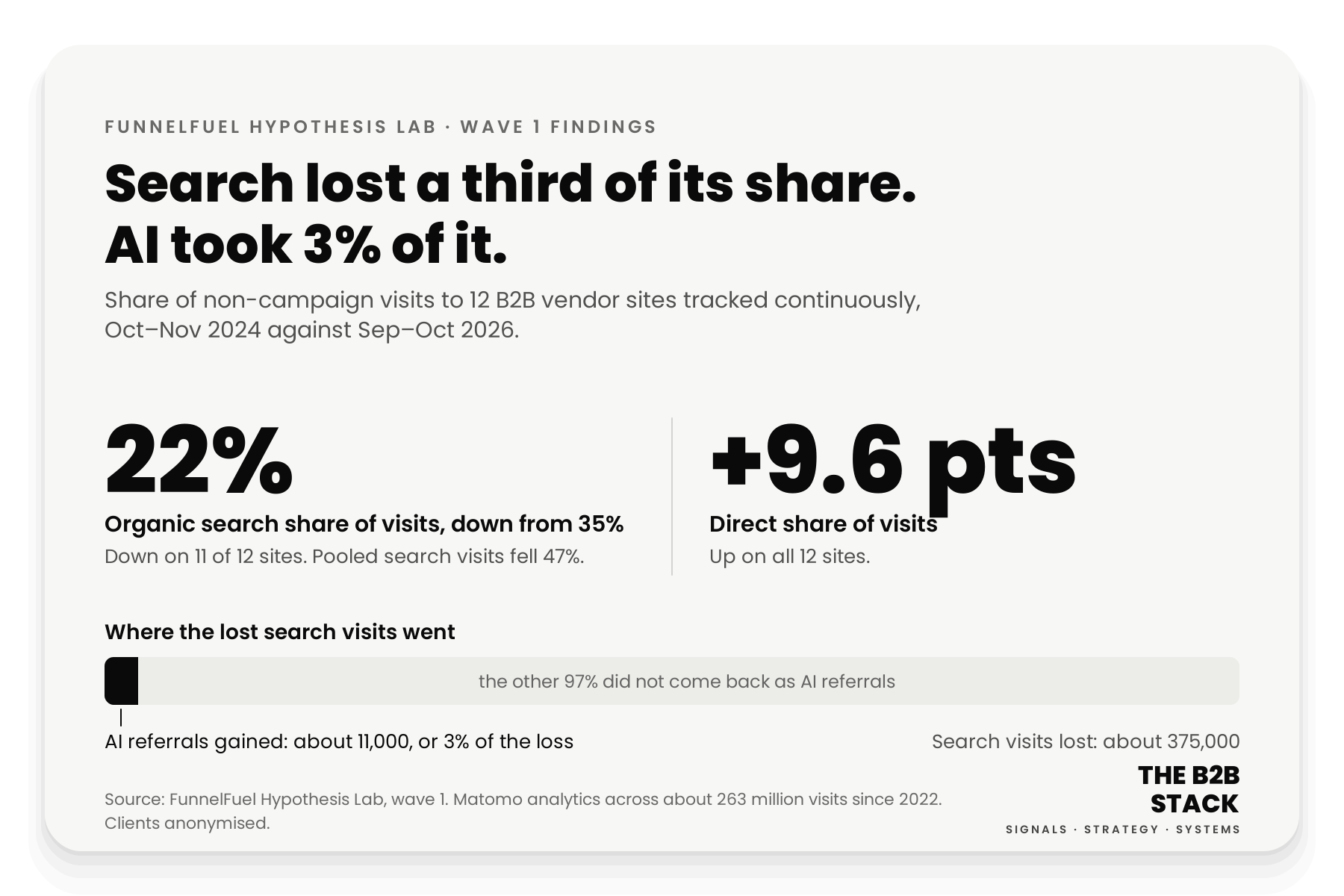
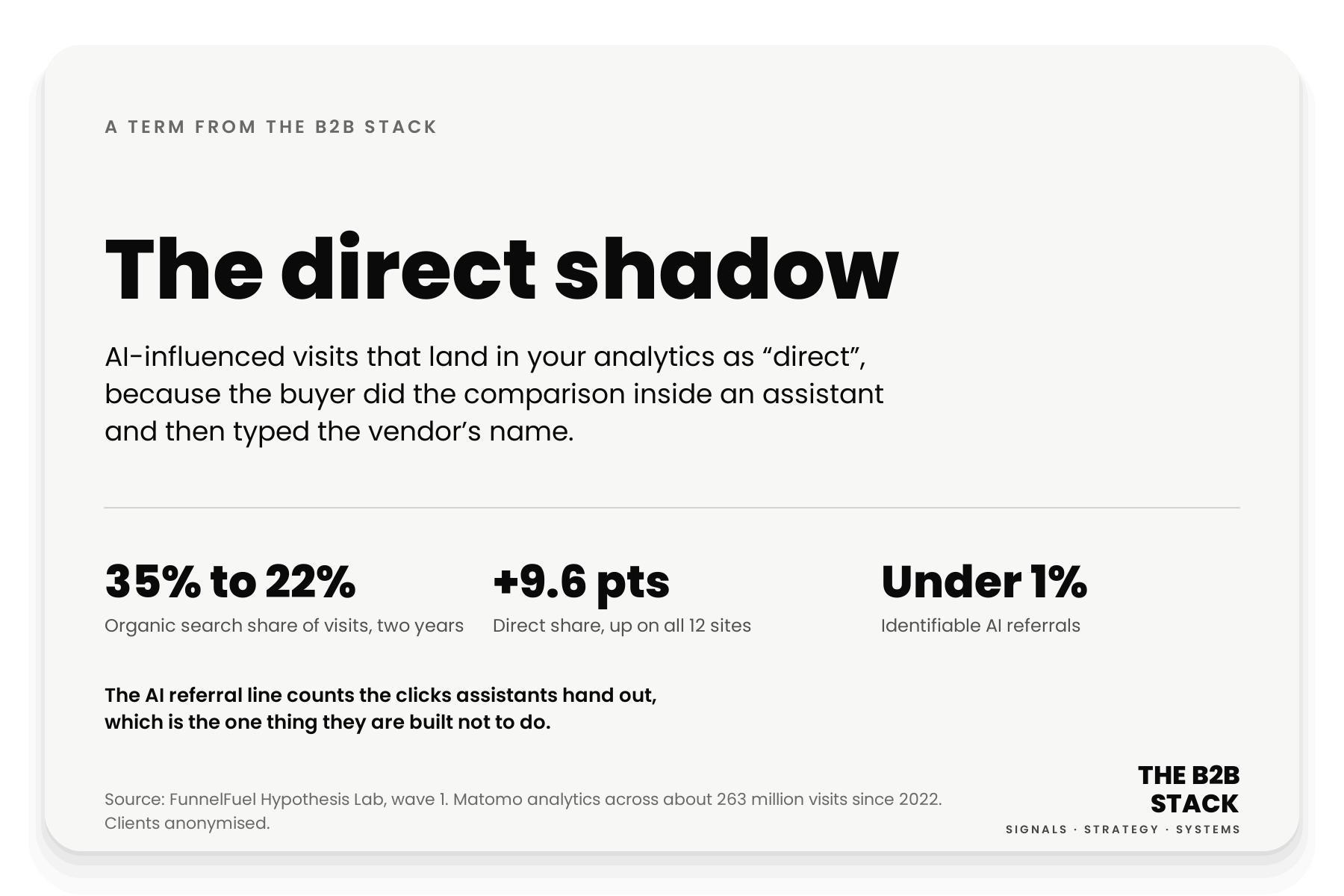
Across the 12 panel sites, organic search fell from 35% of non-campaign visits in late 2024 to 22% in autumn 2026. It fell on 11 of the 12 sites, and in pooled visit counts search was down 47%.
Where it went is the useful part. Direct traffic rose on all 12 sites, up 9.6 points of share over the same period: visits that begin with someone typing the vendor’s name or arriving on a link with no referrer, growing too uniformly to be one client’s brand campaign. I saw it across the wider second panel too. So have B2B buyers suddenly started typing IBM.com into their web browsers?
Two studies suggest why, and it is not a return to the early days of the web. G2’s April 2026 survey of 1,076 B2B software buyers found 51% now start research in an AI chatbot more often than in Google, up from 29% a year earlier, and AI chatbots had become the biggest single influence on which vendors make a shortlist, ahead of review sites and vendor websites. Forrester’s 2025 Buyers’ Journey Survey found 94% of business buyers using AI somewhere in the process, and twice as many naming generative AI or conversational search as their most meaningful source as named any other.
The explanation is plain. A buyer who has done the comparison inside an assistant doesn’t need Google to find you. They know the name, so they type it, and in the analytics that visit is “direct”, with nothing to say an AI was involved. Call it the direct shadow: AI-influenced visits that land in your reports under a heading that hides where they came from. Our data can’t prove the cause, since a buyer who typed your name may have heard it anywhere, but the pattern holds on all 12 sites and it is exactly what the survey data predicts.
Its also worth understanding how analytics platforms treat ‘direct’, because direct hides a LOT more behind it. As much as the above - people typing vendor names in directly probably is happening a little bit more, the reality is a lot of AI and other dark funnel links like those in Slack and plenty of wider social, strip out the refer link. So when that link is not there, analytics reads ‘direct’. So really this growth in direct owes more to growth in the dark funnel, AI included. Do not assume that every visit tracks perfectly, because it does not.
If a third of your search traffic has turned into direct traffic, the question that matters is whose name the buyer typed or clicked from the AI-dark-funnel. My Advanced B2B AI Discovery Playbook is the method I use to find out whether ChatGPT, Perplexity and Gemini name a brand when a buying committee asks, and what to change when they don’t. The Playbook Operator runs the method inside Claude with very little manual work, from a Committee Query Map of seven buying roles against five decision moments. Get the playbook.
How much of the lost search traffic did AI take?
Very little of it, if you count referrals but really an awful lot more if it if we count the wider intel we have.
On the same 12 sites, search visits fell by about 375,000 and visits with an identifiable AI referrer rose by about 11,000, roughly 3% of the loss. AI referrals did grow, and quickly: the site median went from 0.07% of visits to 0.42%, about six times, up on 11 of 12 sites, with ChatGPT 92% of them. The channel is still under 1% of visits.
That matches the public data. Microsoft Clarity’s study of more than 1,200 publisher sites put AI referrals under 1% of traffic, and our own site cut this autumn came out at 0.57% of visits.
The mistake is treating that line as the whole effect. Pew Research found that when an AI Overview appeared, people clicked a traditional result 8% of the time, against 15% when it didn’t, and clicked a link inside the summary just 1% of the time. The assistants answer; they rarely send. So the 3% is the visible edge of something larger; the rest shows up in the direct line and the missing search visits.
Why do AI-referred visitors land deeper and stay longer?
Because the assistant has done the top of the funnel before the visit starts.
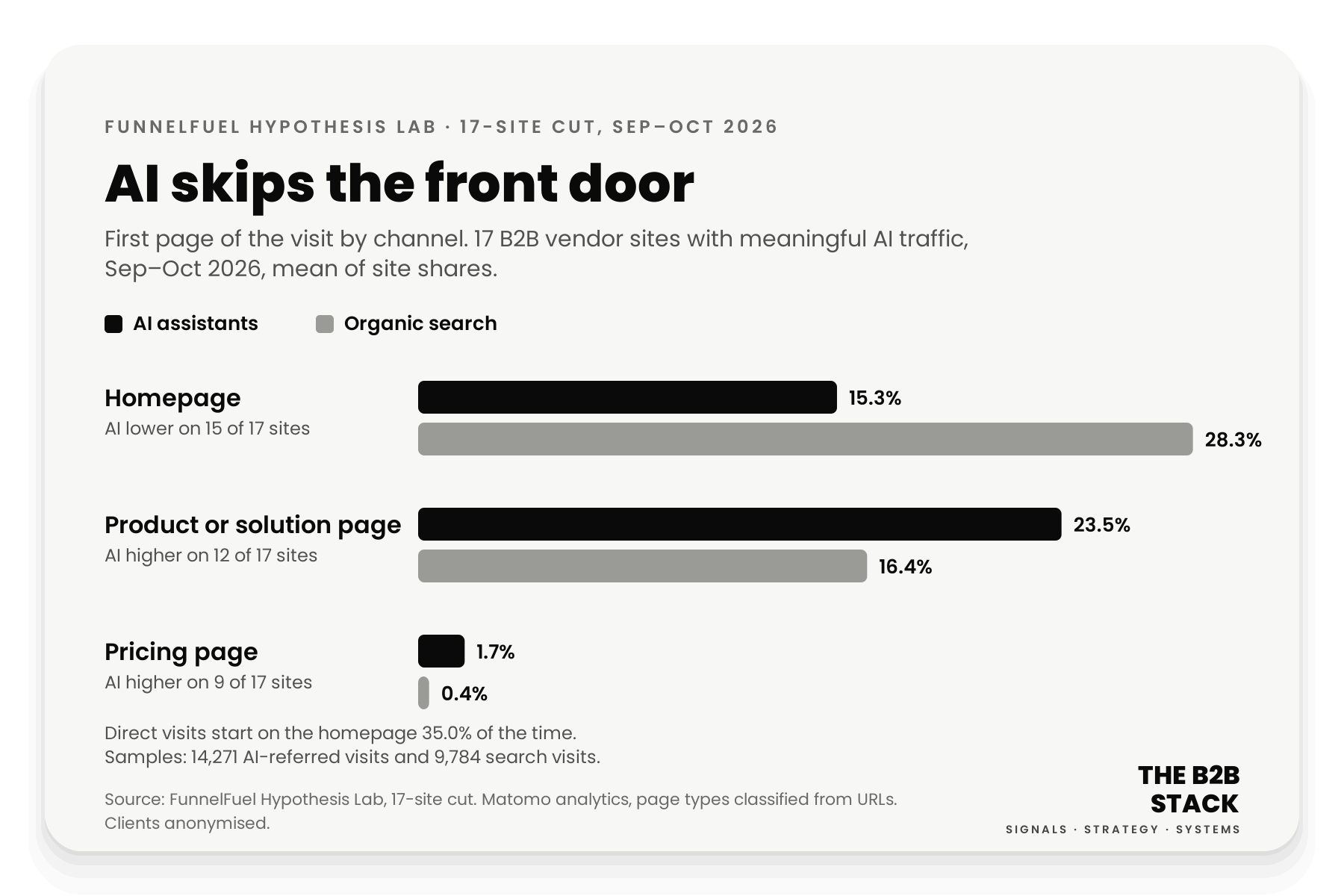
Across the sites I dived into this autumn, 15.3% of AI-referred visits landed on the homepage, against 28.3% from organic search and 35.0% from direct.
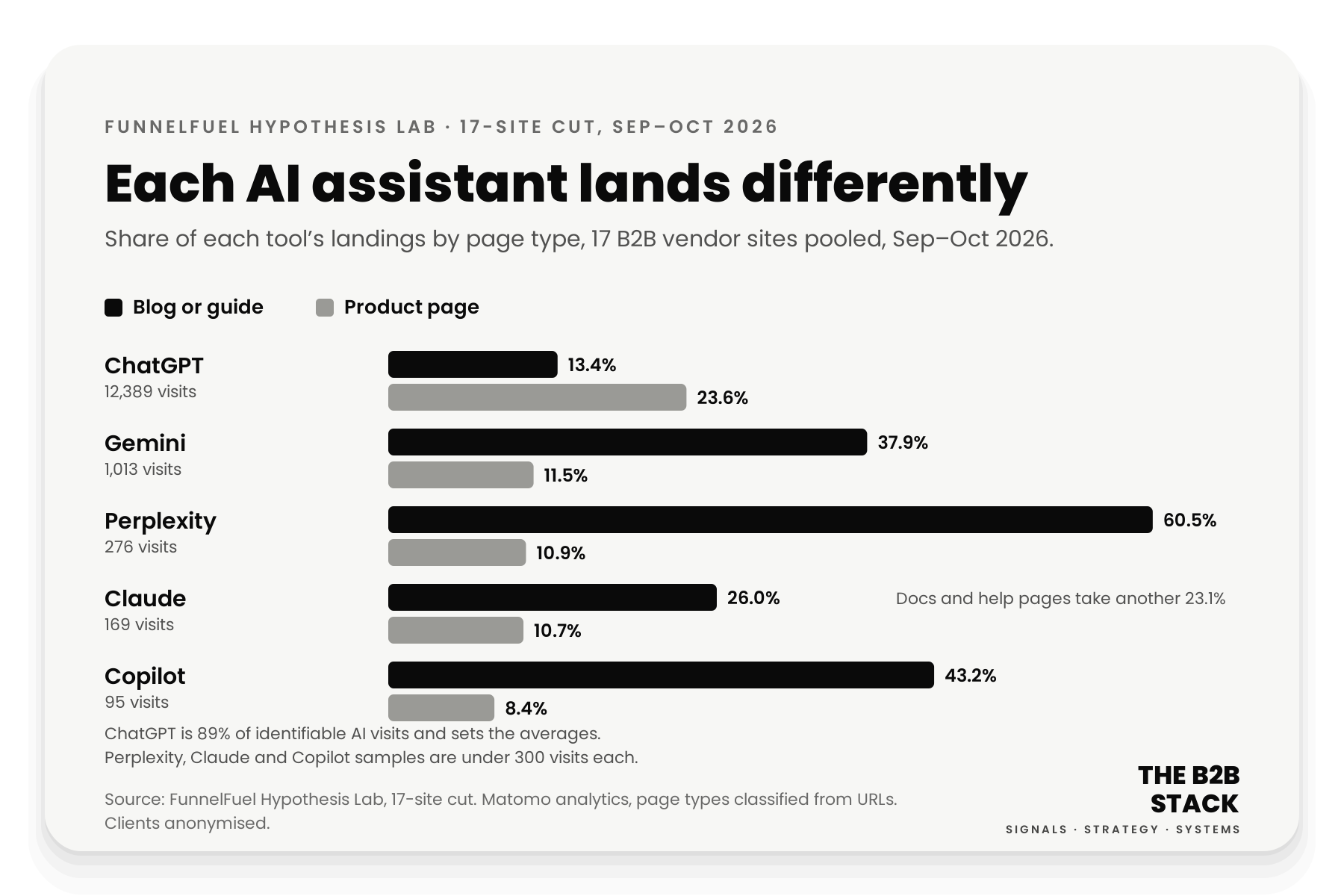
Product pages are AI’s number one landing type, 23.5% of its landings against 16.4% from search, higher on 12 of 17 sites.
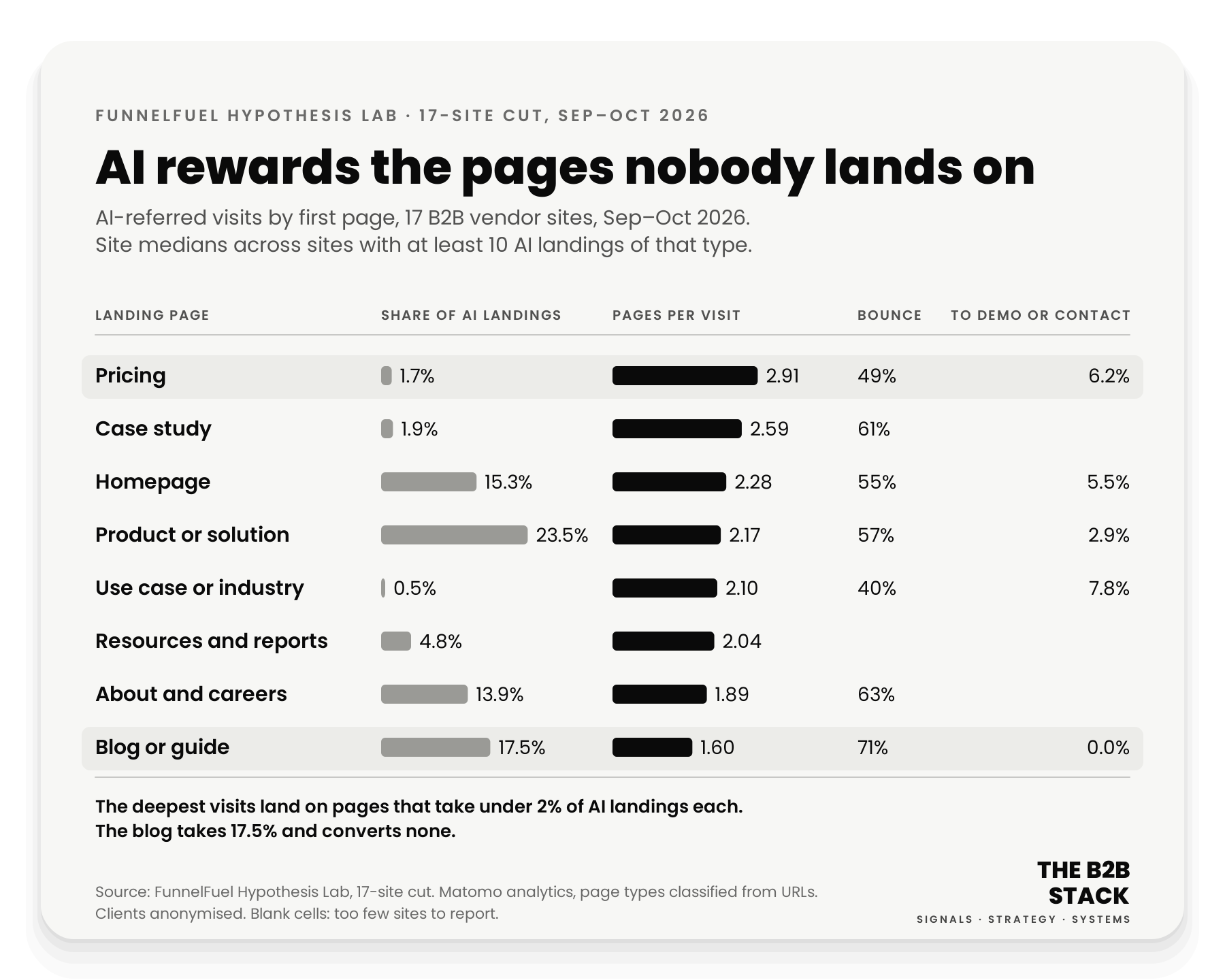
AI also sends four times search’s share of pricing landings (1.7% against 0.4%), and those are its best visits: 2.91 pages per visit, a 49% bounce rate and 6.2% going on to a demo or contact page. On product pages, AI visitors stay 268 seconds against 140 for search visitors.
The wider research says the same in conversion terms: Ahrefs reports AI search at about 0.5% of its visitors and 12.1% of its sign-ups, and Microsoft Clarity measured AI referrals converting at three times the rate of search and social. Different businesses, same shape: fewer visitors, further along.
The pages those visitors engage with most are the ones they are least often sent to. Comparison and alternatives pages take 0.2% of AI landings, use-case pages 0.5%, integrations 0.9% and case studies 1.9%, yet case-study visitors view 2.59 pages against 1.60 for blog visitors.
The buyer asked the assistant to compare you with two competitors, got a shortlist, and clicked through to settle what the assistant couldn’t: does it do X, what’s the proof, what does it cost. When it comes to AI traffic, the visit is verification rather than research, and most B2B sites barely have the pages that answer it, or the engines aren’t citing the ones they have.
As I explore in my Playbook, winning in AI mandates sets of pages in certain structures, many of which the average vendor is simply not creating, maintaining or surfacing.
Why are fewer buyers arriving through the blog?
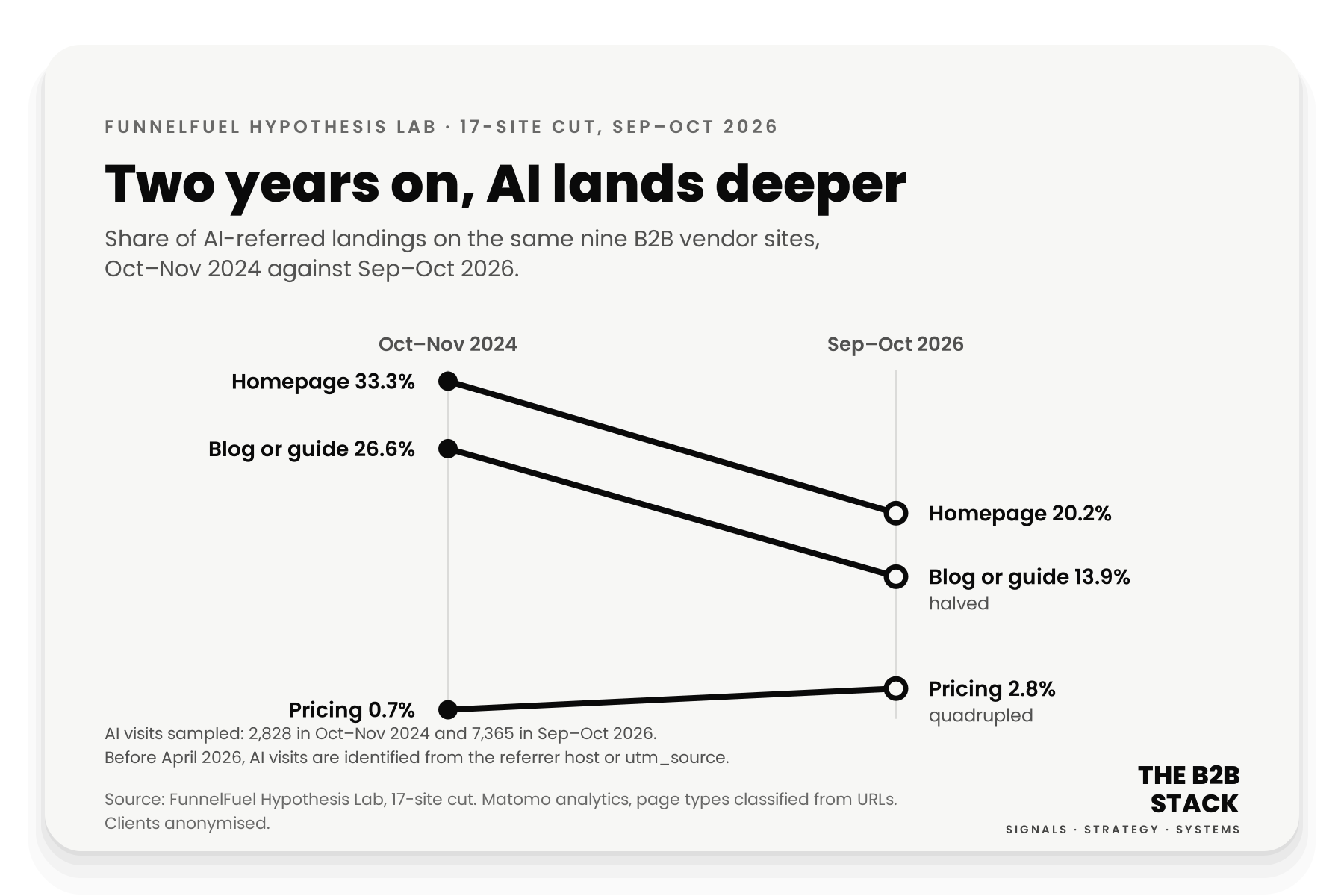
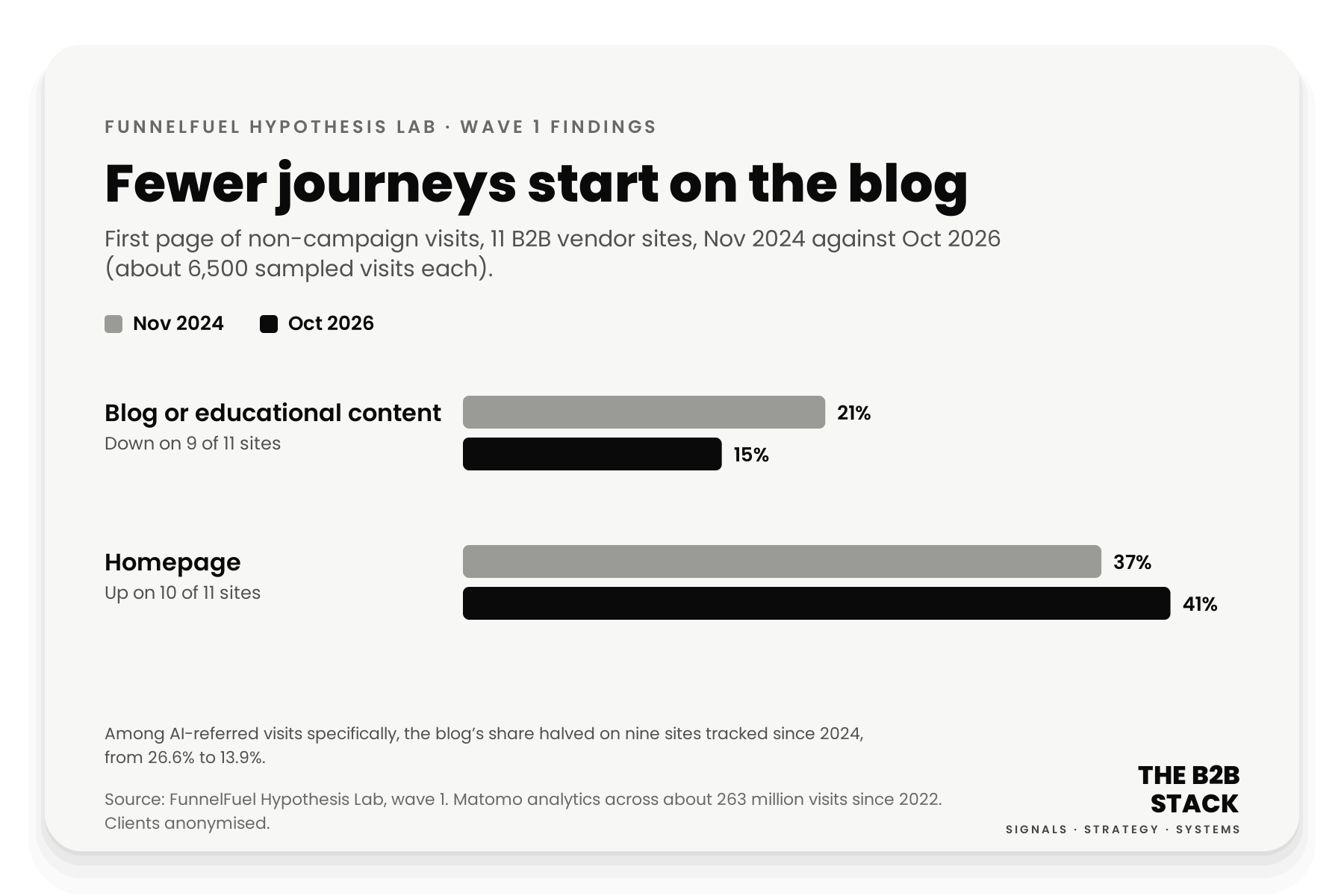
On the sites I could compare, visits that began on blog or educational content fell from 21% in November 2024 to 15% in October 2026, while visits that began on the homepage rose from 37% to 41%, up on 10 of 11. Among AI-referred visits specifically, the blog’s share halved on nine sites tracked since 2024, from 26.6% to 13.9%.
For a decade, educational content was the B2B front door: rank for the question, catch the buyer early, nurture from there. What the panel shows is the front door moving from the blog to the homepage. That fits buyers who learn inside an assistant and arrive already knowing which vendor they want.
It doesn’t mean the content stopped working. It works somewhere you can’t see, and leaks when it does get the visit. In the sites I researched, blog and guide pages still take 17.5% of AI landings, but they are AI’s weakest: a 71% bounce rate and none going on to a demo or contact page. It probably represents earlier stage research from more AI-sceptic committee members and/or those who are more inclined to check their sources at all stages.
Which tool sent the visitor matters too: Perplexity sends 60% of its visits to blogs and guides, while ChatGPT, 89% of all identifiable AI visits, favours product pages. Perplexity is more of a search engine, GPT more of an answers engine, so they are doing very similar but slightly different jobs.
The blog’s job has changed. It used to earn the visit; now it earns the citation that produces a direct visit later, and it has to hand on the reader it does get.
What happened to the straight-to-pricing theory?
This is a theory I had from a dive through some other FunnelFuel data, and it is the hypothesis which this data didn’t support. The popular version of the late-arrival story has buyers skipping everything and landing on pricing, because pricing is often hidden behind reps and invisible to AI - so its a natural AI to human off-ramp. On the panel, pricing is the first page of under 1% of visits, and that share drifted down over two years, from 0.57% to 0.45%. Of 112 newly observed accounts, none landed first on pricing. The data implies that a trend started in this direction, and has reversed. The flaw in the theory is that pricing doesn’t come on the eleventh hour, it is validated very early to ensure affordability, and then negotiated later on. I suspect the more advanced AI models have a solid understanding of the ballpark costs behind many solutions they cite, and have framed that whilst creating the day one consideration list with the user. When the models were weaker, they were sending people to pricing to sense check, now it is less required. More vendors have started publishing pricing over the years since we tracked this too, so as the B2B buying journey has evolved, so has the digitisation of it. These factors combine to mean there is less need to click and land on pricing - we can assume that work is happening in the agent.
So the late arrival is real, but it doesn’t look like a site-wide rush to the pricing page because that is no longer necessary. It looks like the homepage and, for AI arrivals, product and proof pages. Inside AI-referred traffic the trend is clear: on nine sites tracked since 2024, AI’s pricing landings rose from 0.7% to 2.8% and its homepage landings fell from 33.3% to 20.2%. AI really is landing later and deeper; it’s just still too small a channel to move the site-wide number. The pricing page itself still leaks: a 59% median exit rate on the six sites with public pricing, and only 3.9% of its viewers go on to a demo or contact page.
The buying journey didn’t get shorter on your website. It got shorter before it reached your website, and what’s left arrives as direct traffic that already knows your name.
Why is your analytics under-counting AI traffic?
One practical point, because it changes what your own AI line means. ChatGPT appends utm_source=chatgpt.com to many of the links it hands out. Many analytics systems including my own filed those visits under Campaigns until its AI channel arrived in April 2026, and without that fix the panel’s 2025 AI traffic was under-counted by more than 90%. Most setups have a version of this problem: a utm parameter with no medium lands in campaigns or unassigned, an in-app browser strips the referrer, and an assistant built into the browser can look exactly like direct.
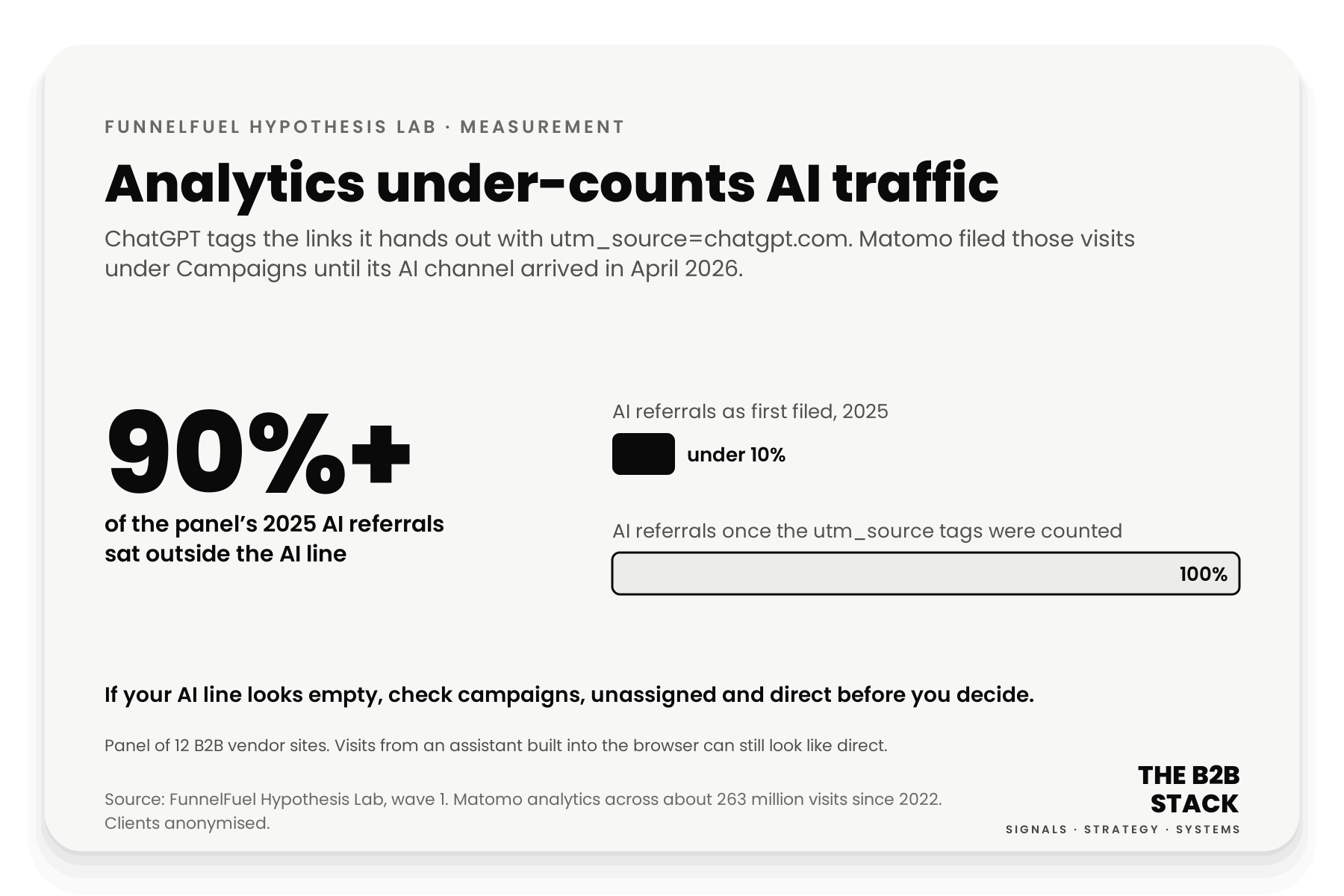
If your AI line shows nearly nothing, check campaigns, unassigned and direct before you decide. Build a channel definition that catches the assistant domains and the utm_source values they set, then break landing pages down by that channel, because the landing-page mix is where AI visitors show themselves even when the referrer doesn’t. There are not so many big AI engines that this is work is too onerous, and the value of understanding AI’s impact on your site is enormous. Split careers traffic out too: about and careers pages take 13.9% of AI landings, and job hunters will flatter your numbers with deeper engagement signals. The panel still can’t see the AI visits that arrive as direct, and neither can you, but you can count the ones that announce themselves.
What should B2B marketers do differently in 2027?
Start by retiring the AI referral line as the measure of AI’s effect on your buyers. It counts the clicks the assistants hand out, which is the one thing they are built not to do. The better indicators move in the direct shadow: branded search volume, the direct share of visits, the homepage’s share of landings, and the landing-page mix of what AI does send.
Then treat the homepage, product and proof pages as the landing pages they have become. The homepage’s job is to confirm, quickly, that this is the vendor the assistant described; the product and proof pages have to settle what it couldn’t. G2’s July 2026 research found that once a shortlist exists, IT security review is the biggest delay before purchase (39% of buyers), with budget approval next (32%). Security, pricing logic and evidence belong a click from the front door.
Content keeps its place, but the brief changes: write for the citation rather than the click, and build the pages the engines want to send people to. Comparison, use-case and integration pages are an open lane: almost nobody lands on them, and the people who do are among the most engaged visitors a site gets. Publish pricing, even if it’s only the plan structure or a “from” figure; AI sends four times search’s share of pricing landings and they convert best. Give product pages the definitions, FAQs and next step the blog used to carry, since that is where AI sends most of its visits, and bridge every guide to a product or a next step, because that is where AI visitors leak.
Finally, reach the committee around the assistant, because you can’t reach them inside it. The name a buyer types has to be built before they open the chat window, across the whole buying group rather than the one person who clicks. That is account-based media’s job. A solution like FunnelFuel exists to put the brand in front of those accounts and to resolve the direct visit back to the account when it arrives.
If this content is useful, I really and truly do appreictae it if you share it with colleagues or socially on platforms like LinkedIn. Many of my subscribers come from colleagues and friends sharing the content, and it helps me justify the time taken to create deep dives like this. Thank you
So how much of the buying journey has moved into AI?
More than the referral line will ever tell you. Search lost a third of its share of visits on our panel in two years, and identifiable AI referrals account for about 3% of what went missing. The rest turned up in the direct line and on the homepage, where buyers arrive from an assistant already knowing the name. The visitors AI does send skip the homepage for product, pricing and proof pages, because the assistant did the top of the funnel for them. Fewer journeys start on the blog, and none of it shows up as a site-wide rush to pricing.
So the question for your analytics in 2027 becomes “how much of our direct traffic did an assistant create, and are we in the answer that created it?” rather than “how much AI traffic do we get?” The first number is small and I expect it to stay small. The second is the one that decides whether the name a buyer types into the address bar is yours or a competitor’s.
My position is that the AI referral line is the least useful number in your analytics for judging what AI is doing to your buyers. If you think it is the right number to watch, what are you seeing that I’m not?
reach the committee around the assistant, because you can’t reach them inside it. The name a buyer types has to be built before they open the chat window, across the whole buying group rather than the one person who clicks. That is account-based media’s job. A solution like FunnelFuel exists to put the brand in front of those accounts and to resolve the direct visit back to the account when it arrives.
One other thing, and the specific need to build that brand gravity, and it joins the two halves of this piece. The signals an engine uses to decide a vendor is real enough to name are the same ones a buyer leaves behind when they already know you: mentions of the brand across the web, branded search volume and branded traffic. Ahrefs studied 75,000 brands and found branded web mentions the strongest correlate of visibility in AI Overviews (0.664), with branded anchors (0.527) and branded search volume (0.392) next, all well ahead of backlinks (0.218), and brands in the top quartile for mentions earned ten times the AI mentions of the quartile below. Paid search barely registered (0.216).
That is the brand-to-demand case in one table. Media built for memory, on CTV, YouTube, audio, out-of-home and display, is what makes people search for a name and talk about it, and those searches and mentions are what get a brand cited. The direct visit and the AI citation come from the same place: a brand the buyer and the engine have both heard of.
If you want to join those dots in 2027, reply to this email or write to me at mike@funnelfuel.io. FunnelFuel runs multi-surface, brand-to-demand media for B2B brands across CTV, audio, digital out-of-home and the open web, resolved back to the accounts it reaches. I also have some innovation credits set aside for anyone who wants to push what is possible next year rather than buy the usual plan.
The buying committee is drafting its shortlist inside ChatGPT, Claude, Gemini and Perplexity before anyone types your name. The Advanced B2B AI Discovery Playbook, 2027 Edition, is the method I use to find out whether a brand is in that answer, role by role, and what to change when it isn’t: 121 pages, 43 numbered sources and 17 figures, a 7 x 5 Committee Query Map, an audit protocol across three engines, 12 proof pages, 40 prompts and 10 templates. The Playbook Operator runs it inside Claude with very little manual work, and it is the method behind this newsletter’s own AI visibility. Get the playbook.