

Most B2B media plans are still built for the person who books the demo. Find the champion, warm the champion, hand the champion to sales. From there the deal is treated as the champion’s to lose. It’s also endemic of how many broader non-specialist [to B2B] agency’s lack deeper nuance into B2B buying journeys and how buying committees drive procurement as a collegiate group.
Today I’m going to look at the psychology of buying groups and look into the nuances that individual members from specific teams might be coming to the party with.
Understanding this and messaging for it could be the difference between closing a deal and being silently blocked by the CFO at the eleventh hour. In G2’s 2026 Buyer Behavior Report, 49% of buyers say their CFO vetoed an already-approved purchase. A purchase that had cleared every other hurdle, and finance killed it anyway.
And the champion was never alone in the room anyway. Forrester’s State of Business Buying 2026 puts the typical decision at 13 internal stakeholders and 9 external influencers. Add generative AI features to what you sell and the buying group averages 14 members, against 7 for purchases without them. Anecdotally, in my conversations, I’ve been hearing of buying groups as large as 22 internal stakeholders in enterprise B2B.
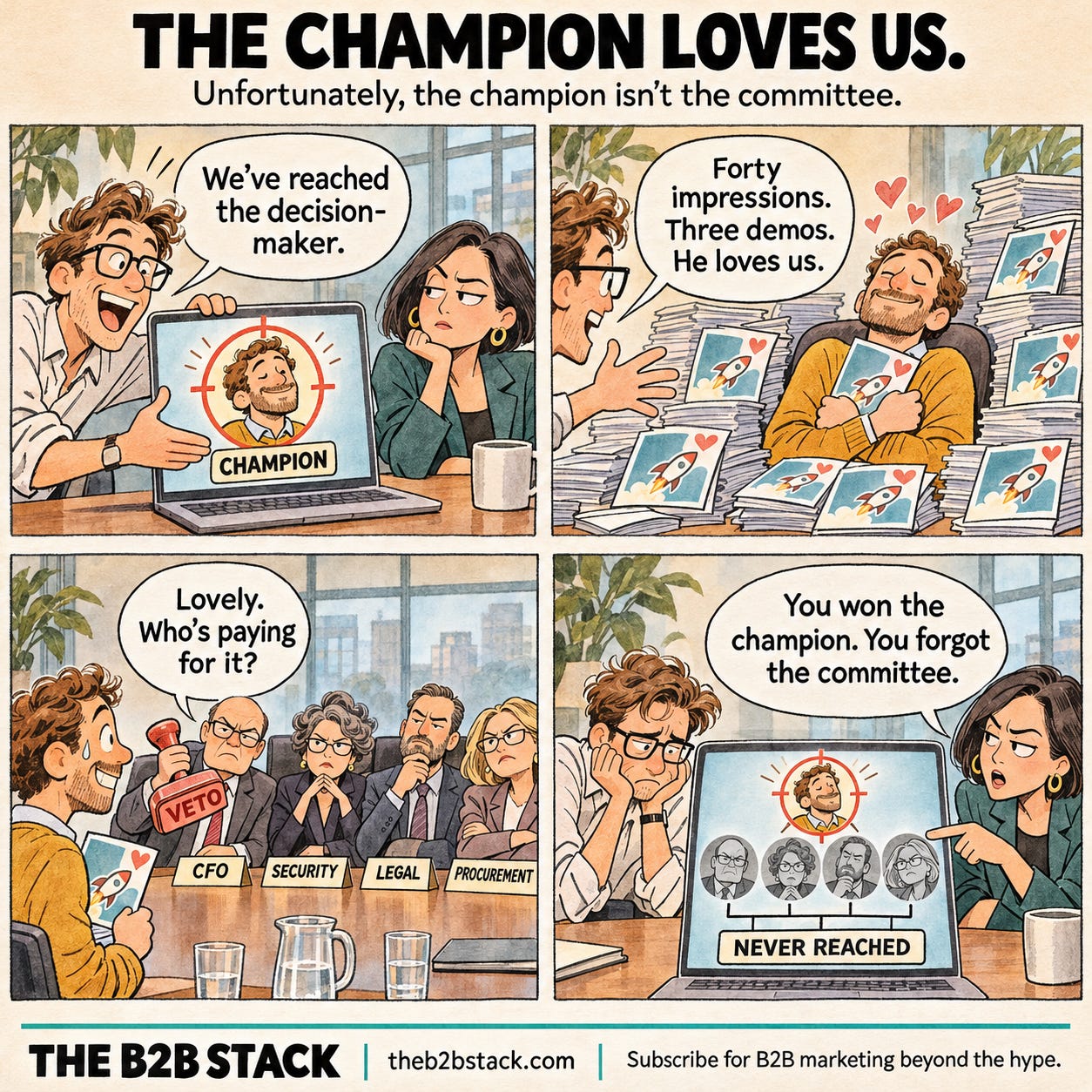
So this is a tour of the heads in that room as we go into 2027: what each is reading, what each is afraid of, what moves them, and what that means for your creative and the media that carries it. It ends with the part most of the industry gets backwards. The answer is not ten campaigns.
New here? I’m Mike Harty. I’ve been building B2B programmatic platforms since 2011. I’m a co-founder of FunnelFuel, where we run advanced account-based programmatic for B2B brands. The B2B Stack is where I write down what the data is telling us before it becomes conventional wisdom. If you want the backdrop to this piece, start with The CIO You’re Targeting Might Not Exist and The Buying Committee Doesn’t Live on LinkedIn.
Subscribe free, join teams from Dentsu, Hubspot, Salesforce, WPP and 1600+ others who subscribe, plus get access to the Subscribers’ Toolkit.
What you’ll learn
Whether the 2027 buyer is fearful or opportunistic, and why the answer is both
What each of the ten roles in an enterprise tech buying group is thinking about, worried about and moved by, and the creative that lands with each
Why the hidden half of the group kills deals, and why personalising to each person makes it worse
How to turn that psychology into a media plan: one story, served role by role at the signal level, with a receipt
What changes in 2027, from finance as gatekeeper to the EU AI Act
Are buyers fearful or opportunistic? Both, and that’s the problem
Start at the top. Gartner’s CEO survey, published in October, has 44% of CEOs struggling to show financial returns from AI, while 75% plan to increase tech investment. Read those together and you have the mood of the 2027 buying group in one line: the money is still coming, and nobody is sure it’s working.
That tension runs through the whole group. 6sense’s 2025 Buyer Experience Report found 70% of buyers say economic anxiety shaped their vendor choice. That is a defensive mindset, and a defensive mindset favours whoever is already in the building.
The same report has 94% of buying groups ranking their preferred vendors before first contact and buying from that favourite 77% of the time. If you’re the incumbent, 2027 looks comfortable. If you’re the challenger, it looks like a locked door.
However, the door isn’t locked. Edelman and LinkedIn’s hidden-buyer research has only 41% of hidden buyers putting “the safest choice” first, while 85% prioritise a vendor that understands their business challenges. Safety is a factor. Understanding wins more often. And the money is still there for the right outcomes: Gartner’s CEO survey has 75% of CEOs planning to increase tech investment. So the challenger’s job is to reassure the fearful roles and prove the outcome to the opportunistic ones.
Then there is the third outcome, which is no outcome. LinkedIn’s B2B Institute, drawing on its research with Bain, puts more than 40% of deals abandoned because the group can’t agree. Neither the incumbent nor the challenger won. Everyone kept their budget.
My take: everything I’m hearing in the conversations I’m having is that we’ve got a particularly fearful and reticent set of buyers as we approach 2027. The job markets are tough. There’s economic uncertainty. There are a couple of global wars going on. There are very real reasons why people are concerned about messing up and making mistakes, which would cost them their jobs. The jobs outlook is, at best, uncertain and, at worst pretty darn scary, with LinkedIn full of bad news stories around people who have been searching in vain for new roles over long periods of time. This negativity seeps into all decisions people are making
I therefore think we are collectively talking to buying groups who are going to make conservative choices in 2027. My view is that we need to be putting our energy into content and creative, which de-risks decisions, particularly for challengers who are coming into new spaces or approaching new accounts. The default position is probably going to be quite guarded amongst these buying groups, so anything you can do to de-risk a decision or a migration or a move to you is probably the right approach to be thinking about moving into next year.
The Advanced B2B AI Discovery Playbook, 2027 Edition. The buying committee now drafts its shortlist inside ChatGPT, Claude, Gemini and Perplexity before anyone visits your website, and the vendor on that first draft wins 95% of the time.
This is the only playbook I know of built for that problem the B2B way: the questions each committee role actually types into an engine, an audit that shows where you are absent and who got cited instead, the proof pages that get you named, and the paid-media plan that makes the engines notice, because across 75,000 brands it is branded mentions, not ad clicks, that correlate with being in the answer.
It ships with the tools to run it in Claude (no manual work!): an audit runner, a live workbook, and the Playbook Operator, a document you load into your own AI that interviews you and works the plan through for your brand, phase by phase, down to what to do on Monday.
121 pages, 43 sources, and the method applied to this newsletter as a public worked example. Get the playbook.
Ten heads, one meeting
Let’s dive into the key roles which often constitute a buying group. Read it as a map of the room rather than ten briefs: the point of knowing each person’s fear is to write one story that survives all of them.
The CEO, or the executive sponsor
Growth is front of mind, and in 2027 growth means AI - but this time with a number attached. They’ve told the board the investment will pay back, and Gartner’s 44% is how many are currently struggling to prove it. Their worry is personal: being the sponsor of the thing that didn’t work. Their world is opportunistic but watched. What moves them is an outcome, framed in the language they used to the board. Creative for the CEO is short, specific about the result, and comfortable being forwarded to their CFO.
The CFO
This is the person this piece is really about. G2 has finance involvement rising from 31% to 46%, alongside that 49% veto. Gartner’s CFO survey adds that only 36% of CFOs are confident they can drive AI impact, which I read as the quiet reason behind the veto: they are being asked to underwrite outcomes they don’t believe they can control. Their world is fearful, rationally so: they are defending free cash flow in a year where every AI line item is a bet - and they’re probably looking at a growing cost line against credit usage as adoption matures. What moves them is a business case they didn’t have to ask for: payback, exit terms, what it costs if it fails, and who in their peer group has already signed. The creative that lands is the finance version of the story, delivered before the deal reaches their desk. More on that below.
The CIO or CTO
They are planning the agentic estate. The Gartner 2026 CIO Agenda has 64% of technology executives planning to deploy agentic AI within 24 months. Their worry is less whether your product is good and more what it does to the stack: integration debt, and what the estate looks like in three years if your roadmap slips. Opportunistic about the direction, fearful about the plumbing. Reference architectures, integration proof and a roadmap they can believe move them. “AI-powered” in a banner does not. Many companies also have engineering teams on the back foot, potentially feeling defensive and potentially feeling the need to demonstrate more value. That can manifest as a “we’ll build it ourselves with Claude Code” mentality, depending on the size and scope of what your offering is. This puts these roles, with the people that report into them, into a psychologically interesting state moving into next year
The CISO
Fearful, with cause. G2 found IT security review is the biggest delay after a vendor has been selected, at 39% overall and 50% in the enterprise. IANS and Artico have 69% of CISOs expecting AI security spend to rise, while overall security budgets grew an average of 5%. So the CISO is being asked to review more AI vendors with roughly the same money and the same people, with overall organisational pressure producing a greater squeeze. What moves them is work you’ve already done: data flows mapped, certifications current, the sub-processor list published, the questionnaire answered before it’s sent. Creative for the CISO is a trust centre exercise.
Procurement
Procurement is a decision-maker in 53% of cycles now, by Forrester’s count. They are rarely opportunistic and rarely fearful; they are comparative. Their worry is being unable to show they evaluated you against alternatives. What moves them is comparability: terms, and a matrix they can defend. If you make yourself hard to compare, procurement reads it as something to hide. Give them the comparison before they build it.
The line-of-business champion
Gartner’s CMO Spend Survey has 70% of CMOs calling AI leadership critical, only 30% AI-ready, and budgets flat at 7.8% of revenue. So the champion is opportunistic and exposed at the same time: they need to look like the one who made the right call, with no extra money to make it. What moves them is ammunition. The creative that lands is the internal deck they’d have to write anyway, written for them.
The end user
Forrester has more than 60% of buyers using a trial, and the end user is who the trial is for. Front of mind is simple: will this make my week harder. They don’t read case studies. They watch the workflow, because they will be tasked with living the workflow if this deal moves forward. Creative for the end user is the product in their hands with the gloss removed, and a trial that takes minutes to start.
IT, architecture and data
The people who have to make it work. Their worry is what you need from them: data residency, pipelines, identity, what breaks on their side. Neither fearful nor opportunistic, mostly tired. What moves them is documentation that respects their time. Creative here is barely creative at all: the docs, the API reference and the integration specifics, surfaced where they research rather than behind a form.
Legal and compliance
For anything with AI in it, legal joins earlier than it used to, and 2027 hands them a date. The EU AI Act’s high-risk (Annex III) rules apply from 2 December 2027. Their worry is liability that outlives the contract (yikes!). What moves them is a plain-language position on data processing and AI Act readiness, written for a lawyer rather than for a marketer.
The AI lead
The newest seat at the table. IBM’s 2026 CEO Study has 76% of organisations surveyed with a Chief AI Officer (a different sample from last year, so I won’t call it a jump). Opportunistic by job description, but their standing depends on AI purchases not embarrassing the company. What moves them is provenance: what the model is, what it was trained on, what it won’t do. Creative for the AI lead explains the AI plainly, limits included.
So what do you get when you add all of this up? an increasingly large, fragmented, disparate group of people who have come together to make a purchase decision collegially and collectively, all coming in with their own different psychology, beliefs, and drivers. To not want to overstate it, but the fear of messing up will be driving them. Therefore, their default position could well be one of risk-averse avoidance and sticking with the status quo - this is the battle we’re fighting over the next 12 to 18 months
The quiet half
The arithmetic is uncomfortable because it’s pointing at people we often don’t think about and certainly don’t usually interact with . Bain and LinkedIn put hidden buyers (procurement, finance, IT, legal) at about half the influence in a deal, and they veto around half of shortlisted vendors. Edelman and LinkedIn found 71% of hidden buyers have little or no contact with sales. The hidden buyers hold half the power, and your sales team has mostly never met them.
When I look at enterprise account-based marketing campaigns that we’re tasked with running at FunnelFuel, we very seldom have deep representation in the personas across these fields above. Agencies and our clients are more typically asking for a much tighter remit of CXO and potentially a layer or two around finance, and some slightly vague IT decision maker asks. We’re certainly seldom getting creative which talks to the drivers behind these ‘quiet half’ of the buying groups.
The instinct is to fix that with more tailoring. Ten personas, ten messages, each one precisely aimed. Gartner’s May 2025 sales survey is the warning. 74% of buyer teams show “unhealthy conflict” during the decision, and teams that reach consensus are 2.5x more likely to report a high-quality deal. Content tailored to the buying group improved consensus by 20%. Content tailored to the individual had a 59% negative impact.
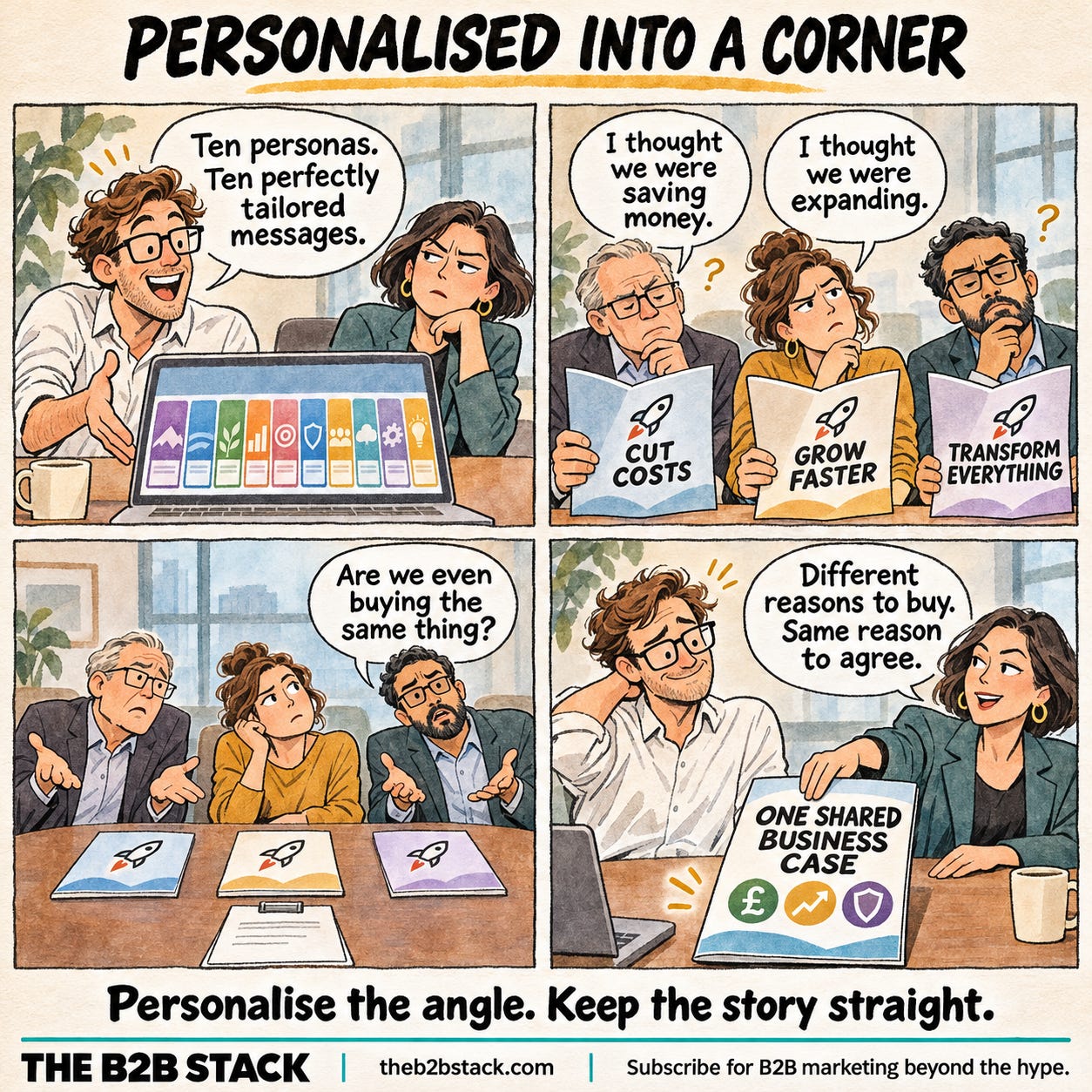
That number should change how you brief creative. Individual tailoring works in the inbox and fails in the meeting: each person arrives with a different version of you, and the room spends its time reconciling the versions instead of agreeing on the purchase. Consensus comes from the opposite. One shared story, with each role able to find its own angle inside it, so the CFO’s version validates the financial case, the CISO’s the security case, the champion’s the growth case, and when the group sits down and lifts pieces out, the pieces fit.
I’d put it as a test. Could two members of the group lay your two ads side by side and agree they describe the same product and the same promise? If not, you’re tailoring to individuals. Call it the agreement test.
As is so often the case when it comes to personalised advertising (like that offered in programmatic), it can be tempting to chase the narrowest, smallest, and most precisely defined cohorts. Zoom right in and completely eradicate waste. To the point where we’re barely able to find a single individual who would match the precision elements of the targeting set. That zoomed-right-in view can drive us down a route of deploying creative which is too spookily precise. all the data I’ve seen shows that there is value in aligning creative to demographic segments, technographic segmentation, intent-derived messaging, and persona group messaging alignment (so long as you follow the above advice of having the common thread running clearly throughout). what I have not seen work is zooming right into calling out the named account in the creative, trying to talk to a persona, and getting precise enough that you’re calling out job roles and company in the creative - at which point your MPU is almost saying, “Hey Mike at FunnelFuel.” . It is spooky to people and turns them off. Like in so many things in life, there’s a good amount of personalization, and then you can have too much of a good thing. We need to stay on the right side of the fence
Turning psychology into a media plan
The programmatic side is where this gets hard to run, because the brief above is impossible with job-title targeting on the open web and a frequency cap set at the user level.
The unit has to be the account, and inside the account, the role. The plan needs to resolve the account first, then read the role signals: which pages are being visited, which content categories, and when. Finance-shaped behaviour inside an account should get the finance version of the story. Security-shaped behaviour should get the security version. The champion should keep seeing the growth version, and frequency needs managing across the group, so the champion isn’t on their fortieth impression while finance has seen nothing. This is the shadow buying group idea from September put to work: the committee reconstructed from signal rather than assumed from a title list.
The defensive job is the one I’d prioritise. Call it the finance pre-read: the business case served to finance-shaped behaviour inside the account during the cycle, so the first time the CFO sees your case is not the meeting where they decide whether to kill it. Paid media’s job in 2027 is increasingly to pre-empt the stakeholder nobody briefed.
Then the receipt. The log test I wrote about last month applies here too: delivery by account and by role, so sales knows before the call that the finance version has been seen in the account, and how often. That receipt is what makes this a media plan rather than a hope.
A solution like FunnelFuel lets you target buying-group members at the signal level, serve each persona its own version of one shared story, and show a full receipt of delivery through the reporting. Intent data and the other signal layers are complementary inputs to that plan.
What changes in 2027
Four things, in my reading. Finance becomes the gatekeeper by default: G2’s 31% to 46% is the direction of travel, and the 49% veto shows what happens when you ignore it. Agentic AI makes the ROI question harder, not easier: 64% of technology executives plan to deploy it within 24 months, into companies where 44% of CEOs already struggle to show the returns. The EU AI Act’s high-risk rules land on 2 December 2027, which pulls legal into AI purchases earlier and hands them a reason to say no. And the shortlist is increasingly drafted by a model before you know the deal exists: G2 has 82% of buyers sourcing recommendations from AI chatbots, and 6sense has 94% of buying groups ranking vendors before first contact. Getting on that list is a brand job. Staying on it through the finance review is a media job.
FAQ
How big is a B2B tech buying group now? Forrester’s State of Business Buying 2026 puts the typical decision at 13 internal stakeholders and 9 external influencers. Measured as the core buying group, purchases with generative AI features average 14 members, against 7 without.
Who kills deals? Finance, most visibly: 49% of buyers in G2’s 2026 report say their CFO vetoed an already-approved purchase. Security review is the biggest delay after selection. And hidden buyers as a group veto around half of shortlisted vendors, per Bain and LinkedIn.
Should every persona get different creative? Different lens, same story. Gartner found content tailored to the buying group improved consensus by 20%, while individual-level tailoring had a 59% negative impact.
How do you reach the people who never fill in a form? 71% of hidden buyers have little or no contact with sales. You reach them in media, at the account and role level, with the version of the story their role needs to see, and you keep the delivery receipt so sales knows it happened.
The person who can say no
Sent me to try and forge a closing position. We have covered a lot of ground today, exploring the psychology of different people who come together to make a group-based decision, which is the nature of B2B. All of the research points paint a picture of this group using AI in order to form a day-one consideration set, going into enterprise LLMs and tweaking what they’re asking of these chatbots based on their own drivers and psychology. As we move into 2027, we can assume that buyers are coming in from a defensive, conservative, and status quo-driven position based on wider macro uncertainties.
Yet against this backdrop, businesses are still investing. with over 70% looking at increasing their technology budgets for 2027, there remains an opportunity to win meaningful new business. When we use paid advertising to drive our go-to-market, we need to be thinking about how we talk to the whole buying group with a common thread running through our messaging (but with the nuance in order to be precise about how we address each key stakeholder in the modern buying group). This isn’t 10 conversations run in silos. It’s one conversation, nuanced and skewed with creative messaging to lean the story into the specific drivers of each buying group member. Over half of the modern buying group are often missed off of media plans, and they’re the ones that often sign on the dotted line
The question I’d leave you with: is your media plan written for the person who says yes, or for the person who can say no?
Where this goes next
The finance row is where most vendors are invisible, and not only in the meeting. When a buying committee researches a category inside ChatGPT, Perplexity and AI Mode, the rows most likely to come back empty are finance, procurement and security, because so few vendors have written a word for them. The Advanced B2B AI Discovery Playbook, 2027 Edition is built around that committee rather than the brand: the Committee Query Map (seven buying roles against five decision moments, with the questions each role actually types into an engine), the citation audit protocol that runs them, and the committee heat grid that shows a leadership team exactly where they’re missing. The second edition is 121 pages and comes with an Operator that runs the method for your brand inside ChatGPT, Claude or Gemini. Subscribers get $30 off via the Subscribers’ Toolkit page.
Get the playbook · Subscribers’ Toolkit for $30 off
Do you know which roles in your target accounts have seen your business case, and which haven’t? If the answer is “the champion, probably”, I’d like to hear how you’re planning the rest of the room for 2027.
FunnelFuel works across a few different models: a full managed service, where we run the account-based media and the buying-group delivery described above; a licensed signal product for teams who want the account graph and the data without outsourcing the media; or something built around what you already run in-house.
Connect with me on LinkedIn, message me directly here on Substack, hit reply if this landed in your inbox (it comes straight to me), or email mike@funnelfuel.io. No pitch attached. Happy to talk through what I’m seeing across the market and whether there’s a fit, and just as happy if the answer is that there isn’t one. More on how we work at funnelfuel.io.
Sources: Forrester, The State of Business Buying 2026. Gartner, sales survey on B2B buyer-team conflict (May 2025). G2, 2026 Buyer Behavior Report. 6sense, 2025 Buyer Experience Report. Bain, Raising the Odds on a Deal, and LinkedIn B2B Institute, The Hidden Buyer Gap. Edelman and LinkedIn, hidden-buyer research (2025). Gartner, CEO survey on AI financial returns (surveyed April–May 2026, published October 2026). Gartner, CFO priorities survey (surveyed August 2025). Gartner, 2026 CIO Agenda. IANS and Artico, AI and security budgets in 2027. Gartner, CMO Spend Survey 2026. IBM, CEO Study 2026. EU AI Act Service Desk, implementation timeline.
Exit terms is the item I'd move to the top of the CFO list. A CFO who has to ask how to get out is already leaning toward no. Putting the cancellation and data-export terms on a public page answers that before the deal reaches their desk.
One thing the plan runs into: open web frequency caps are set per ID, not per account, so managed across the group has to be rebuilt as one line per role, each with its own cap, plus an account level pacing rule in reporting. The other catch is the half you most want to reach. Finance and legal often work from home, so they resolve to a consumer IP and fall out of the account graph. Worth checking what share of your account reach is office IP before the finance pre-read is briefed.