

Most people running B2B programmatic think their data is precise because it has a job title attached to it. A VP of IT at a named account feels like a solved targeting problem. It isn’t. It’s a segment, dressed up to look like a signal, and the industry has been buying against that dressed-up segment for so long that nobody stops to ask what’s actually sitting behind the impression.
I have spent half my lifetime in the programmatic advertising world, and I know 2 things to be true simultaneously - this is a hugely powerful channel that is often run terribly, and seldomly do B2B brands get the upside that it is capable of bringing.
New here? I’m Mike Harty. I’ve spent 15+ years building B2B programmatic infrastructure from the inside, and I still run that infrastructure day to day at FunnelFuel.io
If this is your first issue, two pieces will show you the house argument fastest: The Observer’s Paradox in B2B, on why chasing the wrong metric quietly trains a campaign to find the wrong buyers, and The Dirty Secret of B2B Intent Data, on why more signal often makes the underlying problem worse rather than better.
Subscribe for one argument a week on where B2B, ABM, programmatic and data actually meet, straight to your inbox.
What you’ll learn in this piece:
Why segment-level data creates single-vendor dependency and kills attribution before a campaign even starts
Why clicks are the wrong bellwether for an 18-month buying cycle, and what the buying committee stats actually say
Why B2B can’t be traded like B2C, and what’s structurally missing when agencies try anyway
Why attention, not impressions, is the more honest unit of currency, and what it does to your effective CPM
Why intent data isn’t gospel, and what turns a market signal into an actual buying signal
Why a 50,000-account target list is really dozens of different audiences wearing one CSV
The segment-level trap
Ask most trading desks how confident they are in their B2B data and you’ll get a strong yes. Ask them to prove which specific buying committee member, at which specific account, saw which specific impression, and the confidence disappears. That gap is the whole problem.
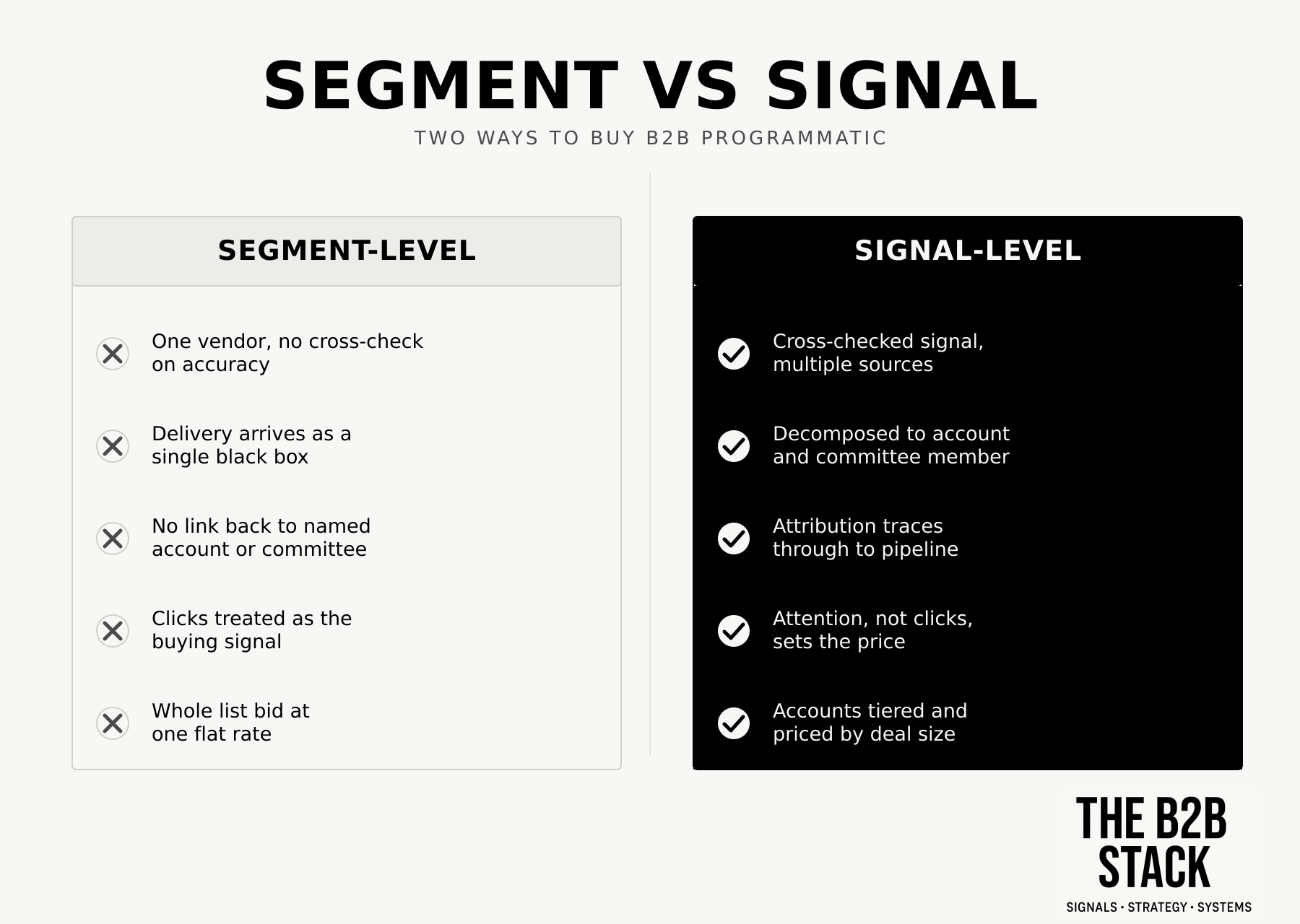
The way most B2B programmatic gets bought today, a desk (e.g. a holding company’s agency trading desk) licenses segment-level data from one of the big providers, points a DSP at it, and buys against the segment as a black box.
Two structural weaknesses fall out of that immediately.
First, single-vendor dependency: there’s no cross-check on accuracy, just a bet (or should I say, hope) that the provider’s methodology holds up, because segment-level access rarely comes with the underlying signal to verify it against anything else.
Second, and worse, there’s no way to decompose a delivered million impressions back into which accounts and which buying committee members actually received them, in what sequence, on what device, at what point in a deal cycle. Buy against a segment and you get delivery. You don’t get a graph.
That second failure is the expensive one, when the number one one of marketing is to showcase their influence on pipeline. Without impression-level decomposition back to named accounts at a minimum and ideally personas aswell, you can’t build real attribution, you can’t show pipeline progression against spend, and you can’t put a credible marketing-to-pipeline view in front of the board. The campaign might have worked brilliantly. There’s no way to prove it, and “I think it worked” doesn’t survive a budget conversation. And it certainly won’t survive that conversation in 2026 when marketing budgets as a percentage of revenue are falling to as low as 7.5% from a post-pandemic peak of 12.9%. You’d have to be living in an echo chamber to not be noticing this is a tough environment where only the most performant budgets are going to survive - and this sort of shoddy programmatic execution is exactly what taints the whole channel, unfortunately
So even going beyond this segment issue, there are other structural problems with how B2B is generally traded by agency groups who are running a mix of consumer marketing alongside B2B advertising, whilst often retrofitting B2C thinking into a B2B workflow which is much more different than most laymen understand. this approach is further hampered by advertising technology that was always designed for the consumer marketing mega-budgets and not the intricacies of long sales cycle B2B marketing
Clicks are the wrong bellwether for an 18-month decision
It still amazes me how many B2B briefs come with the core KPI of delivering a strong click-through rate.
Clicks aren’t the intent signal that they are often hoped or assumed to be, and sadly this game is not that easy, and it comes back to one wrong belief: that a B2B campaign should be judged on the same short-cycle signals as a B2C one, because a click is a click. It isn’t, once you look at how long a B2B decision actually takes and how many people are in the room.
Forrester’s State of Business Buying, 2026 report puts the typical B2B purchase at 13 internal stakeholders plus nine external influencers, a number that climbs further for complex or strategic buys. Other research houses land on a lower but still substantial range, Gartner’s own tracking has shown buying groups roughly doubling in size over the past decade. I recently heard the buying committee referenced as a ‘buying network’, which is a really interesting extension of those nine external people referenced, meaning that a buying group of 13 people internally may all be impacted by a mixture of:
ex-colleagues
trusted industry friends
wider industry experts and contacts that their industry friends loop in
Industry WhatsApp groups and Slack channels
‘Influencers’ across social with a strong POV
a whole wider network of people who they may lean on for an opinion or a point of view that may subtly redirect their whole procurement process and which forms part of our often discussed ‘dark funnel’.
Whichever numbers you prefer, the shape of the problem is the same: a genuinely multi-departmental, multi-week (often multi-year) group decision, with the actual proof of a sale usually arriving as a signed contract reconciled in a CRM many months after the first ad ever served. Clicks are always going to be a poor representation of the complexity of this journey, and at most they’re going to be such a tiny and therefore inconsequential part of the motion that they serve as noise - and that is assuming the clicks were all deliberate. As we’ve discussed on previous newsletters, the click metric is so poor and misguided by accidental clicks that I actually wish that digital ads did not redirect via clicks at all, and we could just reset our expectations around what good looks like
Why Clicks Are a Lie: Building Goals-Based Optimisation for B2B
Clicks are the currency of digital media - but in B2B, I would argue that they’re mostly a distraction.
That’s the root of the metrics problem. With no fixed attribution point anywhere near the media, campaigns fall back on the nearest available number, which is almost always a click, because it’s cheap to report and easy to graph on a dashboard. But a click on a B2B display ad has never been a reliable stand-in for buying intent, and treating it as one pulls the whole campaign towards whatever inventory generates the most clicks, which is rarely the inventory a genuine buying committee member is actually looking at.
The Observer's Paradox In B2B: Why Chasing Clicks Is Training Your Campaigns to Find the Wrong Buyers
Welcome back to The B2B Stack. A Substack note I posted a couple of weeks ago on the click-optimisation trap struck more of a nerve than I expected, so I want to properly finish the thought here: where the problem actually comes from, what the evidence says, why it gets worse the moment you step outside display, and what a saner measurement stack looks like in practice.
B2B isn’t B2C with smaller invoices
This is where a lot of agency trading desks quietly import a B2C playbook and don’t notice the seams. In consumer advertising, a trafficker optimises to return on ad spend by testing segments against a clean, fast anchor: the transaction. Placements, publishers, formats and time-of-day all get tuned against that anchor because it arrives quickly and it’s unambiguous.
B2B has no equivalent anchor sitting anywhere near the media. The purchase decision belongs to a committee, not a device, and the plumbing that could join those devices, sessions and identities back into one committee, and that committee back into an account, mostly doesn’t exist in the way B2C identity graphs do.
The New B2B Account Graph: A Product Perspective on Targeting in 2025

The concept of the “Account Graph” is quietly becoming the most valuable infrastructure in B2B marketing. It’s the connective tissue that decides whether your Target Account List (TAL) becomes a signal engine - or just another spreadsheet collecting dust. As the identifiers behind the companies you target fragment, our product playbook has to change if we’re going to retain the ability to target them.
Every impression against every committee member gets measured in isolation, when the reality is that the committee will move as a group and then one person will go and sign. Trade B2B with a consumer mindset and you’re not just missing the graph, you’re missing most of the actual transactions, because the joins between devices were never built for this. Programmatic was never designed to map up beyond individuals and the audience data we collect about them - the whole construct of groups of people mapping to buying groups and then into their business is missing. There is no use case in consumer marketing and adtech was built for that.
This is close to the argument in The Bland Data Segment Is Dying: resolving account and audience signal sell-side, before the bid even reaches the DSP, turns impression volume that’s functionally invisible to a segment-level buy into something a B2B advertiser can actually bid against. Building that properly, at signal level rather than segment level, is most of what a B2B-native data partnership like the one we’ve built at FunnelFuel with Bombora and D&B actually exists to do.
There’s a second, more human version of the same mistake. The vast majority of the accounts on any target list aren’t in an active buying cycle right now. The LinkedIn B2B Institute, drawing on Professor John Dawes’s research at the Ehrenberg-Bass Institute, popularised this as the 95-5 rule: at any given time, only around 5% of a category’s potential buyers are actively in-market, and the other 95% simply aren’t shopping yet. Programmatic’s job against that 95% isn’t conversion. It’s memory: presence, association with premium environments, being the name that’s already familiar when a buying cycle does eventually start, which could be in five minutes or five years.
Chase clicks against a market shaped like that and you’ll end up buying cheap inventory that isn’t remotely aligned to B2B decision-making, often on mobile, often in gaming environments or obscure apps, sometimes in genuinely bizarre places.
We’ve seen B2B decision-makers’ devices turn up against potty-training apps and children’s games. The data wasn’t wrong exactly, it’s a reminder that devices get shared inside a household, and that a C-suite parent handing a phone to a toddler is putting on a game, not the Wall Street Journal. Context still matters, even when the underlying data is accurate.
Attention, not impressions, is the more honest currency
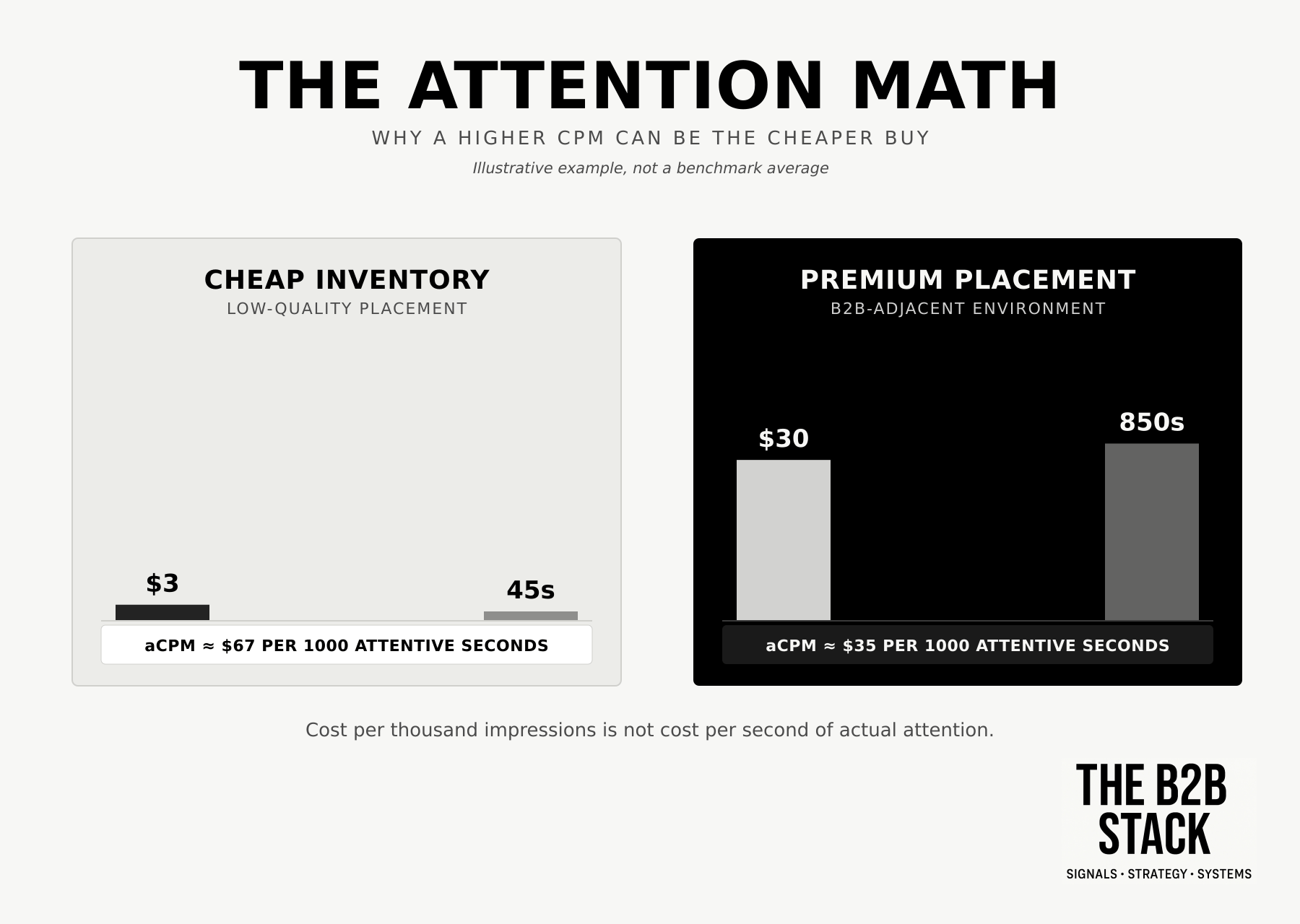
If clicks are the wrong bellwether, what replaces them? The most useful shift I’ve seen is trading impressions for attention, because attention starts to normalise the actual cost of inventory rather than just its volume.

Attention measurement specialists like Lumen Research have built a genuinely useful unit for this: attentive seconds per thousand impressions, and an attentive cost per thousand impressions (aCPM) that divides cost by that figure rather than by raw delivery. Lumen’s own research has found that only a small fraction of standard banner units are ever actually looked at, and that the ones that are tend to hold attention for barely more than a second. Run that maths against a premium, above-the-fold, genuinely B2B-adjacent placement and the picture flips: a $30 CPM in the right environment can produce a far lower attentive cost than a $3 CPM in the wrong one, because the cheap unit is mostly buying impressions nobody ever saw.
That reframing matters because it breaks the “more is better” instinct that cheap inventory keeps rewarding. The IAB and MRC’s formal Attention Measurement Guidelines, published in late 2025, are a signal that this is moving from a niche argument to an industry standard rather than a boutique metric a handful of agencies quote. Buying B2B media against attention, not raw impression counts, is one of the clearest ways to stop funding inventory that technically delivered and never actually reached anyone.
Intent data isn’t gospel, it’s a starting hypothesis
The other place programmatic quietly breaks is intent data, and specifically the assumption that a topic-level intent signal equals a signal for your product. An account showing intent around “CRM solutions” is not the same account showing intent for your CRM, and treating the two as interchangeable is how a perfectly good intent feed ends up wasting budget.
The upgrade here is combining that market-level intent with your own first-party behavioural data, web analytics, CRM activity, the account’s actual footprint on your own properties, so a wider category signal only counts once it’s corroborated by something the account has actually done with you. That’s the difference between intent as a market-wide hypothesis and intent as an actionable buying signal, and it’s a large part of what a genuine account graph, built from a partnership like the raw signal-level relationship we run with Bombora, is for.
The Dirty Secret of B2B Intent Data: Everyone Has It, Almost Nobody Uses It Right
There’s a moment I’ve witnessed inside dozens of B2B teams across my career.
Not all accounts on the list are equal
The final, and probably most under-discussed, failure is treating a target account list as one flat audience. A 50,000 or 100,000-account list looks like a single, coherent thing in a media plan. It isn’t. It contains wildly different company sizes, industries, technographic profiles and, crucially, wildly different deal sizes if a purchase ever happens. A small business and a prospective nine-figure enterprise account can sit in the same CSV, get the same frequency, and get treated by the platform as equally valuable.
The fix isn’t more reach against that list, it’s segmentation before the campaign even starts: pre-tiering by deal size, firmographics, technographic fit, and layered intent and first-party behavioural signals, so the accounts showing genuine live motion get bid harder and more frequently, while the rest of the list gets the steadier, background brand-memory treatment the 95-5 rule says most of the market actually needs.
Curated Deal IDs built off decomposed, signal-level data, rather than a single aggregated segment, are what make that tiering possible at the supply side, and it’s the difference between a campaign that treats a nine-figure prospect the same as a small business, and one that prices the two accordingly from day one.
Field Notes: the direction of travel across the industry backs this up rather than undercutting it. Forrester’s 2026 buying research and the IAB/MRC’s move to formalise attention measurement both point the same way, buying groups keep getting larger and harder to reach with a single generic segment, and the industry’s own measurement standards are shifting away from raw delivery towards something closer to genuine signal quality. Neither development was written with programmatic in mind, but both make the case for signal-level buying stronger, not weaker.
Do this properly and the return isn’t just cleaner reporting. It’s reach that’s genuinely broader than anything available on LinkedIn alone, because the vast majority of a buying committee’s actual time online happens across the open internet, not inside one professional network, provided the buy is built on a graph good enough to find them there.
So here’s the actual disagreement worth having: is the industry’s segment-level default a reasonable trade-off for scale, or is it the single biggest reason B2B programmatic keeps underperforming its own potential? I’ll take the second position and argue it in the comments if you don’t.
Is segment-level data quietly capping what your programmatic spend can prove right now? Whatever that looks like for you, delivery you can’t decompose, attribution that stops at a click, a target list that’s never been tiered, I’d like to hear about it.
FunnelFuel works across a few different models: a full managed service, a licensed signal product for teams who want the data and the account graph without outsourcing the media, or something built around what you already run in-house.
Message me directly here on Substack, hit reply if this landed in your inbox (it comes straight to me), or email mike@funnelfuel.io. No pitch attached, happy to talk through what I’m seeing across the market and see if there’s a fit. Just as happy if the answer is there isn’t one.