

A large enterprise software account told me, flatly, that they don’t care which accounts engaged with their brand campaign in New York at programmatic IO. No interest in the buying-group breakdown, no interest in the contextual environment it ran in and not even interested in a list of the accounts who saw their ads. I was dumbfounded. Despite further reflection, I think that’s an expensive mistake, and I want to show you why.
New here? I’m Mike Harty. 15+ years building programmatic platforms, most recently FunnelFuel, a B2B-only programmatic managed service built around an account graph rather than a cookie. The B2B Stack is where I write the version of this industry the platforms won’t.
Worth reading next to get the full flavour of what the B2B Stack is all about:


Subscribe free, every week and it unlocks our brand report based on the key learnings tracking over 1 billion B2B pages and running $39m in managed programmatic B2B spend.
and share this with the one person on your team still treating brand spend as a pure reach line.
What you’ll learn in this article:
Why a large account running brand advertising told us account-level reporting doesn’t matter to them, and why that reaction is more common than our own echo chamber likes to admit
What “insight-first” reporting actually means in programmatic, and why it only exists because of how impression-by-impression bidding works
The two classes of signal sitting inside your brand campaign’s exhaust: audience enrichment and environment
Why context reads as research intent in B2B, not entertainment, and what that means for connecting brand to demand
Why a buying process that increasingly happens inside AI chat windows makes this exhaust more valuable, not less
What to ask your vendor for before your next brand campaign goes live
Plus, in Field Notes: a fresh, named number on how much of B2B buying is invisible to a CRM, and an honest caveat about how shaky that number actually is across the industry.
A large account said they don’t care who engaged
The meeting itself was good. Strong relationship, the agency does a lot of work with us, no complaints about the media, nothing unusual in how the campaign was proposed to run. Then the conversation turned to reporting, and I got a reaction that’s stuck with me since: “The client doesn’t care about account level reporting when they run brand campaigns”. Reach, frequency, maybe a completion rate. That was it.
It immediately struck me as quite bizarre. In truth, I was close to disbelief. A proper B2B advertiser not having any interest in which prospects had seen their ads
Then it reminded me that we can spend so long selling capabilities that we can forget to talk about the ‘so what’, the whole why would a client need this and what would they actually do with it piece.
Reach and frequency. That was the entire ceiling of what they wanted to see.
Spend long enough inside an account graph, inside an identity spine built specifically to resolve impressions back to named buying groups at named companies, and it’s easy to assume everyone buying B2B media wants that view by default. Most don’t, and the longer I’ve sat with this one, the less I think it’s an outlier account and the more I think it’s a gap between what our side of the industry has built and what most brand buyers have actually been shown is possible.
The Account Graph Is Not an Identity Graph

This piece explores the differences between identity graphs and account graphs. One of them is a genuinely rare thing to build properly, and it isn’t the one that gets the coverage number printed on the sales deck.
So this piece isn’t about that account, or what they do or don’t run next quarter. It’s about what account-level, insight-first reporting actually is, why it only exists in programmatic specifically, and why discarding it on a brand campaign is a considerably more expensive decision than it looks from the media-plan level.
What insight-first reporting actually is, mechanically
Start with the plumbing, because it’s easy to lose sight of once you’re a few layers up in a dashboard. To get to why this is possible, we need to understand the innate differences between programmatic advertising and other forms of digital, from spot buys, to tenancies, and other ‘block’ or segment booked activity.
Programmatic differs because it transacts impression by impression. Every single ad placement is sold of on an eBay like auction, 1 trillion times a day - its an internet scale auction infrastructure where each placement is valued by each bidder, taking factors like time of day, host environment (e.g. which website or app is the ad on), visibility of the placement, device and many other such factors.
That granularity is gross overkill for most of what it gets used for, and it’s also the entire reason the data exhaust exists at all. Every bid, every win, every served impression leaves a line-level record. A direct buy or an upfront insertion order never produces that. It’s a function of the mechanism, not a feature someone bolted on.
Insight-first reporting is the impression-by-impression bid record a campaign already produces, showing which accounts engaged and in what environment. It isn’t a dashboard feature added afterwards. It’s the record itself, left there whether anyone chooses to look at it or not.
Pair that line-level record with an account graph, and the exhaust stops being an anonymous impression count and becomes a resolvable view of which accounts, and which buying groups within those accounts, are showing up against your targeting. That’s the whole premise behind insight-first reporting. It’s the natural by-product of buying this way. Its the exact thing my prospect said they had no interest in.
Two classes of signal hiding in your brand spend
Once you’re looking, two distinct things are worth separating, because they tell different stories and drive different insights.
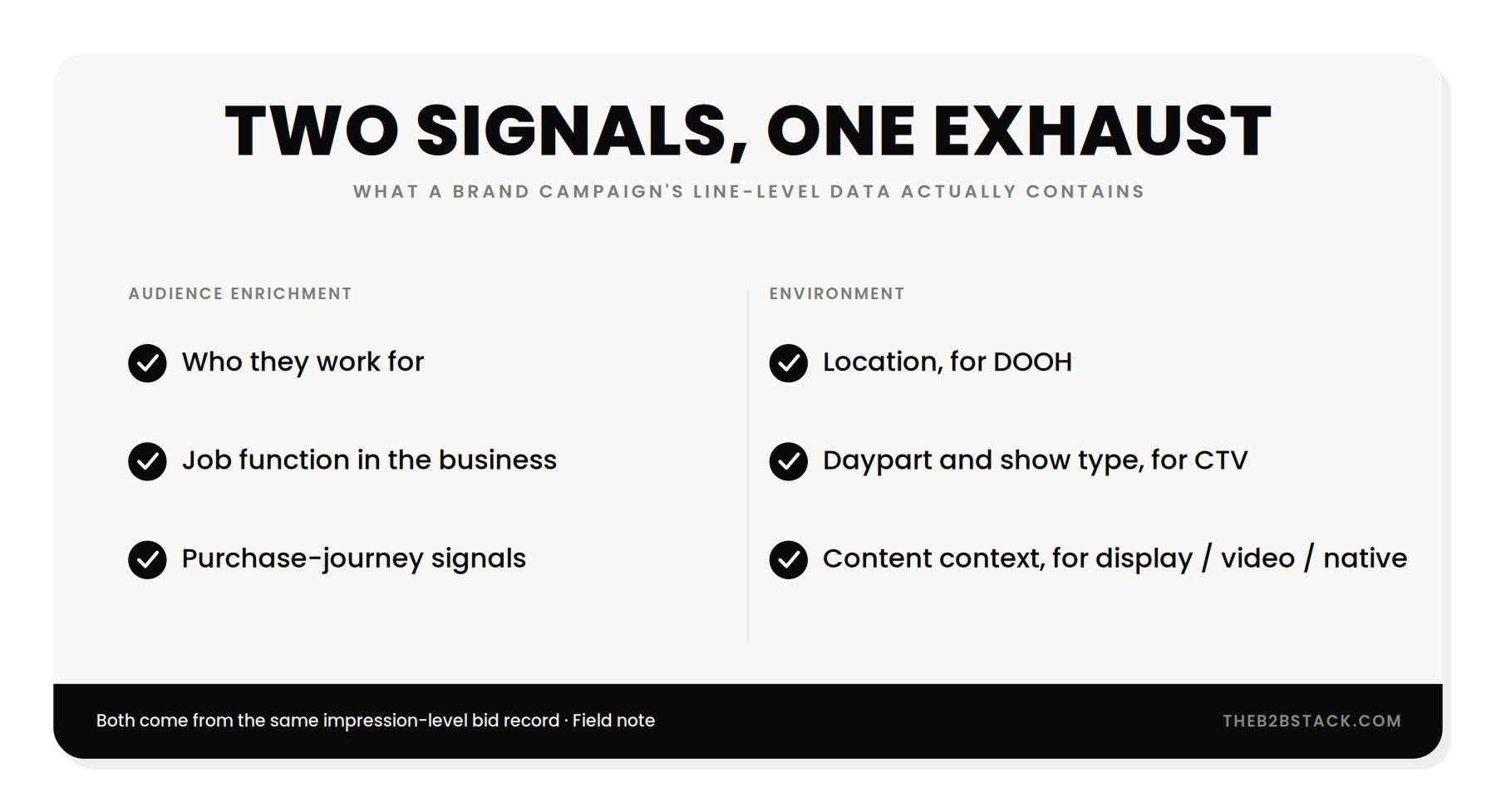
The first is audience enrichment: who the person works for, what function they sit in, and whether the exhaust shows any indication they’re further along a purchase journey than a cold prospect would be. This is the layer most people associate with account-based targeting, and it gets most of the attention in vendor decks. This is intent mapped out of advertising signal.
The second gets talked about far less, and it’s arguably the more interesting one: environment. For digital out-of-home, environment means location and venue type. For connected TV, it’s daypart and show genre, and increasingly whether someone’s using the big screen for something work-adjacent rather than pure leisure viewing. For display, video, native, and in-app, environment becomes content context: the actual editorial or topic someone is engaging with alongside the ad.
Neither requires anything exotic to extract. Both come straight out of the same line-level record the bidding mechanism already produces for every single impression.
In B2B, context isn’t entertainment. It’s research.
Here’s the part of the argument I think gets underweighted because general advertising folks think B2C and not B2B.
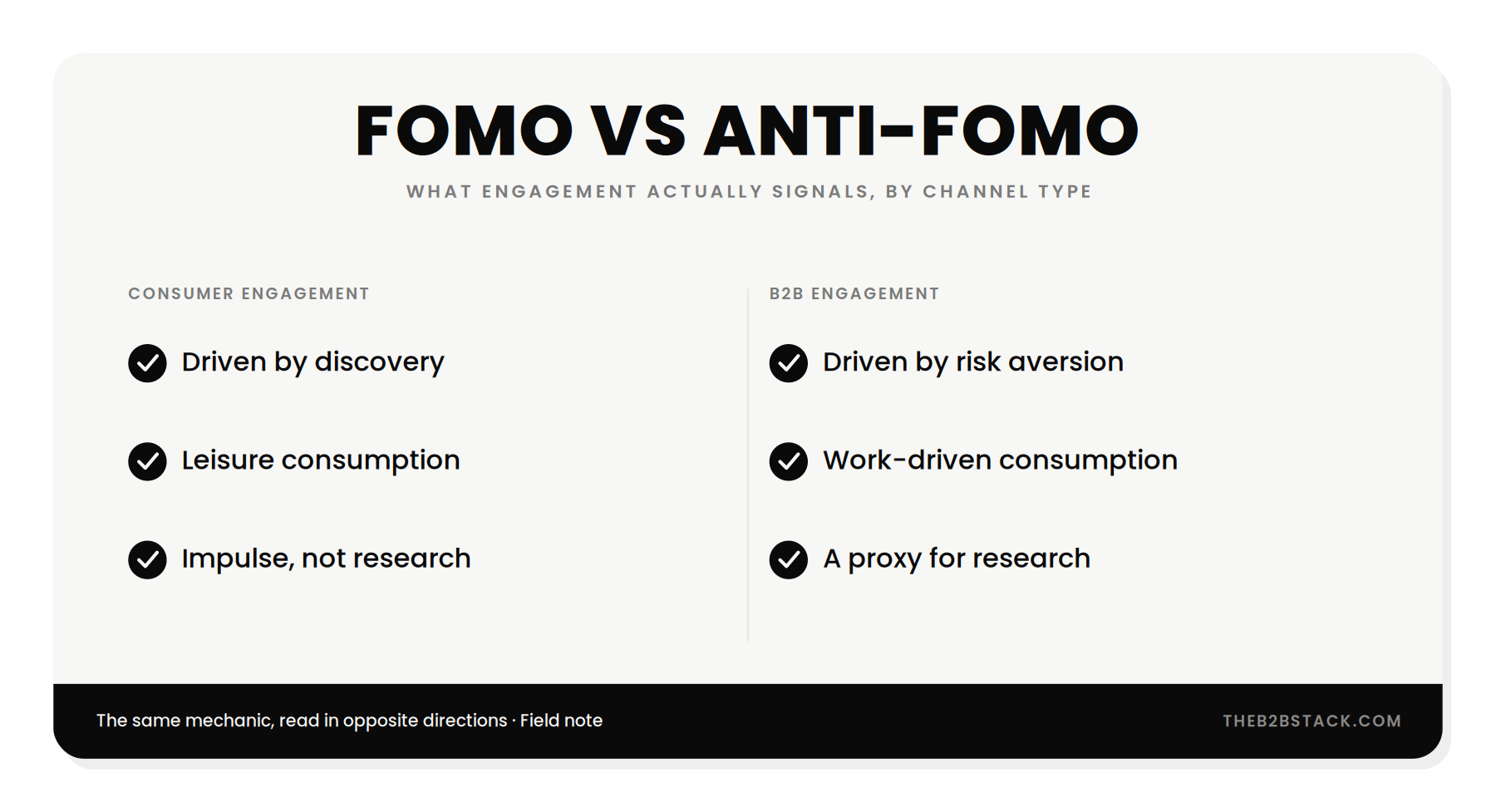
In consumer advertising (B2C), a contextually relevant environment is a reasonable proxy for interest or mood, and not much more than that. Many consumer goods get sold with no further research needed. If I need a new bathroom cleaning spray, I am not going to spend hours researching the different brands.
In B2B, it’s very different and contextual environment gets you closer to a direct behavioural signal.
Nobody reads a dense piece on vendor architecture, or sits through a technical explainer on a category problem, for fun and pleasure. People do that because they’re trying to close a knowledge gap, get better at their job, or avoid the specific professional fear of getting a decision wrong in front of a committee that will remember it (Fear of Messing Up - FOMU). FOMU is close to the opposite of the FOMO driving a lot of consumer engagement. Call it anti-FOMO: the emotional driver is risk aversion, not excitement, and the content someone chooses to sit with reflects that. Human psychology says the fear of loss always outweighs the chance to gain. We’re tapping into powerful innate human psychology here.
So when an account shows up engaging with a relevant contextual environment, that’s not incidental. It’s a reasonable proxy for research happening, and research happening is a reasonable proxy for some stage of a buying journey underway, however early or informal. That’s the thread connecting a brand impression to a demand signal, and it only exists because programmatic’s exhaust lets you see the environment an engagement happened in, not merely that an impression was served.
Haven’t subscribed yet? If this kind of thinking is useful to you, subscribe free for the next issue, and forward this one on to the one person on your team still treating brand media as a pure awareness line with nothing to learn from afterwards.
Why this matters more now, not less
There’s a reason to care about this beyond general tidiness, and it’s a live one. G2’s 2026 Buyer Behavior Report put the figure at just over half of B2B software buyers now starting vendor research inside an AI chatbot more often than a search engine, a share that has moved sharply across a short window. Forrester’s own 2026 research into business buying reaches a similar conclusion: generative AI tools have become a leading influence on buyer shortlists, ahead of review sites and vendor websites. Buyers are doing more of their early thinking somewhere a vendor cannot observe at all. Fewer clicks, fewer form fills, fewer visible footprints than even two or three years ago. Some are even calling the LLMs the most important buying committee member, and in-SERP results are masking the layers of addressable signal further
When observable signal gets scarcer, the signal you do get becomes more valuable, not less. An account showing up against a relevant contextual environment inside a brand campaign is exactly the kind of breadcrumb that’s harder to come by anywhere else right now, precisely because so much of the research that used to leave a visible trail on the open web now happens inside a chat window instead. Treat that breadcrumb as reportable waste and you’re discarding one of the few remaining markers of research behaviour your buyers are still leaving in the open. Treat it properly and you’ve got the start of a nurture track connecting a brand impression to a demand motion, built entirely from data the campaign was already producing at no extra cost.
The actual cost of waving this off
Go back to that meeting I had. The account wasn’t wrong that their campaign would run fine without account-level reporting. The media gets delivered either way, the reach numbers still land, nobody downstream notices anything missing. What they were wrong about, I think, is the value of what they chose not to look at. Refusing insight-first reporting on a brand campaign isn’t a neutral simplification. It’s discarding, for free, the clearest available evidence of which accounts are quietly researching you, at the exact moment most of the rest of that evidence has gone dark.
Sometimes agencies like to avoid over-complication and creating a rod for their own back when it comes to reporting. This is valid and fair - human nature after all - but even then they should take the reporting and leverage it for demand campaigns, and create the uptick downstream on the report the client will read.
If you’re running brand programmatic today, it’s worth asking a direct question internally: does your team actually see this layer, or has somebody quietly decided it isn’t worth looking at?
What does your reporting actually tell you about who engaged, and in what context, the last time you ran a brand campaign?
Field Notes
CaliberMind’s 2026 State of Marketing Attribution Report, published 24 September 2026 by Scott Brinker and Frans Riemersma, puts roughly 81% of the B2B customer journey outside anything a CRM ever records, with the large majority of attributable revenue concentrated in a small share of journeys, data sources and tools. That’s a stark figure from two well-known, independent martech researchers, and it corroborates the argument above directly. If four-fifths of the journey is already invisible to a CRM, the sliver of it that does surface inside a brand campaign’s own exhaust is worth a great deal more scrutiny than most reporting setups currently give it.
Worth a caveat alongside the cheer: nobody in the industry agrees on the actual size of the dark funnel. Depending on which named study you read, estimates for how much of B2B buying happens outside tracked channels range from roughly a third to over four-fifths, swinging heavily on methodology and vertical. That spread is itself a useful, honest data point. No single reporting layer, including the one this piece is arguing for, closes that gap on its own. It’s one additional, verifiable slice of a considerably larger problem nobody has fully solved, not a complete fix for it.
Is brand reporting that stops at reach and frequency a live problem for your team right now? or even a problem you didn’t know you had? Whatever the specific version of it is, I’d like to hear about it.
FunnelFuel works across a few different models: led by a full managed service
Connect with me on LinkedIn, message me directly here on Substack, hit reply if this landed in your inbox (it comes straight to me), or email mike@funnelfuel.io. No pitch attached, happy to talk through what I’m seeing across the market and see if there’s a fit. Just as happy if the answer is there isn’t one.