

Most B2B marketers think the dark funnel is a problem waiting for a better tool.
Sharper identity resolution, a persistent ID that survives a rejected cookie, a CRM finally stitched to organic and paid behaviour in one clean line. Give it another year or two, the thinking goes, and someone will crack it.
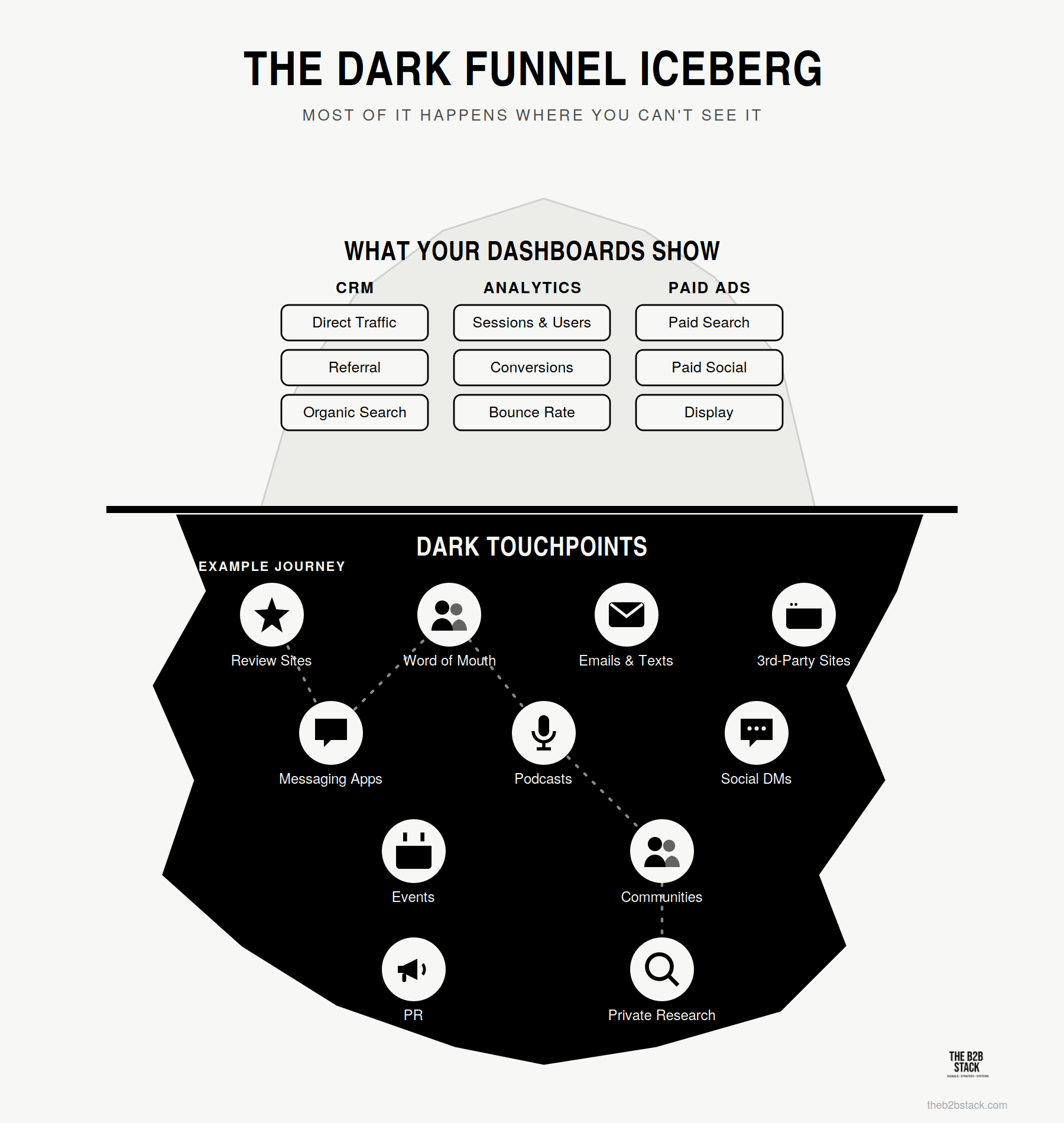
Nobody is going to crack it. Not this year, not in 2027, not ever, because the places your buyers actually do their thinking were never built to be seen. Private Slack channels, WhatsApp groups, one-to-ones over coffee, premium research behind a rejected cookie banner. That last one isn’t a side note. I wrote about why the consent architecture guarantees this outcome structurally, not accidentally, in The Consent Tax. Put the two together and you get a simple conclusion most marketing teams haven’t sat with yet: the dark funnel isn’t a temporary gap in your measurement stack. It’s the permanent shape of B2B research from here on.
So the question worth asking isn’t “how do we see it?” It’s “given that we can’t, what do we build instead?” The smart marketers in B2B are evolving their way around it, and thee are some highly valid tactics you can use to do so
New here? I’m Mike Harty, founder of FunnelFuel, a B2B-native programmatic business, and before that I built PowerLinks, a contextual-native adtech platform, back when the industry first worked out that you can’t always identify who you’re talking to. If this is your first issue, two worth reading next are The Consent Tax on why cookie rejection is structural, and AI Didn’t Kill The Dark Funnel on how agentic research changed the shape of the problem again.
Subscribe for more of this, one issue at a time.
What you’ll learn in this piece:
Why treating the dark funnel as a tracking problem guarantees you’ll always be a step behind it
The genericised trademark playbook, and why Google is the biggest, most geography-proof version of it (but I used Xerox in my title to void confusion with SEM/SEO and agentic ero click optimisation)
Why B2B already has its own live example of a brand becoming a verb, and what that proves
The three-rung ladder from “known vendor” to “unaided category recall” to “the word people actually use”
Where brand memory gets built in 2026, now that clicks and cookies aren’t the mechanism
Why this only works as a permanent discipline, not a campaign
Nobody designed the dark funnel. It just won.
Every dark funnel piece, including the three I’ve written before this one, tends to start from the same place: here’s what’s happening in the shadows, here’s a clever way to infer it or beat it. You can see some of those themes in the below pieces


That’s still useful work. It’s also a losing long game, because the environments themselves keep getting more closed, not less.
Private communities require an invite, and vendors aren’t likely to get one, for fairly obvious reasons. Premium content sits behind a paywall a rejected cookie banner won’t unlock. AI chat interfaces return an answer with no query string, no referrer, no trace that the conversation happened at all.
Treat that as a bug and you’ll spend the next three years chasing a fix that never lands. Treat it as the permanent operating environment and the whole question changes. You stop asking how to see the research your buyers do in private, and you start asking how to make sure your brand is already sitting in their head before they open that private conversation in the first place.
That’s not a consolation prize for giving up on measurement, and I sy that as someone who has built B2B analytics with an account graph over a GA4 style interface, and we extensively use that to de-anonymise. We constatly push the boundaries of what can be tracked, legally and ethically. However, in reality, some stuff just cannot be tracked. It’s the only strategy that was ever going to work inside a space you can’t measure, because it doesn’t depend on measurement to pay off.
The biggest, most geography-proof version of this playbook already has a name
There’s an old trick in consumer branding for exactly this problem, and most people know it without knowing they know it. Hoover became the word for vacuum cleaner in the UK. Sellotape became the word for adhesive tape. Neither company won by tracking every household’s cleaning habits. They won by becoming so synonymous with the category that the brand name replaced the noun.
That’s a nice piece of history, but it’s also geographically narrow. Ask someone in Chicago what a Hoover is and you’ll get a shrug. So if you’re looking for the one example that proves this works everywhere, in every market, in a way that translates instantly, there’s a bigger one sitting in plain sight.
Google didn’t just win search. It won the verb. Nobody says “let me run a web search for that.” They say “just Google it,” in English, in a dozen other languages that have absorbed the same construction, in markets where Google the product barely has meaningful share. AI and the growth of LLM’s may have slightly weakened this point, but I think most of us reading this will be old enough and experienced enough to understand the strong parallels here and just how synonymous with search Google was and is. The brand detached itself from the company and became the name for the action itself. That’s a different and much harder achievement than owning a category noun, and it’s the one worth aiming at, because it survives translation, survives platform switching, survives everything except actually being replaced as the default way people describe what they’re doing.
B2B already has its own proof this can happen, and it’s recent
Here’s the part that should make this land rather than feel like borrowed consumer theory. B2B has already produced its own version of this, inside living memory, inside software, which is the exact category most of us sell into.
Nobody says “let’s start a video conference.” They say “let’s Zoom.” That sentence survived the fact that half the people saying it are on Teams or Meet. Zoom became the verb for a category of behaviour so completely that it now has to be actively fought against by every competitor that launched after it, because the word people reach for by default is already taken. That’s not a marketing campaign that worked. That’s a company that got so deep into daily language that its rivals are permanently playing catch-up on vocabulary, not just features. you may be reading this and thinking, “Well, Zoom has had its day, and it’s not exactly at the forefront of video conferencing anymore.” That’s a valid point, but I would almost argue that it stands truer in the opposite sense because Zoom has been left so far behind by enterprise bundled solutions like Teams that come with Microsoft or Meets that comes with Google. The synonymous nature of its name is what keeps it in any conversations in 2026. What I’m arguing for here is not whether the brand wins or loses, but how do we ensure the brand is in the conversation. I believe that Zoom being so synonymous with video conferencing keeps it in the conversation today when it otherwise may not be if it wasn’t a noun - and that is the point here
If it happened once, in B2B SaaS, inside a five-year window, it isn’t a freak occurrence reserved for hundred-year-old consumer brands. It’s a playbook. The question for the rest of us is what it actually takes to run it deliberately rather than stumbling into it the way Zoom did.
The three rungs between forgettable and inevitable
Brand memory in B2B isn’t a single state you either have or don’t. It’s a ladder, and most companies never get past the bottom rung.
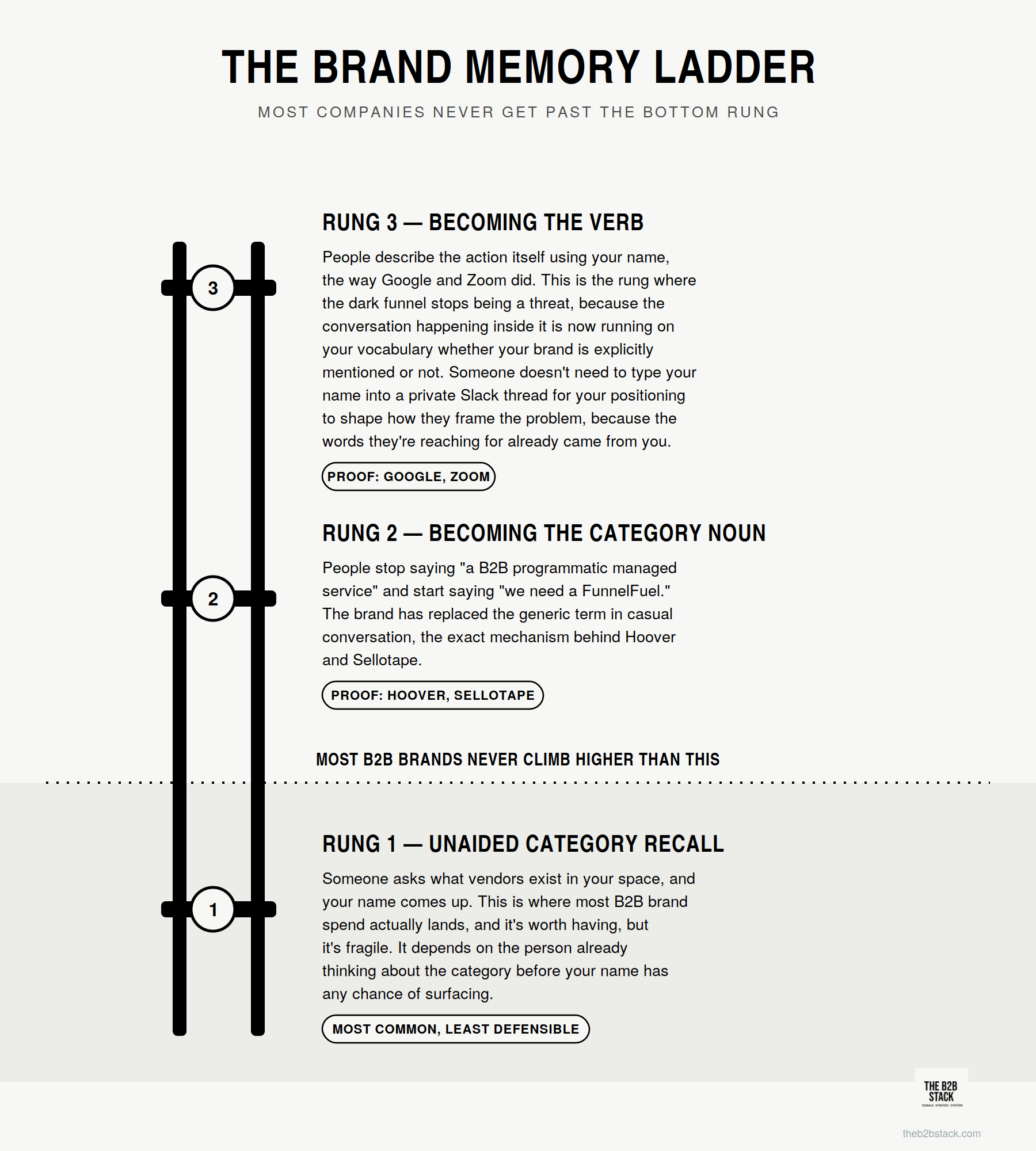
Almost nobody in B2B operates with rung three as an actual target. That’s exactly why it’s available.
You May Be thinking ‘Obviously This Would Be Great’ - But How? What We Are Talking ABout Is Good Old Fashioned BRAND Advertising
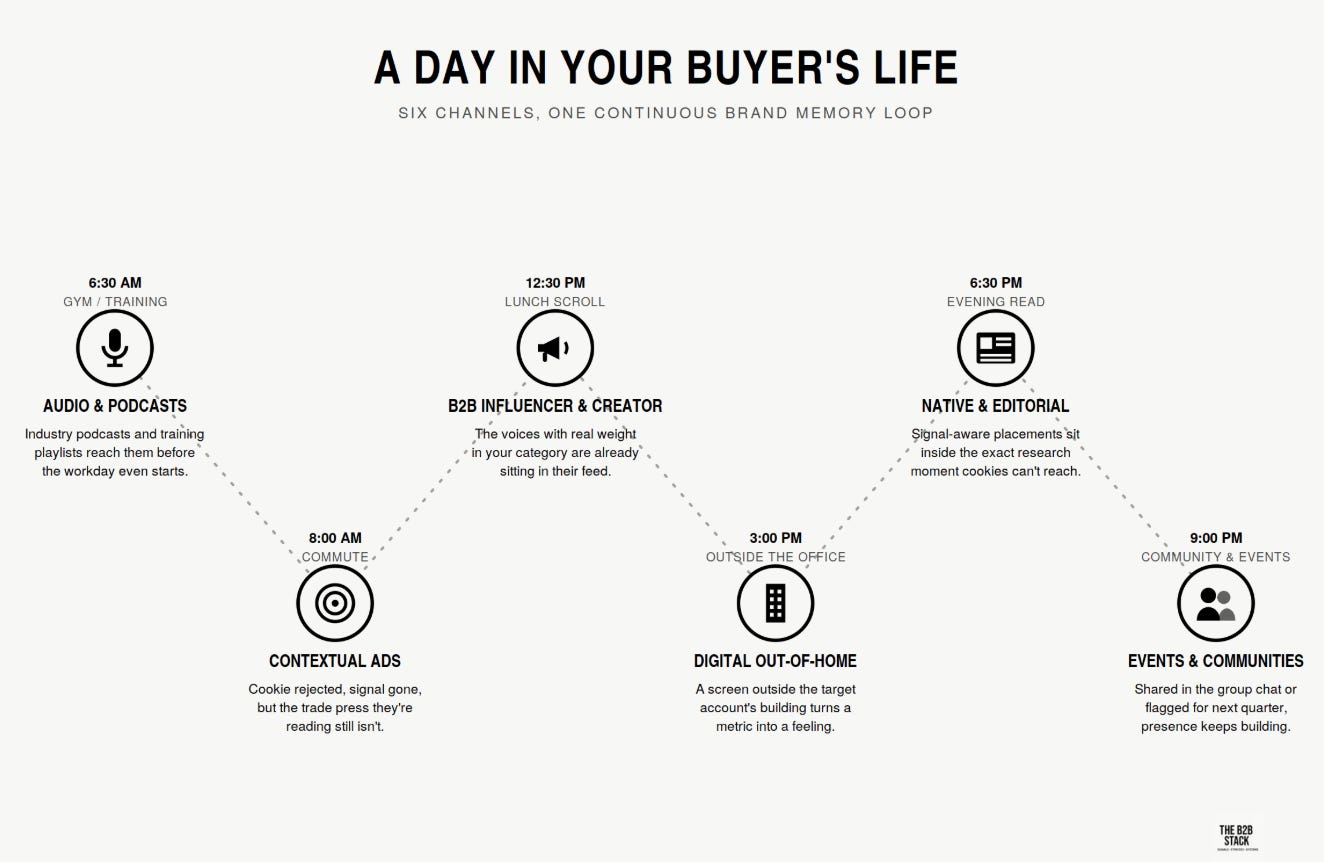
None of this comes from a landing page or a retargeting sequence, because the whole point is that it has to work in environments where nobody clicks anything. It gets built through repeated, low-friction exposure across the surfaces your buyers already spend time in, whether or not that exposure is trackable. I would call out the low friction part of this, because it is a post into-itself. TLDR when we go multi-surface, it is incredibly powerful, but we need to be respectful of environment and time of the day (think no B2B ads during Friday evening movie night)
Audio is one of the most under-used of these. Senior B2B buyers spend real time in industry podcasts, in music while training, in the dead time of a commute, and almost none of that time is being bought with any intent behind it. Contextual advertising is the other underrated lever, and it’s underrated for a specific reason: the moment cookies get rejected, contextual is one of the few signals still standing, which is why I’ve written before about how native and contextual carry signal on their own rather than acting as a fallback for when targeting fails. Physical presence does real work here too. A well-placed out-of-home campaign builds exactly the kind of ambient recognition that later surfaces as “I keep seeing them everywhere” inside a private conversation you’ll never see, and that’s a large part of why it functions less as a performance channel and more as a credibility signal that builds up over months rather than a single campaign.
Native Advertising Didn't Die. Now It's Signal-Aware And Back On Plan

Most B2B marketers think native advertising is a 2016 relic: sponsored listicles, “you won’t believe” thumbnails, the stuff that gave content marketing a bad name. That’s the wrong belief to carry through H2 2026. Native never went away. It went quiet, there was a major shakeout of adtech vendors, it matured to live alongside display rather than being pre-occupied with killing it, and it’s now resurfacing in B2B media plans with a signal layer underneath it that didn’t exist the first time around.
B2B influencer and creator partnerships belong on this list for the same reason. The people carrying weight of voice in your category are precisely the people who get pulled into the private Slack threads and DMs where your buyers are actually forming opinions. Show up in their orbit and you’re borrowing distribution into rooms no pixel will ever enter.
The discipline is always-on, because you don’t get to choose when it counts
Here’s the tough part, including being tough on the budget line. Most of any target account list is not in-market right now. There’s a commonly cited rule that roughly 95% of B2B buyers aren’t actively in a procurement cycle at any given time, and whether that number is exactly right matters less than the shape of the problem it describes. Because of the dark funnel, you don’t know which slice of your list is in the 5%. You can’t reliably see who’s started evaluating, and pretending otherwise just means building a media plan around a guess dressed up as a signal.
Once you accept that, campaign bursts timed to imagined in-market windows stop making sense. The only strategy that survives contact with “we don’t actually know who’s looking” is presence that never switches off, built at the category and vocabulary level rather than the individual account level, running as business as usual rather than as a push tied to a quarter’s pipeline target.
That’s a harder thing to sell into a board than “we ran a campaign and it drove X meetings.” It’s also the only version of brand building that pays off inside a research environment that was never going to let you watch it happen.
The dark funnel isn’t going to get smaller. The question is whether your name is already the word your buyers reach for when they’re in there.
Are you building for unaided recall, or are you actually trying to own the verb? Tell me where you think your own category sits on that ladder, drop it in the comments.
Is your brand invisible inside your own buyers’ dark funnel right now? Whatever that looks like for you, unaided recall that never quite turns into anything, a category noun that’s still up for grabs, media spend that isn’t built for research you can’t see, I’d like to hear about it.
FunnelFuel is expanding across a few different models: a full managed service, a licensed self-serve product for teams who want the data and the account graph without outsourcing the media, or something built around what you already run in-house.
Message me directly here on Substack, hit reply if this landed in your inbox (it comes straight to me), or email mike@funnelfuel.io. No pitch attached, happy to talk through what I’m seeing across the market and see if there’s a fit. Just as happy if the answer is there isn’t one.
I agree with all that. Dark funnel has always existed. Buyer journeys start way before they even engage with a brand. (Brands still think they understand the journey, the sales cycles don’t start when they engage with sales)
When they engage, they already have a first deal consideration list at an enterprise.
What you are describing requires big budgets for penetration and reach. When they become a ‘verb’ it is either they put a lot or cash behind it, or it is a new category where again you need big budgets.
Small brands are small not because they have less loyal customers; they are small because they don’t have reach, penetration and recall at the point of purchase. They need to spend 3X more than enterprise.
So rather than chasing and signalling the hell out od the buyer , a good visible earned media strategy and I am not talking about PR, along with always on will serve well. CAB also helps a lot!
The issue is with moat marketers, brand is not something they wrack their head around to measure with causality. Econometrics, Incrementality, attribution are all correlational.
You need counterfactuals to show your CFO it helps the bottom line along with financial literacy. Otherwise you are a cost center!