

New here? I’m Mike, in adtech since 2011, building programmatic platforms (PowerLinks, now FunnelFuel) and writing about the gap between how B2B marketing actually buys media and how the industry talks about it. If this topic is up your street, you’ll also want The Xerox Strategy: Why B2B’s Best Answer to the Dark Funnel Is Becoming a Verb and The Account Reporting Layer Brand Advertisers Keep Throwing Away.
Free for subscribers: what $39.6m in managed-service media spend taught us. Five findings from 1B+ tracked page loads (402.6 million on 94 B2B vendor sites, 600M+ on B2B publisher sites), read alongside research from Gartner, Demandbase and 6sense. A 15-page report with seven takeaways you can use this week.
Join 1,600+ B2B marketers, including readers at Dentsu, HubSpot, 6sense, Informa and DirecTV.
I am hearing from partners and my network that the big ask of the moment is ‘how to drive more LLM citations’ and to run AEO/GEO or general LLM SEO.
Understandably, every brand is very keen to drive more citations and to show up more within LLMs. And with good reason, all of the biggest and best research at the moment points to brands beginning a purchase journey with a consideration set and commencing the true research within their LLM/s of choice.
The below graphic that I created from mining hundreds of millions of vendor site web visits tracked by FunnelFuel analytics shows quite clearly the impact that AI is having. The precipitous decline in educational content views at the account level is the most demonstrable visualisation of the dark funnel in action that I’ve seen so far. The fact that increasingly the first account-level touch point is with decision pages (where the LLM journey naturally comes to an end because they don’t have access to pricing information) is a further indication of this direction of travel. The crossover came between 2024 and 2025, when decision pages became the most likely first touch point over educational content - where AI flipped Google Search as the go-to web-based research tool.
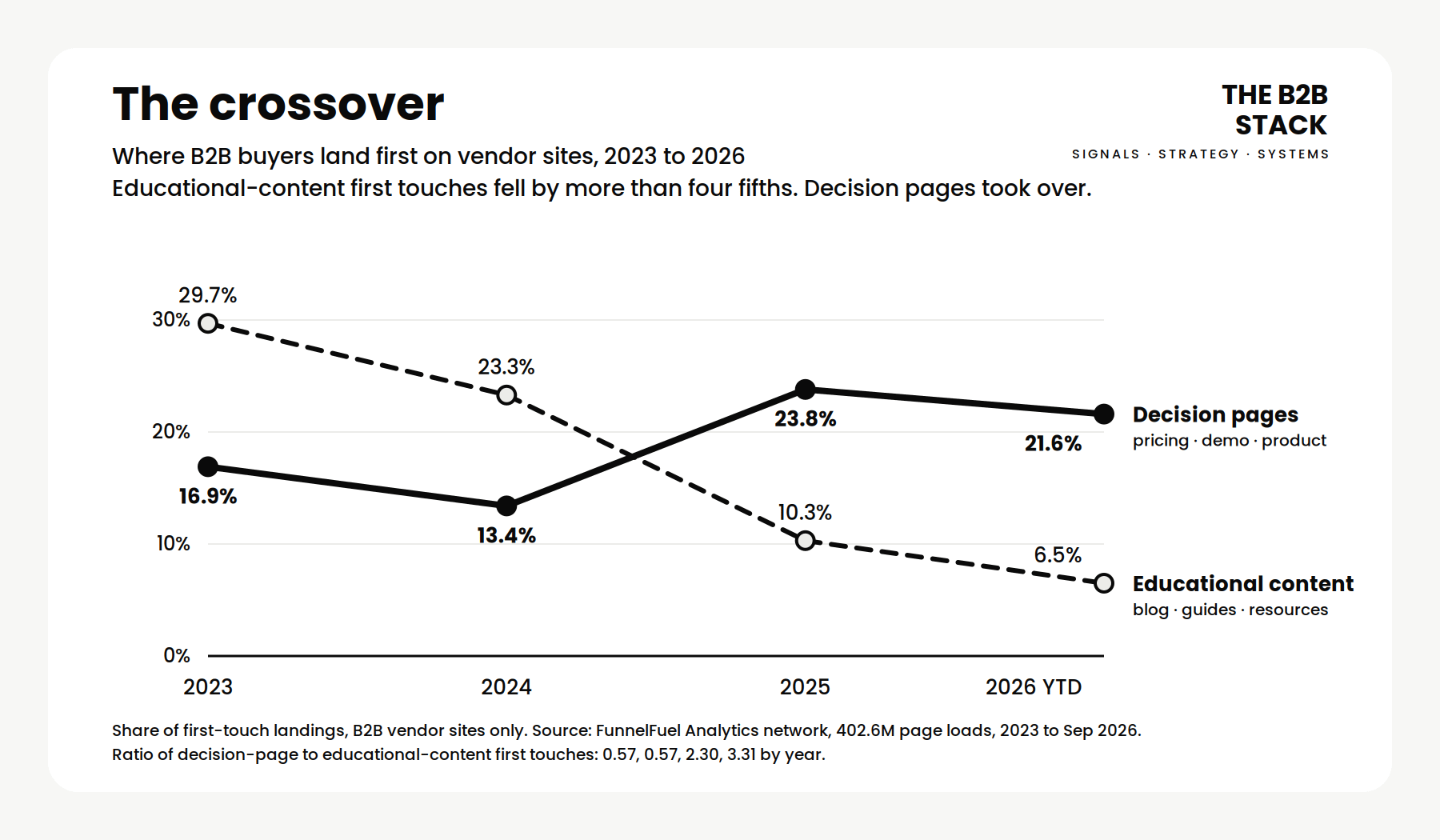
Therefore, the desire to show up in LLMs is driven by very real rationale. However, as we’ll explore today, your brand share of model (which equates to the score of how often leading AI tools like ChatGPT mention your brand) has yet to prove it has the ability to truly move a deal. Based on the above graphic and everything we know about AI chatbot-based research, that sounds like an almost preposterous thing to be saying as we approach 2027, but bear with me.
My sense is that we need to keep clear heads and remain rational without overreacting whilst we remember that the ever-darkening B2B buying journey has nothing to do with ChatGPT specifically, and the bigger opportunity today is probably to treat AI mentions as another dark funnel signal, rather than trying to build a new standalone channel wrapped around it.
To keep some context: Demandbase data shows ChatGPT referrals to B2B vendor sites up 300% year on year, yet independent analysis puts them at a meagre 0.33% of B2B vendor visits, with Google still sending roughly 190x more traffic. With this context, let’s dive in.
What you’ll learn in this article:
Where the term “share of model” actually comes from, and why it’s the fourth name for the same underlying problem
The real number behind AI referral growth, and the smaller number that keeps it honest
Why the B2B buyer journey went darker in 2026 for reasons that have nothing to do with ChatGPT
Why “share of model” tools stop at the edge of the CRM, and why that’s structural, not a maturity gap
The account-graph fix: treating an AI mention as another dark-funnel signal, not a new standalone channel with its own dashboard
What changes in an omnichannel programmatic plan once you stop trying to make AI search prove itself alone
Plus, in Field Notes: a brand already fighting for position inside AI answers with no attribution model at all, and the attribution finding hiding behind this year’s dark-funnel headline.
Part of the B2B Stack guide to B2B attribution and measurement.
The wrong belief?
Here’s the belief I keep hearing in briefings, and I think it’s wrong: that “share of model” is a new metric for a new problem. From share of voice to share of search, we have been here before, trying to capture the hard to capture.
So this isn’t as new as it first sounds, and once you trace where the term comes from, you can watch the industry rename the same problem every few years without ever solving it. Tom Roach, VP of Brand Planning at Jellyfish, laid out the lineage plainly in Marketing Week: share of market, then share of voice, then share of search, and now share of model. Four labels, but they all carry only one underlying question really, which is whether anyone actually knows what’s influencing a buyer before they show up somewhere you can track them. AI chat didn’t create that question. It just gave it a new logo.
LLM visits are up 303% YoY to B2B Vendor Sites - BUT They Are Only 0.33% Of B2B Traffic
Let’s start by trying to understand how significant LLM traffic is for B2B vendors today within their marketing mix. Demandbase’s Labs data shows ChatGPT-referred visits to the B2B websites it measures rose 303% year on year, from roughly 645,000 in June 2025 to 2.6 million in June 2026, with a sharp jump in May 2026 that the data doesn’t fully explain. That’s a real behavioural shift, not an SEO scare story. This absolutely validates our idea that LLMs are a consistent and big part of the dark research journey that’s happening behind B2B procurement today. This is also absolutely no surprise at all!
Here’s the number that keeps it honest and grounded, though: independent analysis of that same dataset puts ChatGPT-referred traffic at around 0.33% of total measured B2B traffic, roughly 190 times smaller than what Google still sends.
So both numbers are true at once; the growth rate is real and the absolute share is still tiny.
A metric can be the fastest-growing thing in your dashboard and a rounding error in your traffic at the same time.
And “share of model” reporting tends to show executives the first number without the second - not least because the vendors peddling the ability to measure share of models are naturally keen to make the LLM models sound like the most important thing in the marketing mix, period. They also have a track record of being wildly disparate and diverging in the stats and insights they give back, so the true ability to dive in and be accurate here has a big question mark next to it anyway, as we’ll explore deeper into this piece.
The buyer journey went darker in 2026, and it’s barely about AI
Here’s the part that should worry you more than any AI-visibility score. Dreamdata’s 2026 benchmarking, built from over 66 million B2B sessions, found the average B2B deal now runs 88 touchpoints across 4 channels and 10 stakeholders over a 272-day cycle, up from 76 touchpoints and 6.8 stakeholders the year before. And 81% of that journey now happens entirely outside anything a CRM can see, up from 70% a year earlier.
Read that again: four-fifths of the journey was already invisible before a single buyer typed a question into ChatGPT. The other standout point that hits me as a business owner is just how blind my CRM is to the true state of the pipeline that we are working to generate. We see this with our own business. HubSpot, our CRM of choice, is essentially only valuable for forecasting the next 2 to 4 weeks.
I digress, but the big point is that the dark funnel didn’t appear because of AI search. It was already there, already growing, already the majority of the buying process.
AI chat is a new room in a house that was already mostly dark.
How Paid Media Shapes What AI Assistants Tell B2B Buyers (the AI Dark Funnel)

Free report: “5 Things $39.6M in B2B Programmatic Spend Taught Us.” Three years of managed spend and a billion tracked page loads, turned into five findings platforms won’t put in a pitch deck. Subscribe free to unlock it, plus every new issue of The B2B Stack.
Quick answers
What is “share of model”? A score for how often AI tools like ChatGPT mention your brand, usually against named competitors. It follows share of market, share of voice and share of search as the fourth label for the same question: what influences a buyer before you can track them.
How much B2B traffic comes from ChatGPT? Demandbase’s Labs data shows ChatGPT-referred visits to the B2B sites it measures up 303% year on year, but independent analysis puts them at around 0.33% of measured B2B traffic, roughly 190 times smaller than Google.
Can share of model prove pipeline? Not yet. There’s no session ID, cookie or deterministic handshake back to a CRM record, because the model isn’t serving an ad with a clickthrough. It’s answering a question.
How should B2B teams measure AI visibility instead? Treat an AI mention as another dark-funnel signal. Fold it into the same account engagement score as intent, site visits and HVA progression, and read it against account-level pipeline velocity over a quarter.
The rest of this piece covers why “share of model” tools stop at the edge of the CRM, and the account-level fix. It’s free for subscribers.
Why “share of model” tools stop at the edge of the CRM
A visibility score tells you the model mentioned you, roughly how often, and against which competitors.
Much like in wider B2B advertising, it has limitations because it wasn’t necessarily designed for B2B account level thinking. Therefore, it doesn’t tell you which account saw that mention, whether that account later opened a deal, or whether the mention moved anything versus the dozen other signals touching that buyer the same quarter. There’s no session ID, no cookie, no deterministic handshake back to a CRM record, because the model isn’t serving an ad with a clickthrough. It’s answering a question.
As John Barham, managing partner at performance media agency Roast, put it to Digiday in August, CMOs have been under sustained board and investor pressure for well over a year to crack exactly this link, and no single tool paints the whole picture.
Marketers who’ve noticed this are already working around it:
Rippling’s growth team triangulates visibility data from Profound and AirOps against ChatGPT ad conversions, branded-versus-unbranded search traffic, and a media mix model built on Google’s open-source Meridian platform.
Roast uses Causal Impact, Google’s own Bayesian model built for exactly this kind of unattributable-input problem.
Both are credible. Neither produces a CSV a CFO will call “attribution.”
The IAB only published its first standardised AI-visibility measurement guidance in August 2026, and Google only added generative-AI performance data to Search Console that June. That timeline tells you how early this still is as a discipline. Chasing a deterministic pixel here is chasing the wrong and unattainable prize.
The fix is the one B2B programmatic already built
This is where I think the industry is overcomplicating something B2B programmatic solved years ago, out of necessity, because the same unattributable-input problem already existed for display, CTV, audio and native. There was never a clean click path from a CTV ad to a closed-won deal either. The answer wasn’t a better pixel. It was the account graph: every signal touching a named account, scored and aggregated at the account level, read against pipeline velocity rather than last-click.
The Account Graph Is Not an Identity Graph

Most of the industry uses “account graph” and “identity graph” as if they’re the same asset wearing two names. They aren’t. One of them is a genuinely rare thing to build properly, and it isn’t the one that gets the coverage number printed on the sales deck.
An AI-search mention is not a new channel. It’s a new signal.
It ideally belongs in the same account-level model as a programmatic impression, a dark-social share, or an unbranded direct visit, all of which have always been commercially real and structurally untraceable to a single touch. Giving “share of model” its own dashboard, disconnected from pipeline, just rebuilds the single-channel attribution mistake B2B marketing spent the last decade unlearning.
Practically: fold AI-visibility data into the same account engagement score that already ingests Bombora intent, site visits and HVA progression, rather than reporting it up as a parallel KPI with no pipeline connection. Score the account, not the mention. Ask whether model visibility correlates with account-level pipeline velocity over a quarter, the way you’d already ask it of a CTV flight, not whether a single citation converted.
If you’re building that account engagement score now, the 100+ high-value actions, scoring templates and GTM setup guide are in The B2B Signal Optimisation System. Subscribers get 30% off with the code in their welcome email.
If there’s one person on your team building the “our AI visibility score” deck for next quarter’s board meeting, forward them this before they finish the slide.
What changes in the plan
Once AI-search presence stops being measured as a standalone channel, a few things follow for anyone running a multi-service, omnichannel B2B programme.
Content gets funded against accounts, not citations. Content built to earn an LLM citation, a benchmark page, a comparison piece, a specific named data point a model can match against a query, gets commissioned and funded the same way a CTV creative or a DOOH placement would be: against an account-level outcome, not a citation count.
Paid programmatic doesn’t get defunded. Media planning stops treating “AI search” as a reason to defund paid programmatic in favour of pure organic content plays, since the accounts a model is citing you to still need to be reached, retargeted and moved through committee the normal way.
No third dashboard. And reporting stops producing a third dashboard nobody in revenue reads, and starts producing one more row in the account engagement view that already exists.
None of this makes AI search less important. It makes it less exceptional, which is the correct outcome for a channel this early in its measurement maturity, and it’s the exact pattern we’ve watched repeat across a small proportion of FunnelFuel managed-service accounts running omnichannel programmatic: the channels that look unmeasurable in isolation stop looking that way the moment they’re read at the account level instead.
Field Notes
Seeking.com’s Reddit intervention (reported August 2026). Dating brand Seeking.com hired an agency to monitor and respond inside high-traction Reddit threads, on the logic that Reddit content gets scraped and summarised by AI tools before most brand content does. It’s a textbook dark-funnel move: no pixel, no attribution, pure brand-memory conditioning at the exact point AI tools are drawing from. Whether it moves pipeline is, tellingly, not something the brand claims to measure directly.
The attribution finding hiding behind the dark-funnel headline. CaliberMind’s 2026 State of Marketing Attribution Report, researched with Scott Brinker and Frans Riemersma, found something easy to miss next to the 81% dark-funnel number above: roughly 80% of revenue traces back to about 20% of customer journeys, data sources and tools. Nine in ten marketers interviewed couldn’t name their three most decisive revenue moments on the spot. The practical reading: don’t try to instrument all 88 touchpoints evenly. Find the 3 to 5 that actually move revenue in your segment and instrument those first.

Buyers arrive late, decided and deep-linked. Homepage first touches fell by nearly two thirds in a single year. Across 94 B2B vendor sites, first touches on educational content fell by more than four fifths in three years, and decision pages took over. On B2B publishers, article first touches fell from 79% to 17% of entries. The 15-page report sets out what that means for your media plan, with benchmarks for bounce, dwell, depth and return rate to hold your own campaigns against.
Free for subscribers. V2 with new data is on its way.
If you’re the one being asked to build the AI-visibility report your board will actually believe, this is the exact kind of account-level modelling FunnelFuel builds for clients already running omnichannel programmatic, and it’s a large part of what the special report mentioned above digs into: what hundreds of millions of tracked vendor-site page views across our managed-service book have actually taught us about which signals move pipeline and which just move a dashboard. If that’s live for you right now: tell me whether you’d rather run it as part of a fully managed service, license the underlying account graph into your own stack, or scope something bespoke in-house. Reach me on LinkedIn, reply to this on Substack, or drop a line to mike@funnelfuel.io. No pitch, no obligation, just a conversation if it’s useful.
Where do you land: is AI visibility a channel that deserves its own KPI, or a dark-funnel signal that belongs inside the account graph with everything else? Make the case in the comments.