

Free report: “5 Things $39.4M in B2B Programmatic Spend Taught Us.” Three years of managed spend and a billion tracked page loads, turned into five findings platforms won’t put in a pitch deck. Subscribe free to unlock it, plus every new issue of The B2B Stack.
Most B2B marketing still gets built on a drawing of a funnel.
I’m sure you have all seen what I am talking about. Awareness at the top, consideration in the middle, a tidy decision at the bottom, with one buyer walking down the stairs in an orderly fashion. Everyone in this industry knows the picture is wrong yet I do not see much evidence of B2B marketers changing what they build because of it, and I include fifteen years of my own campaign structures in that.
The gap became impossible to ignore this week, not because of an analyst report, but because of a comment thread. A reader called Ayse Guvencer left a response on the CIO piece that was sharper than most of the paid research I’ve read this year, and it turned into a proper back and forth in the replies. What I didn’t expect, when I went looking for the data behind what she said, was that nearly every number she’d quoted from memory turned out to be conservative. This is that argument, attempting to be written properly, with the research she was remembering substantiated and stitched back in, the places I pushed back, and the mechanics of programmatic itself, which explain why this is structural rather than a failure of effort.
New here? I’m Mike Harty. Fifteen-plus years building programmatic platforms, most recently PowerLinks, now FunnelFuel, a B2B programmatic managed service. The B2B Stack is where I write the version of this industry the vendors won’t, entirely from y own personal lens
Worth reading next: this piece grew out of The CIO You’re Targeting Might Not Exist, where the shadow buying group was first named, and The Buying Committee Doesn’t Live On LinkedIn makes the reach argument this one leans on.
Subscribe free, every week. Share this with the one person on your team still building a lead score around a single buyer. Referrals unlock early access to future reports.
What you’ll learn in this article:
Why “signalling” your way to demand is a category error, not a hard problem: the Day 1 list research, the 95:5 rule, and what a DSP’s optimisation loop actually does with an ABM segment
What the committee really looks like across ~22 people, and why half its influence sits outside your addressable audience
Why deals die to fear of messing up (FOMU is kinda the anti-FOMO) rather than to the wrong vendor, with the one dataset that finally measured it
Why the dark funnel is a structural blind spot in what programmatic can observe, not a match-rate problem
Why ICP by title and industry breaks against a company’s actual circumstances, and why quarterly-refreshed firmographics make it worse
The case for brand as the only lever that reaches the whole committee, the correct B2B spend ratio (it isn’t 60:40), and what treating brand as CapEx would require of a CMO on a four-year clock
Plus, in Field Notes at the end: three pieces of research published in the last three weeks that land on exactly this argument.
You can’t signal your way onto the Day 1 list
Ayse’s opening point was blunt. ABM created the delusion that you can signal your way to the buyer. As nice as the concept is, the reality is you can’t. When an enterprise account starts engaging, it already arrived with a first-day consideration set, built from the category before your outbound ever reached it. Bombarding an account with touches doesn’t create demand, it gets noticed by people who were already going to buy something in this space.
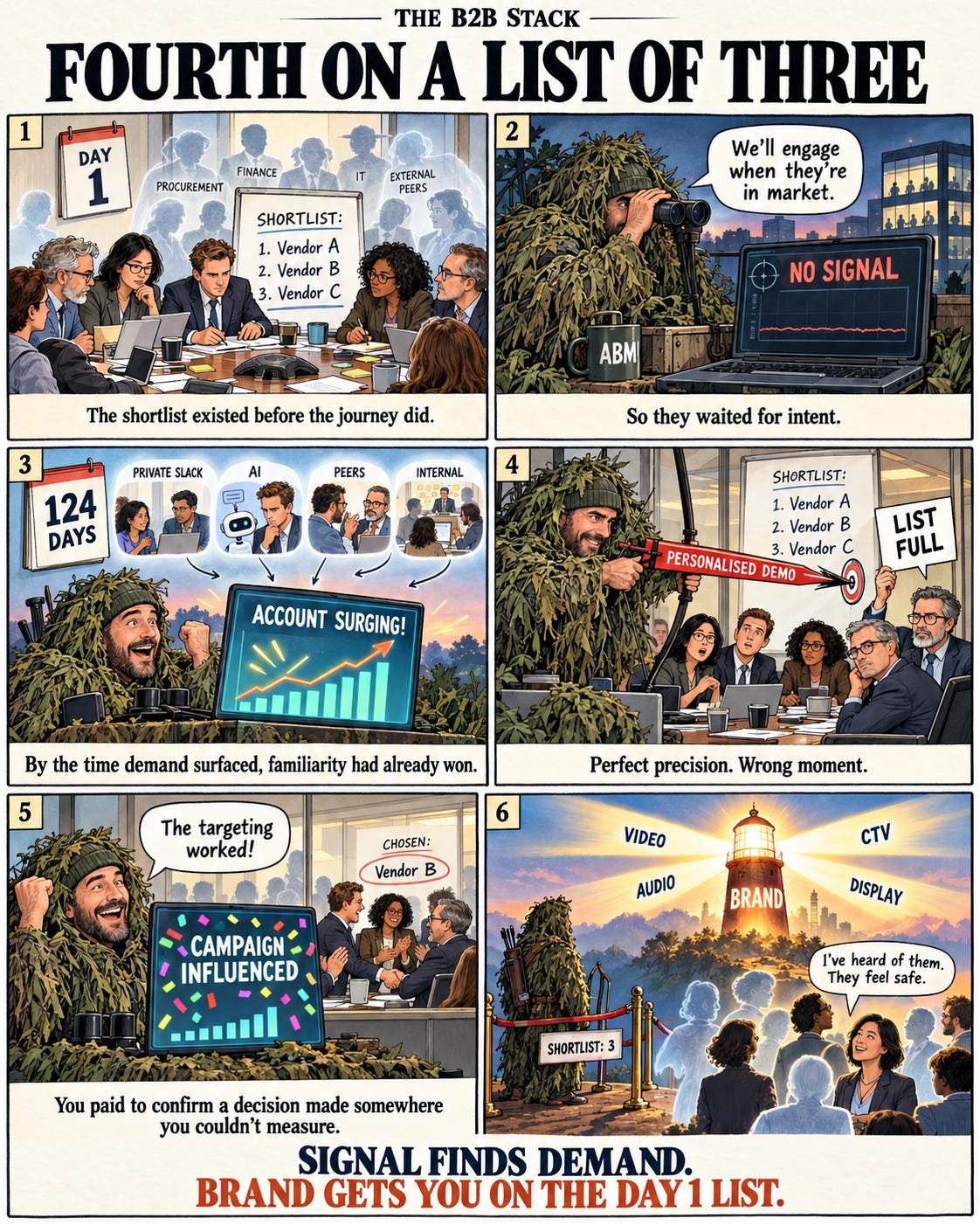
The research on this is older than most ABM platforms and more damning than the vendors admit. Bain and Google surveyed 1,208 B2B buyers and found that 80 to 90 percent of them have a list of vendors in mind on day one, before any formal evaluation starts, and that roughly 90 percent of the time the eventual purchase comes off that list.¹ To me the takeaway is clear, our job has to be to build the awareness and trust to take a seat on the day one list, and not to get pre-occupied chasing too much signal in order to sniper a demand gen opp. This stuff is hardcore brand building work.
Bain’s newer work with LinkedIn, published this year, has turned that into a metric it calls Likelihood to Buy, and the first component of the score is simply whether you were on the list at all. If you weren’t, the rest of the model doesn’t bother with you. Layer on the 95:5 rule from the Ehrenberg-Bass Institute, that in any given quarter around 95 percent of your category is out of market, and the arithmetic of “find the in-market accounts and hit them hard” starts to look like what it is: a strategy for being fourth on a list of three.²
I don’t actually think this removes merit from using sensors like High Value Actions and account level visits, alongside intent in its broader sense, to run priortiy over accounts and to focus bidding into in-motion accounts. However, the bigger lesson is to not neglect the 95% who aren’t lighting up signal based dashboards.
Most ABM machinery, the intent data, the scoring models, the orchestration layers, was built to answer “who is in market” with more precision. Almost none of it was built to answer the harder question underneath, which is who gets included in that Day 1 list in the first place. And here’s the part that should worry anyone running paid media against these segments: a DSP’s optimisation loop doesn’t know the difference. Feed it an ABM audience and a conversion goal (assuming one can be captured in a transactional/commerce B2B sense) and it will spend the budget finding the accounts inside that list who were always going to buy, because that’s the shortest path to the number you told it to hit. The bid shading, the pacing, the lookalike expansion, every mechanism in the loop is tuned to find the cheapest conversion, and the cheapest conversion is always the one that was going to happen anyway. It looks like the campaign worked. What actually happened is you paid to confirm a decision made somewhere you weren’t measuring. Precision on a target account you’ve already lost the coin flip for isn’t precision, it’s expensive confirmation, and the reporting dashboard will never tell you which one you got.
The committee is 22, and half its influence is outside your audience
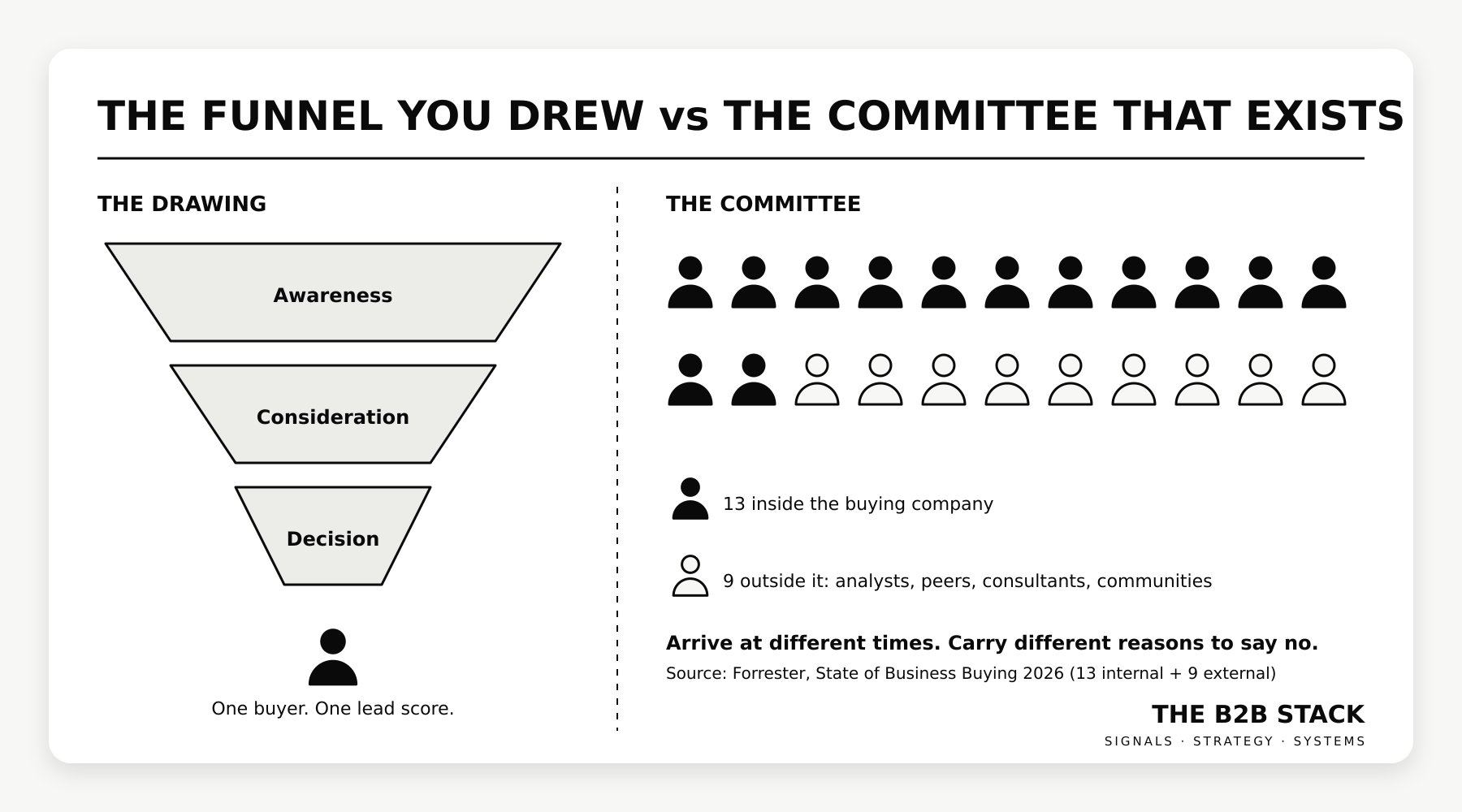
Once you count the economic buyer, the champion, direct and indirect users, legal, data privacy, InfoSec and procurement, you come out with ~22 people in the average buying group. My first reaction was that number likely hedged “towards the high end of what the research firms have measured”. I was wrong to hedge it. Forrester’s most recent State of Business Buying research, built on its 2025 Buyers’ Journey Survey, puts the average complex purchase at 13 internal stakeholders plus 9 external participants: analysts, consultants, peers, references, the people in the private Slack. That is 22.³ Gartner’s number for the internal group sits at 11, up from 7 in 2017, and its May 2025 survey found that 74 percent of buying teams show what it politely calls unhealthy conflict during the decision.⁴ Forrester’s 2024 edition found 86 percent of purchases stall at some point and 89 percent cross two or more departments.⁵
So to summerise; for all the evolution in buying journeys enabled with zero search and LLMs; the output is growing committee sizes, who are doing what humans do when they form big groups whilst making decisions in a state of fear (the often under-appreciated default position in a lot of buying processes - the fear of messing up and losing jobs). They bicker and disagree and often cases, agreement is never found and the process ends painfully with ‘no decision’
The number matters less than the changing shape. The assumption baked into most funnel models is that this group enters the journey together, at the same stage, moved by the same content, and that a lead score attached to one of them tells you something about the other 21. It doesn’t. They arrive at different times, from different starting points, carrying different reasons to say no.
Then there’s the finding I think should reorganise how every B2B media plan gets sized. Bain and LinkedIn split the committee into target buyers, the users and product owners every campaign is built around, and what they call hidden buyers: procurement, finance, IT, the fiduciaries whose job is to protect the company from a bad decision.
Hidden buyers hold half the influence over whether you make the Day 1 list.⁶ Half! And by construction they are the people least likely to fill in a form, click a retargeted ad, or show up in an intent feed, because they aren’t researching the category. They’re waiting to be asked whether the category is safe.
This is where I want to name something. In the CIO piece I called the people inside the account who do the deciding without carrying the title the shadow buying group. The ghost committee is the wider ring: the share of those 22 that no identity graph, no DSP and no CRM has ever resolved, because they emit nothing your stack is built to catch. The shadow buying group is a targeting problem, and signal can help with it. The ghost committee is a reach problem, and signal can’t.
Deals die to FOMU, and someone finally measured it
FOMU, fear of messing up. Not fear of the wrong vendor, fear of being the person whose name is on the decision when it goes wrong. Sounds opaque and perhaps over-stated yet 70 percent of deals die here.
Matt Dixon and Ted McKenna’s research for The JOLT Effect analysed 2.5 million recorded sales conversations and found that somewhere between 40 and 60 percent of qualified pipeline ends in no decision at all, not in a loss to a competitor.⁷ Inside those no-decision losses, 56 percent were buyers who had already agreed they wanted to change and then froze, against 44 percent who preferred the status quo. The part sales teams get wrong is the response: applying more urgency, more fear of the cost of inaction, backfired in the great majority of indecisive deals, because the buyer’s fear was never that they’d miss out. It was that they’d be blamed.
Read that against a 22-person committee with half its influence sitting in procurement and finance and FOMU stops being a strange soundbite. A single champion cannot absorb the risk of a room that size on their own, so the deal stalls until enough of the room feels covered. Gong’s analysis of 1.8 million opportunities found multi-threaded deals over $50,000 win at more than double the rate of single-threaded ones, and that closed-won deals carry about two-thirds more buyer contacts than closed-lost.⁸ Nobody in that room is being moved by a whitepaper at that point. They’re being protected, or they’re not.
Which is also why “nobody ever got fired for buying IBM” has outlived IBM’s relevance in half the categories it once dominated. The line traces back to 1970s enterprise sales culture, and it was never about the product.⁹ It was about IBM being the safe name in a room full of people trying not to be blamed. I still roll the phrase out and I wasn’t alive when it resonated hardest. Every category has one, and it’s rarely the vendor with the best intent-data match rate.
If you’ve got a colleague who’s still building lead scores around a 22-person committee moving as one, this is the bit worth forwarding to them. Sharing it is the fastest way anyone finds The B2B Stack.
The dark funnel is a structural blind spot, not a data problem
There’s a second layer here that the industry still talks about as if it were a measurement gap waiting for better tooling.
The journey doesn’t start when someone fills in a form. It starts in what 6sense named the dark funnel and Chris Walker at Refine Labs did more than anyone to popularise: word of mouth, private communities, organic social, direct navigation, and now the chatbot session, none of which throws an event your tracking stack can see.¹⁰
CaliberMind’s 2026 attribution report, published last month, put roughly 81 percent of the B2B customer journey outside anything the CRM can track.¹¹ If your measurement only lights up once someone touches your website, you’re measuring the last stage of a process and calling it the whole thing. My own research, which involved pointing Claude at over 1 billion vendor web sessions over 3 years showed me the evidence; 3 years ago we (the Funnelfuel B2B web analytics) picked up first-account touches on higher order content like blogs and broad comparison pieces. Today we don’t, we pick them up much much deeper - often seeing first touches on pricing pages which is about the exact point where the LLM’s stop helping you in a B2B buying journey, coincidentally or not.
This is where the account graph conversation gets hard rather than merely fashionable to complain about. An identity graph resolves a device or a hashed email to a company. It has never once resolved a private Slack conversation between a champion and a sceptical CISO who is never going to click a retargeted ad, because that CISO isn’t in the addressable audience to begin with. No amount of match-rate improvement closes that gap, because the gap isn’t a data-quality problem. It’s a limit coming from the client or their agency on what gets input into the programmatic system, and resultantly by design, what it can observe, traget and measure. The bid request carries a device, a context and, if you’re lucky, a resolved account. It does not carry the nine external participants, and it never will.
Same job title, completely different buyer
Here’s where the ICP conversation usually goes wrong. A VP of Marketing at a Series B company isn’t a persona, it’s a shopping list that depends entirely on circumstance. One just closed a raise and is building a growth function from nothing. Another is twelve months past the raise, the product has stalled, and they’re now the person who has to explain why the last twelve months of spend didn’t move the number. Same title. Same industry. Same seniority. Different trigger, different pain, different willingness to take a meeting. This is before you get into how different the responsibilities behind one job title can be between companies.
Firmographic and title-based targeting treats those two people as interchangeable, and there’s a practitioner detail that rarely makes the deck: most account graphs and firmographic databases refresh company-level attributes on a quarterly cycle at best, and funding stage or headcount tier is exactly the field that goes stale fastest, because it changes the moment a company raises, stalls or restructures. The cheque lands and the cash starts draining, and the attitude on day one with a full bank account can be different just 3-6 months later - been there myself and seen it first hand. Therefore, you aren’t just targeting the wrong persona, you’re targeting a snapshot of a company that may no longer be true by the time the DSP fires the impression.
I wrote about the older, deeper version of this problem yesterday, the classification debt sitting under every industry code in your target account list, and the two compound: a stale category applied to a stale snapshot. This is a different failure mode to the demand-capture problem above and needs a different fix: not better matching, but data triggered by the event itself (a funding announcement, a hiring freeze, a leadership change) rather than refreshed on a calendar.
Your Firmographic Targeting Is Running On A 1937 Filing System

B2B marketing has spent the better part of a decade getting more precise about identity. It’s a positive part of the digitisation of B2B advertising. Intent data, buying committee scoring, account level signals from network IPs to hashed emails, the account graph itself: all built to answer one question with more confidence than a demographic guess ever could.
Put the pieces together, no signalling your way onto the Day 1 list, a committee of 22 with half its influence in the ghost ring, deals dying to fear rather than to the competitor, and an ICP that’s a shifting set of circumstances rather than a job title, and you arrive at an eye-opening [for those living in textbooks] conclusion - there is no funnel. What we’re looking at is open-ended, non-linear, probabilistic and time-lagged, and we should stop building measurement systems and content calendars as if it were anything else.
The only lever that reaches the whole committee, and the number isn’t 60:40
My instinct, and I said this in the thread on my CIO piece, is that all of it points hard at brand saliency.
If the committee is this large and this fragmented, and a meaningful share of the journey happens in a dark funnel you can’t instrument, then demand-capture tactics can only ever reach the people who’ve already surfaced. A strong brand is one of the only things that can touch the ghost committee at once, including the nine people who never engage with a single asset you produce, because reach media (video, CTV, audio, high-frequency display bought for coverage rather than click-through) is the one media type an account graph can size against total addressable roles rather than just the addressable ones with a cookie or a form fill. It’s also, I’d argue, the only real answer to FOMU. Nobody gets fired for buying the category leader, and the category leader got there by being familiar to the hidden buyers long before the deal opened.
I have previously called this the Xerox strategy - and dived into it deeply here
The Xerox Strategy: Why B2B's Best Answer To The Dark Funnel Is Becoming A Verb, Not Just A Vendor

Most B2B marketers think the dark funnel is a problem waiting for a better tool.
I want to be careful here, because this is the argument marketers have made for decades to justify spend nobody can attribute, and I’d rather give you the honest number. The famous Binet and Field split, roughly 60 percent of budget to long-term brand building and 40 percent to short-term activation, comes from their analysis of nearly a thousand IPA effectiveness cases, most of them consumer.¹² When they reran the work for the LinkedIn B2B Institute in 2019, the B2B optimum came out at 46 percent brand and 54 percent activation.¹³ B2B needs more activation than consumer categories do, and then shows that brands running almost no brand investment at all, which the same LinkedIn survey found was most of them, are a long way off even that. The same research found brand effects take at least six months to show up in the numbers. This long cycle reflects the time for procurement to start, the day one consideration set to be jotted down and the prompting to begin, which is where the next problem starts.
The tenure trap, and why brand keeps losing the internal argument
Marketing didn’t end up obsessed with promotion by accident, it got there because of incentives. CMO tenure is short, and you cannot build a multi-year brand case, let alone prove it, inside a short tenure. The soundbite version is “12 to 24 months”, but Spencer Stuart’s latest tenure study, which now tracks S&P 500 companies rather than the Fortune 500, puts average CMO tenure at 4.1 years against 5 years for the C-suite as a whole, the second-shortest seat at the table.¹⁴ That isn’t a two-year job. But almost nobody running B2B SaaS marketing works at an S&P 500 company. The fractional-CMO industry’s own data, which is directional rather than peer-reviewed, puts full-time SaaS CMO tenure at around 25 months, with growth-stage tenures frequently shorter.¹⁵ The 12-to-24-month reality is a B2B tech and growth-stage phenomenon, not a universal one, and it’s exactly the segment most readers of this newsletter sit inside. Put a six-month lag on brand effects against a 25-month tenure and you’ve explained the whole thing without needing a villain:
the CMO has roughly one planning cycle in which a brand bet could plausibly show up before the board starts asking what it was for.
The deeper problem is financial literacy, or the lack of it, combined with a weak grip on causal measurement. Marketing at its best is a multiplier. It amplifies every other function in the business rather than producing revenue on its own in a clean, attributable line because it is not marketings job to close orders. The small number of CMOs who get this frame marketing as safeguarding an asset, tangible and intangible, which is a CapEx mindset rather than an on-off switch. That’s a real, falsifiable position to put in front of a CFO: a 46:54 benchmark, a six-month minimum before you judge it, a share-of-voice target, and a counterfactual measurement design over a time-lagged system, instead of demanding a same-quarter ROAS figure from something that was never built to produce one on that timeline.
You can’t protect a brand budget if the function running it treats itself as disposable the moment margins tighten. The CFO conversation is really a request for a different kind of contract, one where brand gets underwritten across several quarters against a proper benchmark and measurement framework, rather than getting cut first every time the board asks a hard question.
Where this leaves us
None of this is comfortable, because it removes the easy playbook. There’s no template for signalling your way into a committee of 22, no persona deck that survives contact with a Series B company’s actual circumstances, and no brand campaign that produces a next-quarter number a nervous CMO can defend. What’s left is harder and more honest: build for saliency across the whole committee, including the nine people your tracking stack has never once resolved; treat brand as an asset with a multi-year case backed by thirty years of IPA data rather than a lever you flip; and go find the people in the business who are actually willing to underwrite that case on those terms.
That last part is the real constraint. It was never really a marketing problem. It’s a governance and finance problem wearing a marketing team’s clothes.
If you sit closer to the CFO side of that conversation than the CMO side, I’d like to hear how you’d actually build the case for a multi-year brand investment inside a business that reviews budget every quarter. What would you need to see to underwrite it, and what would make you say no?
Field Notes
Three pieces of research in the last three weeks that land on this argument, with the practitioner read.
LinkedIn and Factors.ai, 24 September. LinkedIn published research claiming B2B buyers start researching around 124 days before they speak to a seller, and that vendors reaching more of the buying committee early win measurably more. It’s a LinkedIn Ads sales document and should be read as one, but the 124-day figure is the Day 1 list problem with a clock on it. Four months of category formation before a single seller conversation is four months in which the only thing you can buy is familiarity, and most B2B media plans have no line item for it.
CaliberMind’s 2026 State of Marketing Attribution, 24 September. Scott Brinker and Frans Riemersma’s report puts around 81 percent of the B2B journey outside CRM tracking. The useful part isn’t the headline, it’s the implication for how you read your own attribution. If four-fifths of the journey is dark, a model that assigns full credit across the fifth it can see isn’t measuring influence, it’s measuring surface area. Treat it as a map of where your tracking works, not a map of what worked.
G2’s 2026 Buyer Behavior Report. Just over half of B2B software buyers now start vendor research in an AI chatbot rather than a search engine. That is a new wing of the dark funnel opening in real time, and it sharpens the brand argument rather than weakening it: a model answering “who should I consider for X” is drawing on the same category familiarity a human buyer draws on when they write a Day 1 list, and it has never clicked a retargeted ad either.
Haven’t subscribed yet? “5 Things $39.4M in B2B Programmatic Spend Taught Us” is waiting behind the button below. Three years of managed spend, a billion tracked page loads, five things about B2B programmatic that don’t show up in a platform’s pitch deck. Subscribe free to unlock it.
Is the ghost committee a live problem in your own pipeline right now? Whether it’s a committee your media can’t reach, a brand budget you can’t defend past the next quarterly review, or an account list that looks precise and performs like confirmation, I’d like to hear the specific version of it. FunnelFuel works across a few models: a full managed service, a licensed signal product for teams who want the account graph without outsourcing the media, or something built around what you already run in-house. Connect with me on LinkedIn, message me here on Substack, hit reply if this landed in your inbox, or email mike@funnelfuel.io. No pitch attached. Happy to talk through what I’m seeing across the market, and just as happy if the answer is there isn’t a fit.
Sources and further reading
Bain & Company and Google, B2B buyer survey of 1,208 US professionals: 80 to 90 percent of buyers hold a Day 1 vendor list; around 90 percent purchase from it. See Bain, “Raising the Odds on a Deal: How Likelihood to Buy Rewires B2B Growth” (2026) for the follow-on metric.
Ehrenberg-Bass Institute and the LinkedIn B2B Institute, the 95:5 rule (2021): roughly 95 percent of category buyers are out of market in any given period.
Forrester, The State of Business Buying 2026, drawing on the 2025 Buyers’ Journey Survey: 13 internal stakeholders and 9 external participants per complex purchase.
Gartner B2B buying research (2024): average enterprise buying group of 11, up from 7 in 2017; Gartner survey, May 2025, n=632: 74 percent of buying teams report unhealthy conflict.
Forrester, The State of Business Buying 2024 (press release, 4 December 2024): 13 internal stakeholders on average, 89 percent of purchases involving two or more departments, 86 percent of purchases stalling.
Bain & Company and LinkedIn, buying group research on “buyability” (2026): hidden buyers hold half the influence over Day 1 list inclusion.
Dixon, M. and McKenna, T., The JOLT Effect (2022), analysis of 2.5 million recorded sales conversations: 40 to 60 percent of qualified pipeline lost to no decision; 56 percent of those attributable to indecision rather than status-quo preference.
Gong Labs (2025), analysis of 1.8 million new-business opportunities closed in 2024: multi-threaded deals over $50,000 win at roughly 2.3 times the single-threaded rate; closed-won deals carry about 67 percent more buyer contacts. The widely quoted “6x” figure has no traceable primary source, so I haven’t used it.
“Nobody ever got fired for buying IBM” is generally traced to 1970s enterprise procurement culture; no single documented originator.
6sense coined “dark funnel”; Chris Walker, Refine Labs, is widely credited with popularising it.
CaliberMind, 2026 State of Marketing Attribution Report, Scott Brinker and Frans Riemersma, 24 September 2026.
Binet, L. and Field, P., The Long and the Short of It (IPA, 2013), based on nearly 1,000 IPA Effectiveness Awards cases.
Binet, L. and Field, P., The 5 Principles of Growth in B2B Marketing (LinkedIn B2B Institute, 2019): optimum B2B split of 46 percent brand to 54 percent activation; brand effects take at least six months to appear.
Spencer Stuart, CMO Tenure Study (January 2026 edition, S&P 500): 4.1 years average versus 5 years for the C-suite; prior edition (Fortune 500, 2024 data) was 4.3 years.
Fractional-CMO industry estimates (GrowTal, Behind the CMO): roughly 25 months for full-time SaaS CMOs. Industry estimates, not peer-reviewed.